


Hi, I'm Chloe. I'm always curious about what makes people fall in love with a destination. For me, travel is not just about visiting famous sights, but about slowing down, connecting with local people, and discovering the stories behind each place. I love turning these insights into meaningful travel experiences and hope my ideas inspire you to explore the world with more curiosity and connection.
Before visiting Fujian, I always thought the greatest attraction of Tulou would be the architecture.
The UNESCO World Heritage status. The massive rammed-earth walls. The defensive design. The differences between circular and square structures.
As a Travel Experience Designer, these were exactly the things I wanted to understand during this research trip.
Could Hekeng Tulou become a meaningful cultural experience for our guests? Beyond simply "seeing an old building," what could travelers truly take away from their visit?
And could Master Zhang, an 82-year-old representative inheritor of Tulou construction techniques, explain this ancient craft in a way that visitors could truly understand?
I thought this would be a journey about architecture.
By the end of the day, I realized I remembered something completely different.
Not the walls.
Not the structure.
But the people who still call Tulou home.
When We Arrived at Hekeng Tulou, the First Person We Met was Master Zhang.
I had only seen him in photos before, so I didn't recognize him at first.
Straw hat, blue polo shirt, old cloth shoes, with a wooden rammer in hand.
He dressed simply, smilingly greeting us beside the Tulou.
We followed him walking straight toward the earthen wall, and he gently tapped it.
Then he began explaining.
How the soil was layered and compressed.
Why the walls had to be so thick.
How different materials were carefully mixed together.
He wasn't repeating information from a guidebook.
He was sharing decades of personal experience.
In fact, what he told us was even more detailed than the materials I had prepared beforehand.
Before coming, I had planned to discuss with him what parts of the experience would be suitable for guests and what additional explanations might be needed.
But after listening for a while, I realized there was no need.
I thought the builder of tulou was the best storyteller.
I Thought I Understood Rammed Earth — Until I Tried It Myself
Later, Master Zhang picked up a wooden rammer and demonstrated how the walls were built.
"Dong."
"Dong."
"Dong."
The heavy sound echoed through the Tulou courtyard.
Watching from the side, it looked surprisingly simple.
But when it was my turn to try, I quickly realized how difficult it was.
The rammer was much heavier than I expected.
It wasn't only about strength. You needed the right rhythm, direction, and control to make the soil compact evenly.
After just a few attempts, my arms were already tired.
At that moment, I finally understood why Tulou could stand for hundreds of years.
It was not simply because of an impressive architectural design.
It was because generations of craftsmen repeated the same precise movements, layer after layer, until these massive structures became possible.
Some things cannot be fully understood by looking.
One attempt at ramming the earth taught me more than ten minutes of explanation ever could.
Later, Master Zhang Led Us into Xiaochun Lou, the Tulou He Designed and Helped Build When He Was Only 23 Years Old.
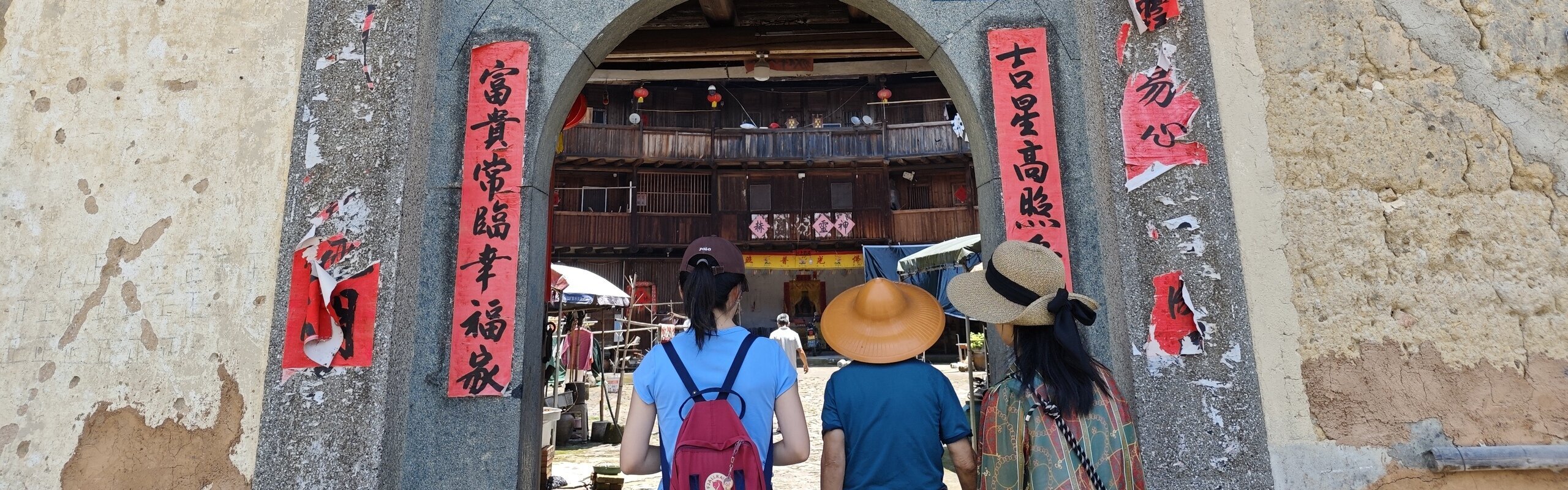
As soon as we stepped into the courtyard, my attention slowly shifted away from the architecture.
I started noticing the everyday life happening around me.
The elderly rested in a wooden chair near the entrance, slowly waving a fan while chatting.
Grannies prepared lunch outside their rooms, with cooking pots, vegetables, and utensils arranged on small tables by the windows.
A toddler pushed a toy car across the stone floor, running around the courtyard again and again.
Clothes hung from bamboo poles.
Grains and dried fruits sat on bamboo trays.
Chickens and ducks wandered casually between the houses.
Everything felt completely ordinary.
And that was exactly what made it special.
This did not feel like a tourist attraction.
It felt like a village.
As we walked past, an elderly resident looked up and casually asked:
"Would you like to come in for tea?"
There was no performance, no sales pitch, no forced hospitality.
Just the kind of greeting you would receive from a neighbor.
Later, when we showed interest in the dried waxberries in the courtyard, a villager invited us to try some.
Seeing that we enjoyed them, he went back inside and brought out a bottle of homemade preserved green plums for us to taste as well.
It felt as if I had walked into the home of a long-lost relative, finding the warmth of family connection in a place more than 2,000 kilometers away from home.
One Small Detail During the Visit Stayed with Me
Whenever Master Zhang wanted to bring us into a resident's room or upstairs, he would always stop and ask first:
"I'll bring them up to take a look, is that okay?"
Only after receiving permission would he continue.
Even though he had once lived here and was the designer Xiaochun Lou, he still respected the residents' personal space.
Later, I remembered seeing tourists online complaining that some Tulou residents refused to let visitors go upstairs.
I also remembered reading about Tulou residents sharing their frustrations: sometimes, before they were even fully awake, a tourist's phone was already being pushed through their window for a photo.
From a visitor's perspective, we may think:
"I'm only here for a few minutes."
But from a resident's perspective, this is their everyday life.
That was when I truly understood:
Tulou is not a museum. It is someone's home.
Protecting cultural heritage is not only about preserving old buildings.
It is also about respecting the people who continue to live inside them.
Interestingly, while walking to his new home for tea, Master Zhang joked with our guide:
"Don't bring too many visitors here. If too many people come, we won't have our quiet village life anymore."
It sounded like a joke.
But it was also the truth.
He welcomed travelers from far away, while hoping that tourism would not take away the peaceful life that made this place special.
This Changed How We Thought About Designing Tulou Experiences
Several generations living within the same structure. Neighbors knowing each other. Children playing freely. It's a sense of community that is becoming increasingly rare in modern cities.
But Master Zhang also told us that many young people no longer want to return.
Xiaochun Lou once had dozens of households.
Today, only a small number of families still live there permanently.
The reasons are practical.
The wooden buildings have poor sound insulation. You have no secrets here.
And many modern facilities are difficult to add to these centuries-old structures.
I had read about these challenges before. But standing inside Tulou and hearing them from someone who had lived there for decades made me realize these were not just descriptions in a travel guide.
They were real experiences shaping people's daily lives.
Later, we visited Tianluokeng Tulou Cluster and Yuchang Lou.
They were equally impressive, but there were more visitors, shops, and souvenir stalls.
The buildings remained beautiful. But something felt different. There was less everyday life.
That was when I understood what truly moved me about Hekeng Tulou.
It was not only the architecture, but the life still happening inside.
It was the elderly residents sitting and chatting in the courtyard.
The smell of lunch drifting from the kitchens.
And Master Zhang standing beside the rammed-earth walls, proudly telling the story of the Tulou he helped build as a young man.
A meaningful Tulou experience should not only show travelers a World Heritage building. It should help them understand the people, skills, and daily life that keep it alive.
This became the foundation of the Tulou experience we later developed.
In Inside a Living Tulou: Build with a Master, Live Like a Local, travelers step beyond the role of a visitor and enter the world behind the earth walls.
They meet a master builder who has spent decades preserving traditional rammed-earth techniques, hear the stories behind the Tulou he helped create, and discover the craftsmanship that allowed these remarkable homes to stand for generations.
They also experience Tulou as a living community — walking through shared courtyards, seeing how local families continue their daily lives, and understanding how Hakka communities have lived together for generations.
Most importantly, travelers have the chance to try the rammed-earth technique themselves and sit down over tea with the master builder, turning an ancient structure from something to observe into something they can truly connect with.
Because the true value of cultural travel is not only in preserving what we can see, but in understanding the people and traditions that give it meaning.