
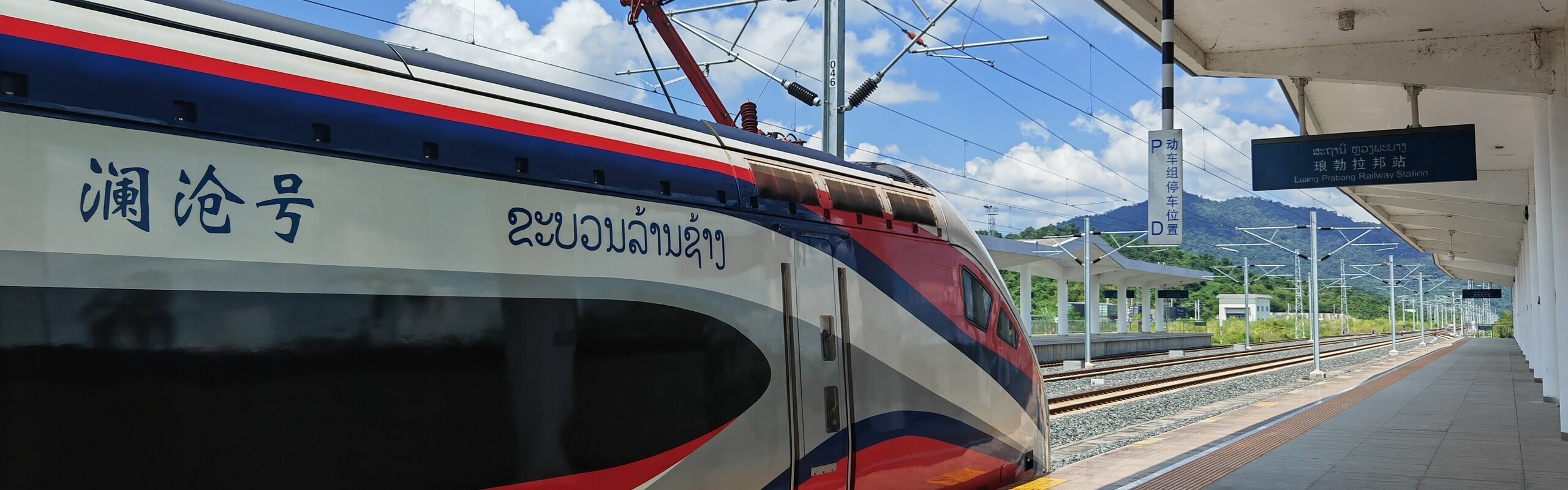

If Laos is the main part of your trip, the easiest way to add Yunnan is to travel north by the China-Laos Railway after Luang Prabang.
A practical route is Vientiane → Vang Vieng → Luang Prabang → Pu'er, where you can either stop in southern Yunnan or continue north to Dali and Lijiang.
The key is not to split your time equally. Spend about 7 days in Laos first, then add as much of Yunnan as your total trip length allows.

1. Start in Vientiane and Travel North Through Laos
For a first trip in Laos, Vientiane, Vang Vieng, and Luang Prabang make the most practical 7-day route.
You get three different experiences without backtracking: temples and colonial-era sights in Vientiane, limestone scenery and outdoor activities in Vang Vieng, and historic temples and traditional Lao culture in Luang Prabang.
The China-Laos Railway links all three, so you can keep moving north before crossing into Yunnan. The train from Vientiane to Vang Vieng takes about 1 hour, while the journey from Vang Vieng to Luang Prabang also takes about 1 hour.
| Destination | Days | Highlights |
|---|---|---|
| Vientiane-Laos's capital | 2 days | Temples, Patuxai (war memorial), Buddha Park, Mekong riverside, and night markets |
| Vang Vieng | 2 days | Limestone karsts, Nam Song River, caves, cycling, and hot-air ballooning |
| Luang Prabang-UNESCO-listed former royal capital | 3 days | Morning alms, historic temples, Royal Palace, Kuang Si Falls, and elephant experience |
Tips for Booking Trains in Laos:
For travel within Laos, you can book tickets using your passport details through the official LCR Ticket app or platforms such as Trip, 12Go and Booking. Tickets can generally be booked up to 7 days in advance.
Station ticket offices and city ticket outlets are also available, but online booking is more convenient. For popular departures, it is better to book as soon as the tickets are released rather than wait until the last few days.
2. Take the Cross-Border Train from Luang Prabang into Yunnan
After visiting Luang Prabang, you can take the China–Laos Railway north to Pu'er in Yunnan. The journey takes about 5 hours.
Do not think of it as an ordinary train ride. You need to get off twice for border formalities, with around 50–60 minutes each.
Train staff will provide an immigration card after boarding. Bring your own pen to save time.
At Boten, the Lao border checkpoint, take all your luggage off the train and complete the exit procedures.
After returning to the train, it takes about 15 minutes to reach Mohan, where you get off again with your luggage for Chinese immigration and customs. After clearing immigration and customs, return to the train and continue to Yunnan.
Tips for Booking Trains from Laos to Yunnan:
For a cross-border journey, you can buy tickets through the official LCR Ticket app, on platforms such as Trip, 12Go, and Booking, or at international ticket counters at railway stations.
Cross-border tickets must be booked with your passport and are released 15 days before departure.
If you book online, you must take your original passport to the railway station before departure to exchange the booking for a paper ticket, which is needed for the border procedures. We recommend arriving at least 1 hour early to collect it.
3. Choose Pu'er as Your First Yunnan Stop
We recommend making Pu'er your first stop rather than Xishuangbanna. It gives you a clear change of scenery and experiences after Laos, with a focus on tea, coffee, and mountain landscapes. Allow 2–3 days here.
We especially recommend spending 2 days and 1 night exploring Jingmai Mountain. Walk through ancient tea forests, explore centuries-old villages, and see how generations of tea farmers have preserved their traditional way of life in this UNESCO-listed tea landscape.
Choose Xishuangbanna first only if you want to continue the tropical scenery, Dai culture, and Southeast Asian atmosphere you experienced in Laos. Otherwise, Pu'er offers a more distinctive start to your Yunnan journey.
Ready to combine Laos with Yunnan? Contact us and we'll help you create a smooth cross-border itinerary.
4. After Pu'er, Decide How Much More of Yunnan You Want to See
If you don't plan to explore Yunnan further, you can end your Yunnan journey in Pu'er.
If you want to see more of Yunnan, head north. Pu'er is known for tea, while Kunming, Dali, Lijiang, and Shangri-La offer some of the province's most distinctive experiences—lakes, ancient towns, snow mountains, and diverse ethnic culture.
For a more relaxed pace, we recommend allowing around 17–19 days for this route: Laos → Pu'er → Kunming → Dali → Lijiang → Shangri-La.
- Day 1-7: Laos
- Day 8-9: Pu'er
- Day 10-11: Kunming (Naigu Stone Forest, Yuantong Temple)
- Day 12-13: Dali (Erhai Lake, Dali Ancient Town, flower cake making)
- Day 14-15: Lijiang( Lijiang Ancient Town, Jade Dragon Snow Mountain, Naxi family visit, Tiger Leaping Gorge)
- Day 16-18: Shangri-La (Dukezong Ancient Town, Songzanlin Monastery, Pudacuo National Park)
Kunming
Kunming's Stone Forest is one of the city's main highlights, known for its karst formations.
For a more peaceful experience, we recommend Naigu Stone Forest, where you can enjoy the dramatic landscape at a slower pace.
Dali
Slow down after your railway journey. With Cangshan Mountain behind you and Erhai Lake ahead, you can walk or cycle along the lakeshore, stop at a café with a view, and simply enjoy the landscape without filling every hour with sightseeing.
If you simply walk around, Dali Ancient Town can feel like little more than old buildings and busy streets. We take a different approach, using local food to introduce you to Bai culture and the traditional values behind it.
Lijiang
Jade Dragon Snow Mountain is a highlight of Lijiang, rising dramatically above the city. Take the cable car to Glacier Park for views of the snow-covered peaks, then continue to Blue Moon Valley, where turquoise water winds beneath the mountains.
In Tiger Leaping Gorge, you can enjoy the spectacular canyon from the viewpoints, or take a relatively easy 2-hour hike for a closer look at the gorge, depending on your fitness level and how much time you want to spend outdoors.
Shangri-La
Shangri-La changes the character of the trip again. In Dukezong Ancient Town, you can experience Tibetan architecture and everyday life, while Songzanlin Monastery offers a glimpse of Tibetan Buddhist traditions.
We recommend allowing at least 2 days for Shangri-La. If you have only 14–16 days, it is better to end your trip in Lijiang than to rush on to Shangri-La.
If you'd like to leave the planning and logistics to us, our 8-Day Kunming, Dali, Lijiang, and Shangri-La Tour can make the Yunnan part of your journey easy to arrange.
Here is how we would match your total trip length with the amount of Yunnan to explore.
| Trip length | Recommended route | Best for |
|---|---|---|
| 9-11 days | Laos → Pu'er | Laos + a short Yunnan extension |
| 14–16 day | Laos → Pu'er → Kunming → Dali → Lijiang | Laos + classic Yunnan |
| 17–19 days | Laos → Pu'er → Kunming → Dali → Lijiang → Shangri-La | A full Laos–Yunnan journey |
FAQ
1. Should I Visit Yunnan First?
It depends on what you want to get out of the trip.
If Laos and traveling by the China-Laos Railway are your priorities, we recommend starting in Laos.
Choose to start in Yunnan if your main destination is Yunnan
If you want to experience Yunnan and Laos more equally, the order matters less. You can start in either country and choose the direction that works better with your international flights and the places you want to visit.
2. Do You Need a Visa for Both Laos and China?
China and Laos have separate entry requirements. Whether you need a visa depends on your passport and how you enter each country.
For China:
Citizens from the UK, Canada, Australia, New Zealand, and many European countries can currently use China's 30-day visa-free policy for tourism.
U.S. citizens are not included in China's 30-day unilateral visa-free list. However, U.S. citizens are among the nationalities eligible for China's 10-day (240-hour) visa-free transit policy if they meet all transit requirements.
If you are not eligible for any visa-free policy, you must apply for a visa.
For Laos:
Most citizens from the U.S., UK, Canada, Australia, and Europe need a visa to visit Laos. We recommend applying for a Lao eVisa before departure.
You can use the dedicated eVisa lane on arrival instead of joining the Visa on Arrival queue, making immigration quicker and easier.
| Lao eVisa | Visa on Arrival | |
|---|---|---|
| Where to apply | Online before departure | At eligible border checkpoints and airports |
| Stay | Up to 30 days | Up to 30 days |
| Entry | Single entry | Single entry |
| Passport | At least 6 months' validity and 2 blank pages | At least 6 months' validity and 2 blank pages |
| Processing | Apply at least 5 days before arrival | Apply on arrival |
| Ticket | Not required for application; required at immigration | Return/onward ticket Required |
| Hotel booking | Not required for application; required at immigration | Required |
If you apply for an eVisa, download and print your eVisa Approval Letter before departure. You must present the printed copy with the passport used for your application when you arrive in Laos.
Laos also requires foreign travelers entering through Vientiane and Luang Prabang international airports to complete the Lao Digital Immigration Form (LDIF) within 3 days before arrival. This is separate from your visa.
3. When Is the Best Time for a Laos–Yunnan Railway Trip?
November to March is generally the best time to combine Yunnan and Laos.
Both destinations have drier weather, less rain, clearer skies, and comfortable conditions for sightseeing and outdoor activities, so you can enjoy both countries more easily in one trip.
The main exception is Shangri-La. Due to its high altitude, winter temperatures there are much lower, and the grasslands turn yellow and the landscape is less attractive. We recommend avoiding Shangri-La in winter.
4. How Much Does a Laos–Yunnan Trip Cost?
Laos generally costs less than Yunnan for hotels, food, and everyday transportation.
For an international trip, airfare is usually the biggest extra cost. As a reference for travelers from the U.S., a one-way economy flight to Kunming is around US$370–800, while a one-way flight to Laos is roughly US$450–1,000.
For a private trip with 2–5 people staying in four-star hotels, budget around US$220–250 per person per day in Yunnan and US$180–210 per person per day in Laos.
Actual costs vary depending on your travel dates, hotel choices, group size, and activities.
5. Can I Take the China-Laos Railway Directly from Laos to Dali or Lijiang?
No. The China-Laos Railway does not pass through Dali or Lijiang.
After entering Yunnan, you can continue by China's domestic high-speed railway network. A common route is: Laos → Pu'er → Dali → Lijiang.
From Pu'er, it takes about 5.5 hours to Dali or 7.5 hours to Lijiang by high-speed train.
Travel with Us
The challenging part of this trip is not simply getting from Laos to China. It is making the train schedules, border procedures, hotel transfers, and Yunnan connections fit together without wasting a day.
We can arrange the route around your actual trip length, including private transfers, hotels, local guides, railway tickets, and the transition from Laos into Yunnan.
You decide how far you want to go; we coordinate the journey between the two countries. Just contact us.