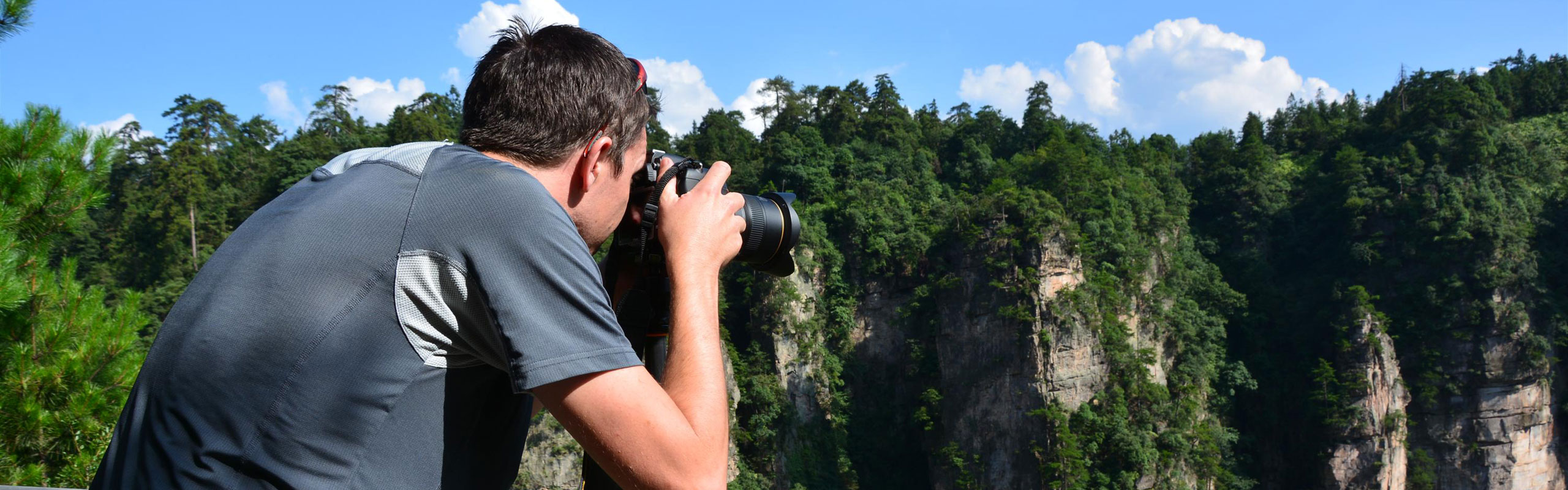

China Photo Tours

Record China’s natural and cultural beauty with China Highlights’ China photo tours.

With a long history, diverse terrain and various cultures, China has so much beauty worth recording, such as ancient water towns in South China, the Yellow Mountains, the Great Wall, Longji Rice Terraced Fields and Tibetan culture. Through our China photo tours, we will take you to the popular photography destinations and attractions. China Highlights can also tailor-make a China photo tour to suit your needs as professional or amateur photographers.

China Ancient Cities and Celebrated Mountains
China Ancient Cities and Celebrated Mountains 15-Day Beijing, Xian, Chengdu, Emeishan, Leshan, Hangzhou, Huangshan and Shanghai Tour
Mountains hold a special place in Chinese culture. Stories are told about their creation and their effects on the lives of the Chinese people. Let us show you some of the most famous and beautiful mountains in China together with some of our most famous landmarks.
View More Details
Shanghai and Xitang Water Town Combo
Shanghai and Xitang Water Town Combo 4-Day Shanghai and Xitang Tour
Take a break from the stresses of Shanghai. Xitang is really a good place to chill out and experience the quieter side of Chinese life. This water town has the most picturesque scenery, and visitors have photo opportunities in all directions, especially on rainy days.
View More Details
The Essence Tour of Yangshuo
The Essence Tour of Yangshuo 2-Day Yangshuo Tour
Yangshou is a quaint and beautiful town in one of China's unique areas. A wonderful place to escape the hustle and bustle of the big city to the clear water and unique countryside. In this tour, you will venture into the Yangshou is a quaint and beautiful town in one of China's unique areas. A wonderful place to escape the hustle and bustle of the big city to the clear water and unique countryside. In this tour, you will venture into the Yangshou countryside to cycle or drive through the rice paddies and experience the real China at Xingping Ancient Town.
View More Details
Yellow Mountain Classic Tour
Yellow Mountain Classic Tour 4-Day Huangshan Tour
Huang Shan or Yellow Mountain is known for its "four wonders" imposing peaks, spectacular rocks, odd-shaped pines, and a sea of clouds but you will find much more to see and explore. Get back to nature at Huang Shan.
View More Details
Travel on the Roof of the World
Travel on the Roof of the World 8-Day Lhasa, Shigatse and Dingri Tour
Tibet fascinates many people. It is known for its exotic culture, unique highland landscapes and friendly people. This tour takes you to the holy cities of Lhasa, Tse-tung and Shigatse and also to the foot of Everest. It will create a lifetime of memories.
View More Details
The Great Wall Hiking around Beijing
The Great Wall Hiking around Beijing 5-Day Beijing Tour
Explore for sections different sections of the Great Wall to get a great feel for this wonder of the world. Walk about 9-10km per day and 4-5 hours per day. This is a truly "authentic" wall experience.
View More Details
Pingyao Photography Festival Tour
Pingyao Photography Festival Tour 4-Day Pingyao Tour
Pingyao Photography Festival has attracted thousands of exhibits by master photographers from more than ten countries. This festival combines the history and modern arts of China and foreign countries. This tour would appeal to art and photography lovers.
View More Details
Autumn at Yellow Mountain and Tachuan Village
Autumn at Yellow Mountain and Tachuan Village 4-Day Huangshan Tour
Autumn is the most colorful season at Huangshan. The autumn scene at Tachuan Village which is 2km from Hongcun Village is one of the most picturesque places imaginable with the leaves of its ancient old trees turning red and yellow. The place has become one of the most popular locations in China for photographers.
View More Details
Yuanyang Terrace Fields Breaking Tour
Yuanyang Terrace Fields Breaking Tour 7-Day Kunming, Jianshui and Yuanyang Tour
Escape the "Rat race" for a glorious 7 days to the spectacular scenery of the mountain terraces at Duoyishu Village. Climb to Tiger Mouth Pass which has extensive views of terraces. Experience the folk culture of the Qingkou Hani Ethnic Village. All of these are waiting for you to explore.
View More Details
Guilin Minority Discovery Tour
Guilin Minority Discovery Tour 4-Day Longsheng and Sanjiang Tour
Guilin is multi-ethnic place that has the total of four minorities live there; they are Zhuang, Yao, Miao, Dong. This tour will illustrate the real life of the those people, and their traditional customs, the terrace field, wind and rain bridge and the drum tower are the best reprehensive of their culture, they will welcome you with the warmly enthusiasm.
View More Details
Guilin & Yangshuo Photography Tour
Guilin & Yangshuo Photography Tour 5-Day Guilin and Yangshuo Tour
This tour is design for the professional photographer; and an in-depth photography tour, we choose the most popular shooting locations and material by the local photographers, including Li River, Yulong River and countryside ancient house, with the topic of sunrise and sunset scenery, Li River cormorants and Bamboo Boats. The tour will be guided by the professional photography tour guide, who has many years photography experience and acknowledge about the best shooting routs in this area.
View More Details
  • Slideshow
  • Highlights:
    1. Water Streaming around the Old Town
    2. Old Houses, Small Boats and Guest Inns in a South eastern Chinese Style
    Best time:Spring & Autumn
    Tips:The rainy scenes are very beautiful.

    Xitang Water Town
    Xitang is flat with many rivers, and has a very quiet natural environment. Nine rivers converge at this town, dividing it into eight sections, with many bridges holding this water town together. There are many well-preserved buildings which were constructed during the Ming and Qing dynasties. The artistry and workmanship of these buildings has attracted experts in antique architecture from both China and other countries. A bird's-eye view of the town shows the canals as green ripples and every family living close to the water.

    See Xitang Tour SH-6A

  • Highlights:
    1. Cole Flowers
    2. Anhui’s Ancient Architectures with White Wall and Grey Tile
    3. Painting-like Ancient Villages
    Best time:March-April

    Wuyuan
    Located in the northeast of Jiangxi Province, Wuyuan County is home to some of the best-preserved ancient architecture in China. Each of the numerous ancient buildings has a distinctive shape and structure. They emerge from among the emerald green mountains, clear rivers, green trees and the crisscrossing paths between the fields. Wuyuan was built in 740 during the Tang Dynasty, and the idyllic scene remains unsullied. Clean brooks, delicate wooden buildings, unique bridges, and the tranquil lifestyle is enjoyed by many photographers from the homeland and abroad.

    See Wuyuan Tour CHT-SC-04

  • Highlights:
    1. Sunrise and Sunset
    2. Granite Peaks, Strangely Shaped Rocks and Gnarled Trees
    Best time:All Year around
    Tips:Watch your footing when climbing the steps and be mindful of your safety when taking the photos.

    Huangshan
    Located in the south of Anhui Province, with an area of about 1,200 square kilometers, known as "the loveliest mountain in China",famous for magnificent scenery whatever the season: granite peaks piercing the clouds, strangely shaped rocks and gnarled trees, hot springs, waterfalls, wonderful outlooks and over 1500 plant species. No traffic within the core area of about 150 square kilometres, accessible by cable car or on foot. Many enticing walks of all grades, all include some steps.

    See Huangshan Tour HS-2

  • Highlights:
    1. Typical Anhui Ancient Architectures with White Wall and Grey Tile.
    2. Villages
    Best time:Spring & Autumn

    Xidi & Hongcun
    Xidi and Hongcun Ancient Villages were listed as World Heritage Sites by UNESCO in 2000. These two villages are the most representative local-style residences in southern Anhui Province. Xidi Village has a history of over 900 years. The village is famed as being the 'Ming and Qing Dynasty Local Residence Museum'. It has about 124 ancient residences and three ancestral halls. Hongcun Village is located not far from Xidi Village. It is built in the shape of an ox and has a history of about 900 years. Built with pink walls and black tiles, all the residences are arranged to a special design. Many different figures and patterns are carved on the columns, beams and door frames and are gilded with gold.

    See Xidi & Hongcun Tour HS-2

  • Highlights:
    1. Terraced Fields Stretching along Mountains
    2. Hani Minority Culture
    3. Mushroom Room - Unique Minority Architecture
    Best time:Middle November - Hani Terraced Fields Festival

    Yuanyang Terraced Fields
    Yuanyang Terraced Fields are located in Honghe County, in southern Yunnan Province. They have an area of an area of 20,000 square kilo meters. They rise from 200 to 2000 meters above sea level and their history can be traced back 2000 years. The first tribe to settle this area and construct terraces for farming purposes was the Hani ethnic group. This incredible piece of engineering was not discovered until 1980s and is now one of China World Heritage Site Candidates.

    See Yuanyang Tour YN-2

  • Highlights:
    1. Amazing Karst Geography
    2. Idyllic Sceneries with Rural Sites
    Best time:April – November

    Yangshuo
    Yangshuo, 65 kilometers to the southeast of Guilin, is an internationally acclaimed tourist destination, characterized by crystal clear rivers, limestone crags, lush vegetation, traditional Chinese architecture and customs, which have been immortalized in Chinese classical landscape paintings and poetry. The beautiful natural scenery so admired by painters and poets has made Yangshuo famous throughout China and internationally. Yangshuo County has a good portion of the world’s most impressive Karst landscape. Multi-shaped pinnacles, caves, pristine rivers, and mesas are clustered over the 1,400 square kilometer area. The Karst along the famous Li River is given an extra dimension of beauty by the water.

    See Yangshuo Tour GL-3

  • Highlights:
    1. Terraced Fields in the Morning or Afternoon Light
    2. Minority Villages and people
    Best time:Spring & Autumn and Winter Snow

    Longsheng
    The Longji Terraced Fields are located in Longsheng County about two hours from Guilin. The rice terraces are built into the hillsides, and look like great chains or ribbons as they wind round the contours in tiered bands. In some places there are terraces from the bottom to the top of the hillside. It offers some of the most fantastic scenery in Guilin or indeed China. Beautiful when the sun reflects in the water of the paddy fields and glowing with yellow ears when the harvest is ripe, Longji (Dragon's Back) is a feast for the eyes.

    See Longsheng Tour GL-3

  • Highlights:
    1. Folk Customs of Qiang and Tibetan Minority
    2. Crystal Lakes with Colorful Reflections
    3. Waterfalls Hidden in the Furious Forest
    Best time:Autumn
    Tips: Please pay attention to keep warm in the early morning and late night.

    Jiuzhaigou
    Located at the lower reaches of Baishuijiang River, Jiuzhaigou Valley Scenic and Historic Interest Area has been called “the beautiful world”. It was listed as world natural heritage by the UNESCO in 1992. It is a peaceful place and because of its remote geographic condition and no noise cause by the outside world. The primitive natural scenery is preserved and it is said that there is no other place in the world is as peaceful as in Jiuzhaigou.

    See Jiuzhaigou Tour CHT-SC-01

  • Highlights:
    1. Snowy Alpine Mountains
    2. Painting-like scenery
    Best time:Mid October
    Tips:
    1. Please pay attention to keep warm in the early morning and late night.
    2. Remember to bring enough film and batteries as they are difficult to buy in remote areas.

    Daocheng
    Located at the southwest edge of Sichuan, in the Ganzi Tibetan Autonomous Prefecture, Daocheng is beautiful place and the woodland in south of the county is especially beautiful. The high mountain peaks are clad with snow all the year round providing ample water for the lakes and tree studded rivers. Most of the 30,000 Tibetan inhabitants live a traditional lifestyle and the Tibetan architecture is a feature of the region.

    See Daocheng Tour CD-11

  • Highlights:
    1. Tibetan Customs
    2. Songzanlin Monastery
    3. Alpine Meadows
    4. Colorful Vegetation and Crops
    Best time:May-September
    Tips:
    1. Please pay attention to keep warm in the early morning and late night.
    2. Remember to bring enough film and batteries as they are difficult to buy in remote areas.

    Shangri-La
    Shangri-La in Yunnan province. The scenery is spectacular. The blend of snow-covered mountains, gorges, prairies, lakes, and virgin forests and local customs that have been preserved for hundreds of years because of its remote location make this an excellent for photographers, nature lovers, hikers and adventurers. A famous Tibetan temple - Songzanlin Monastery is located in this area. The temple is well-preserved. It was built in the 1700s by the Fifth Dalai Lama.

    See Shangri-La Tour KM-3

  • Highlights:
    1. The Ancient Town
    2. A Ice World at Jade Dragon Snow Mountain
    3. Tiger Leaping Gorge - the source of the mighty Yangtze River
    4. Naxi Minority Culture
    Best time:All year around
    Tips: Remember to bring sunglasses and a hat to prevent sunburn in the highland area.

    Lijiang Ancient Town
    Lijiang in northwestern Yunnan Province is situated on the Jinsha River and has a history which dates to the time of the Yuan Dynasty (CE 1279-1368). Lijiang was part of the Ancient Tea & Horse Caravan Road. Nahki is the largest ethnic minority in Lijiang. The city of Lijiang will spoil you with its cobblestone streets, its willow-lined canals, its hurly-burly markets, waterside cafés, and its ethnic diversity. Lijiang's harmonious blend of ethnic cultures is in fact one of the chief reasons why UNESCO placed the city on the World Cultural Heritage List.

    See Lijiang Tour KM-3

  • Highlights:
    1. The Ancient Town
    2. Old Streets and Houses dated back a Thousand Years
    3. Folk Life of the locals in the Old Town
    Best time:Spring & Autumn
    Tips: Pingyao International Photography Festival is held in September each year.

    Pingyao Ancient Town
    Pingyao is a tiny ancient town located in central Shanxi Province, 100 kilometers from Taiyuan, capital of the province. Originally built in the West Zhou Dynasty, it boasts a long history of over 2,700 years. It is almost as old as legends before the recorded history of Chinese nationality. Pingyao was added to the UNESCO's World Heritage List in Dec. 31st 1997 because of the preservation of urban landscape from China's Ming and Qing Dynasty,. The Pingyao International Photography Festival is hold in September every year.

    See Pingyao Tour PY-3-GP

  • Highlights:
    1. Ancient Towers in the Light of the Sunset
    2. Miao Minority Culture
    Best time:Spring & Autumn
    Tips: Go early if you want to take photos of the stone alleys.

    Fenghuang Ancient Town
    Located at south Xiangxi Autonomous Prefecture in Hunan province, Fenghuang, was described as "the Most Beautiful Town in China" by famous New Zealand writer Rewi Alley. This small county is renowned for its natural beauty, rich history and culture as well as colorful ethnic customs. The town has along history of about 1,000 years in the Tang Dynasty. It is embraced by green mountains, with Tuo Jiang River running through its heart. Unique wooden houses constructed on stilts are built along the riverbank. Fenghuang people still live a very simple life and the town reminds people of the scenes in Chinese paintings and old Chinese films.

    See Fenghuang Tour HUN-1

  • Highlights:
    1. Blue Sky, White Clouds and Grassland Backdrop and the forest.
    2. The people as they go about their daily life.
    Best time:Summer & Autumn

    Bashang
    The Bashang Grassland is 280 kilometers north of Beijing. The special climate and the geographical position on the junction of the North China Plain and the Inner Mongolia Grassland give Bashang its unique natural landscapes and make it a popular destination for tourists and photographers. Bashang is admired as a world of flowers, a sea of trees, source of water and the hometown of clouds. You may be interested to stay at farmers' homes, to eat roasted meat whole sheep and other traditional food, talk with farmers, and all sleep on the same heated brick bed.

    Tailor-made Bashang Tour

  • Recommended Great Wall Sections to shoot:
    1. Jiankou Section
    2. Jinshanling Section
    3. Gubeikou Section
    Tips:Remember to bring sunglasses and a hat to prevent sunburn.

    Jiankou Great Wall
    The Jiankou Great Wall is located in Huairou County, 73 kilometres north from Beijing City. It connects with Mutianyu Great Wall ten kilometers to the east. This section was built in 1368 during the period of the Ming Dynasty. Due to the lack of repairs, it is almost one of the most dangerous sections of the entire Great Wall.

    Tailor-made Jiankou Great Wall Tour

  • Recommended Great Wall Sections to shoot:
    1. Jiankou Section
    2. Jinshanling Section
    3. Gubeikou Section
    Tips:Remember to bring sunglasses and a hat to prevent sunburn.

    Jinshanling Great Wall
    As one of the UNESCO World Heritage Site in China, The Great Wall is not just a wall, but a symbol of bravery and wisdom of Chinese people. Jinshanling is 140 kilometers at the north-east end of Beijing City, and it was initially built from 1368 to 1389 in the Ming Dynasty. The Jinshanling Great Wall has never been repaired. It is second only to the Badaling Great Wall in its completeness.

    See Jinshanling Great Wall Tour BJ-34

  • Recommended Great Wall Sections to shoot:
    1. Jiankou Section
    2. Jinshanling Section
    3. Gubeikou Section
    Tips:Remember to bring sunglasses and a hat to prevent sunburn.

    Gubeikou Great Wall
    Gubeikou, situated in Beijing's Miyun County, is 125 kilometers away from Beijing proper. The main part of today's Gubeikou Wall was constructed under the supervision of Xu Da, a noted general in the Ming Dynasty. The Gubeikou Great Wall was built along the precipitous mountain ranges, rising and falling at various sections. It has long been a town of military significance and an important passage to the capital city.

    See Gubeikou Great Wall Tour BJ-34

  • Highlights:
    1. Grand palaces and Tibetan Temples
    2. Plateau backdrop with Snow Mountain
    3. Lamas and the dedicated believers
    Best Time:August - Nagqu Horse Racing Festival & Tibet Shoton Festival.
    Tips:
    1. The temperatures in Tibet will reduce the life of the battery so remember to being plenty of spares.
    2. Remember to bring enough film and as they are difficult to buy in remote areas.
    3. Obtain permission from the lamas before taking photographs in the temples.

    Tibet - Potala Palace
    Tibet Autonomous Region is located in the southwest of China, with a land area of 1.22 million square kilometers and a population of 2.3 million, of which 95% are Tibetan. With an average altitude of over 4,500 meters above the sea level, it is known as “The Roof of the World”. The snow-capped mountains, abundant gemstone-like lakes, countless species of wild life and of course the people capture the imagination of many photographers.
    The world famous Potala Palace is located on Moburi (Red) Mountain, to the west of old Lhasa. It is a huge treasure house of materials and articles from Tibetan history, religion, culture and art.

    See Tibet Tour XZ-4

  • Highlights:
    1. Grand palaces and Tibetan Temples
    2. Plateau backdrop with Snow Mountain
    3. Lamas and the dedicated believers
    Best Time:August - Nagqu Horse Racing Festival & Tibet Shoton Festival.
    Tips:
    1. The temperatures in Tibet will reduce the life of the battery so remember to being plenty of spares.
    2. Remember to bring enough film and as they are difficult to buy in remote areas.
    3. Obtain permission from the lamas before taking photographs in the temples.

    Tibet - Lamas
    Tibet Autonomous Region is located in the southwest of China, with a land area of 1.22 million square kilometers and a population of 2.3 million, of which 95% are Tibetan. With an average altitude of over 4,500 meters above the sea level, it is known as “The Roof of the World”. Mt Everest the world’s tallest mountain at 8,848 meters above sea level straddles the border between Tibet and Nepal. The snow-capped mountains, abundant gemstone-like lakes, countless species of wild life and of course the people capture the imagination of many photographers.
    Tibetan Buddhism was referred to as Lamaism. Lamas are the religious believers of the Tibetan Buddhism. There are many young Lamas in the Tibet now.

    See Tibet Tour XZ-4

  • Highlights:
    1. Grand palaces and Tibetan Temples
    2. Plateau backdrop with Snow Mountain
    3. Lamas and the dedicated believers
    Best Time:August - Nagqu Horse Racing Festival & Tibet Shoton Festival.
    Tips:
    1. The temperatures in Tibet will reduce the life of the battery so remember to being plenty of spares.
    2. Remember to bring enough film and as they are difficult to buy in remote areas.
    3. Obtain permission from the lamas before taking photographs in the temples.

    Tibet - Mt. Everest
    Tibet Autonomous Region is located in the southwest of China, with a land area of 1.22 million square kilometers and a population of 2.3 million, of which 95% are Tibetan. With an average altitude of over 4,500 meters above the sea level, it is known as “The Roof of the World”. Mt Everest the world’s tallest mountain at 8,848 meters above sea level straddles the border between Tibet and Nepal. The snow-capped mountains, abundant gemstone-like lakes, countless species of wild life and of course the people capture the imagination of many photographers.
    Mt. Everest, called Mount Qumulangma in Tibetan Language, is the highest peak of the Earth and probably the most coveted mountain in adventurous travelers’ eyes. Journey to Mt. Everest Base Camp is a both physical as well as psychological challenge to you, but it will definitely reward you with the most unparalleled views – a panorama of Himalayan peaks - and never-forgotten beautiful memories

    See Tibet Tour XZ-4

  • Highlights:
    1. Alpine Meadows with Sheep, Cattle, and the Yurts of the Herdsman
    2. Colorful Kanas Lake
    3. Traditional life and Custom of the Minorities
    4. The Ancient Ruins of once rich Silk Road Cities
    Best Time:Summer
    Tips:Remember to bring sunglasses and a hat to prevent sunburn.

    The Northern Region of Xinjiang - Gubi
    Xinjiang Uyghur Autonomous Region sits on China's west-northwest frontier and borders eight countries including Tibet to the south. The Northern Region of Xinjiang region has been known as the photographer's paradise for its colorful minority cultures and the natural beauty. From the vast Gobi desert to the green grassland, mountains and the beautiful alpine rivers and lakes it is a land of contrasts which is waiting to be seen and enjoyed.

    See North Xinjiang Tour XJ-4

  • Highlights:
    1. Alpine Meadows with Sheep, Cattle, and the Yurts of the Herdsman
    2. Colorful Kanas Lake
    3. Traditional life and Custom of the Minorities
    4. The Ancient Ruins of once rich Silk Road Cities
    Best Time:Summer
    Tips:Remember to bring sunglasses and a hat to prevent sunburn.

    The Northern Region of Xinjiang - Kanas Lake
    Xinjiang Uyghur Autonomous Region sits on China's west-northwest frontier and borders eight countries including Tibet to the south. The Northern Region of Xinjiang region has been known as the photographer's paradise for its colorful minority cultures and the natural beauty. From the vast Gobi desert to the green grassland, mountains and the beautiful alpine rivers and lakes it is a land of contrasts which is waiting to be seen and enjoyed.
    Kanas Lake takes on different colors following the four seasons of the year, sometimes it's crystal blue, sometimes it's dark green, or even gray, you may find it containing many colors setting off each another at a time, thus it got a name as the color-changing lake.

    See North Xinjiang Tour XJ-4

  • Highlights:
    1. Architecture of minority Miao and Dong
    2. Famous Minority Embroidery
    3. The Silver Decorative Head Dresses and Colorful Costumes
    4. Traditional Customs and Festivals of the Minority groups
    Best Time:
    1. The 16th day of the first lunar month - Lusheng Festival
    2. From the 15th day to the 17th day of the third lunar month - Sisters Meal Festival

    Qiandongnan Miao and Dong Autonomous Prefecture - the Sisters’ Meal Festival
    The Miao & Dong Autonomous Prefecture in Southeastern Guizhou (Qiandongnan in Chinese) is located in the southeastern part of Yunnan-Guizhou Plateau, bordering Hunan Province and Guangxi Zhuang Autonomous Region. It is home to 38 minority groups, with Miao, Dong, and Yao People being the largest groups. It is becoming a favored destination to photograph beautiful landscapes sceneries and colorful minority culture.
    Every year on the fifteenth day of the third lunar month (April 28th in 2010), the Miao people in Taijiang county start celebrating the Sisters’ Meal Festival, also known as the Sisters’ Rice Festival. It is a local version of Valentine’s Day and lasts three days.

    See Qiandongnan Tour GY-2

  • Highlights:
    1. Architecture of minority Miao and Dong
    2. Famous Minority Embroidery
    3. The Silver Decorative Head Dresses and Colorful Costumes
    4. Traditional Customs and Festivals of the Minority groups
    Best Time:
    1. The 16th day of the first lunar month - Lusheng Festival
    2. From the 15th day to the 17th day of the third lunar month - Sisters Meal Festival

    Qiandongnan Miao and Dong Autonomous Prefecture - Zhenyuan Acient Town
    The Miao & Dong Autonomous Prefecture in Southeastern Guizhou (Qiandongnan in Chinese) is located in the southeastern part of Yunnan-Guizhou Plateau, bordering Hunan Province and Guangxi Zhuang Autonomous Region. It is home to 38 minority groups, with Miao, Dong, and Yao People being the largest groups. It is becoming a favored destination to photograph beautiful landscapes sceneries and colorful minority culture.
    Zhenyuan, a tranquil ancient town, lies hidden in the east of Guizhou Province. It has been a center of land and water transportation since early times. Zhenyuan County was formed in 202 BC in the Han Dynasty. Two thousand years have passed and now it has become a famous historical and cultural city.

    See Qiandongnan Tour GY-2

>
Planning a trip? Ask us here 800-2682918 (USA & CA) 86-773-2831999 1800-764678 (AU) 0800-0327753 (UK) 800-8793-007 (China)

Do you want to book a tour/hotel/Wi-Fi. etc.
Your Name Your Email