

China is one of the world's four ancient civilizations, and the written history of China dates back to the Shang Dynasty (c. 1600–1046 BC), over 3,000 years ago.
Timeline of Chinese History
| Year | Era | Dynasty | Capital | Remarks |
|---|---|---|---|---|
| 2100–1600 BC | Ancient China | Xia | Luoyang Dengfeng Zhengzhou |
The first dynasty in traditional Chinese historiography |
| 1600–1046 BC | Shang | Anyang | First dynasty to have historical records remaining | |
| 1046–221 BC | Zhou | Xi'an Luoyang |
Confucianism emerged | |
| 221–206 BC | Imperial China | Qin | Xi'an | First to unite China as a country under an emperor |
| 206 BC – 220 AD | Han | Xi'an Luoyang |
The same period as the Roman Empire | |
| 220–581 | Wei, Jin, Northern and Southern Dynasties | Luoyang Chengdu Nanjing |
Frequent regime changes | |
| 581–618 | Sui | Xi'an Luoyang |
A system was established to select talents by examination | |
| 618–907 | Tang | Xi'an Luoyang |
It had the only female emperor. | |
| 960–1279 | Song | Kaifeng Hangzhou |
Printing, the compass, and gunpowder were invented. | |
| 1271–1368 | Yuan | Beijing | The first foreign regime to unite China | |
| 1368–1644 | Ming | Nanjing Beijing |
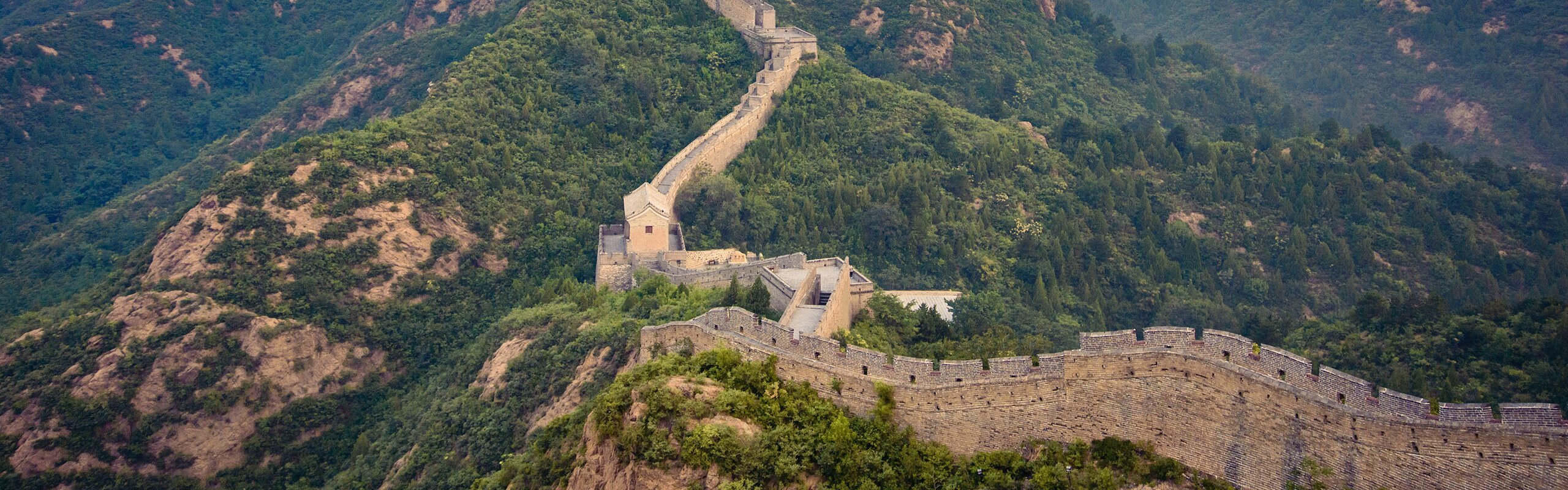
Most of the Great Wall today was built or repaired during the Ming Dynasty. | |
| 1644–1912 | Qing | Beijing | The last dynasty of China | |
| 1912–1949 | Republic of China | Republic of China | Beijing Wuhan Nanjing |
|
| 1949–present | Modern China | People's Republic of China | Beijing |
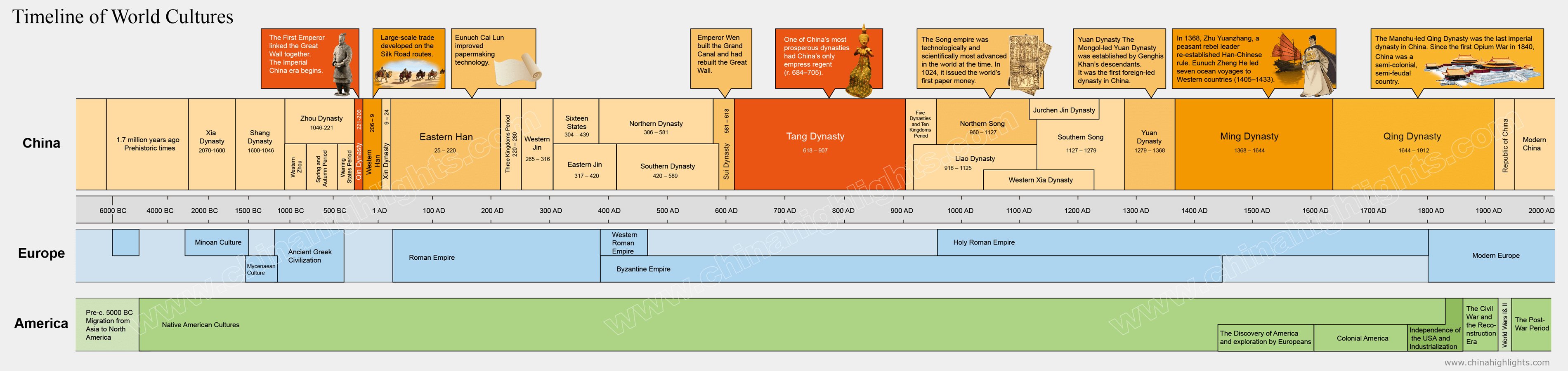
A more detailed table please see China's historical timeline and some key events. There's also a simple comparison with the world's historical development.
Dynasties of China in Order
Before the emergence of the dynasties, China was a primitive society.
Some of the earliest human remains were found in China: Yuanmou Man, found in Yunnan, Lantian Man in Shaanxi Province, and Peking Man.
Peking Man could use fire and made stone implements. They lived in groups as hunter-gatherers. This was the first stage of primitive society.
17,000 years ago, evidence suggests Upper Cave Man formed a relatively fixed group of blood relations. Such clans also appeared in Banpo Village in Xi'an and other archeological sites along the Yangtze River. Then people farmed and raised animals. This is the second stage of primitive.
From the clans, dynasties coalesced.
The Xia Dynasty (2070–1600 BC)
- The Xia Dynasty was considered as the first dynasty of ancient China.
- It's generally believed that the Xia Dynasty consisted of several clans living alongside the Yellow River.
- The Xia Dynasty is traditionally considered to be the beginning of China's hereditary dynasty.
- Considered mythical by many historians, Xia era relics found in a site called Erlitou in the central Yellow River Basin are yet to be conclusively linked with the Xia Dynasty as described in Zhou Dynasty writings.
The Shang Dynasty (1600–1046 BC)
 Map of Shang Dynasty
- The Shang Dynasty was the first dynasty with historical records remaining.
- The earliest form of Chinese writing — oracle bones — were found to tally with later accounts of the Shang Dynasty.
- Chinese civilization truly began along the Yellow River in the Shang era.
- The Simuwu Rectangular Ding in the National Museum of China was made in the Shang Dynasty is the largest bronze vessel ever found in the world.
The Zhou Dynasty (1045-221 BC)
Map of Western Zhou- The Zhou Dynasty was divided into the Western Zhou (1045–771 BC), the Spring and Autumn Period (770–476 BC), and the Warring States Period (475–221 BC). The latter periods are also known as the Eastern Zhou.
- Compared with the peace and prosperity of the Western Zhou, the Eastern Zhou was a period of great division. The Zhou king lost his authority and seven prominent states emerged.
- Of these seven states, Qin was the final winner and established the later Qin Dynasty.
- Major philosophies and religions emerged that were the basis of Chinese beliefs in later eras, such as Confucianism and Daoism.
Qin Dynasty (221–206 BC)
Map of Qin Dynasty- The Qin Dynasty was the first to unite China as a country under an emperor instead of a ruling clan, which meant the beginning of China's feudal era.
- The Qin Dynasty was the shortest dynasty in China, lasting only 15 years.
- The First Emperor — Qin Shi Huang was first to use the title of emperor in China.
- Qing Shi Huang standardized units of weight and measurements, as well as the writing system.
- Great building projects, such as the Great Wall and the Terracotta Army were built in this era.
The Han Dynasty (206 BC – 220 AD)
Map of Western Han- The Han Dynasty was one of the most powerful, prosperous, and important dynasties in China's history.
- The Han Dynasty existed at the same time as the Roman Empire.
- The Han Dynasty was known for starting Silk Road trade and connecting China with Central Asia and Europe.
- Confucianism was officially elevated to orthodox status and was to shape the subsequent Chinese civilization.
- Buddhism, originating in ancient India was introduced to China, and Taoism, China's local religion, arose.
- Hua Tuo invented the first anesthetic — mafeisan and was the first doctor in the world to operate under general anesthesia.
- Cai Lun improved the technique of paper making, and Zhang Heng invented a seismograph that could measure earthquakes.
Wei, Jin, and the Southern and Northern Dynasties (220–581)
- This period saw the most frequent regime changes in Chinese history.
- When the Han Dynasty fell into decline, it fractured into the Three Kingdoms Period (220–265). The Jin Dynasty came after the Three Kingdoms Period with partial unification. However, China again fractured, this time into the Southern and Northern Dynasties (420–589).
- During this period, other ethnicities in the north established political power and moved to the central plains, gradually accepting the Han culture. National integration reached its climax.
- During this messy time, Buddhism was popular and was supported by governors. The rulers used Buddhist ideas to encourage the people to willing endure suffering and put their hope in the afterlife, so as to give up the resistance to the ruling class.
The Sui Dynasty (581–618)
- The Sui Dynasty was a short, intense dynasty, with great conquests and achievements, such as the Grand Canal and the rebuilding of the Great Wall.
- One of Emperor Wen's most prominent achievements was to create the imperial examination system to select talented individuals for bureaucratic positions.
- Japan sent emissaries to the Sui Dynasty to study the culture, economy, and political system, which influenced the culture of Japan.
The Tang Dynasty (618-907)
Map of Tang Dynasty- The Tang Dynasty ruled one of the most powerful countries in the world. Its capital Chang'an (now Xi'an) was then the largest city in the world.
- The second emperor of Tang, Li Shimin, was one of the greatest emperors in Chinese history. His openness and valor laid the foundation for the prosperity of the dynasty for 100 years.
- The Tang Dynasty produced the only female emperor in Chinese history — Wu Zetian.
- The Tang Dynasty was also the golden age for poetry, painting, tricolored glazed pottery, and woodblock printing. Great Tang poets included Li Bai and Du Fu.
- During the period, Korea, Japan, and other vassal countries sent many students to study in Chang'an and Luoyang.
- China's papermaking, textiles, and other technologies spread to West Asia and Europe through the Arab region. Islam was introduced to China.
- Women's status improved significantly, and people were free to marry and divorce.
The Song Dynasty (960–1279)
Map of Northern Song- The Song Dynasty saw high levels of growth in the commodities economy, culture, education, and scientific innovation in Chinese history.
- According to some estimates, China's GDP in the year 1000 was US $26.55 billion, accounting for 22.7% of the world's total, and its per capita GDP was US $450, higher than the US $400 of Western Europe at that time.
- The shipbuilding industry was very developed. Overseas trade was prosperous, communicating with the South Pacific, the Middle East, Africa, Europe, and other areas of more than 50 countries.
- The "four great inventions" of the Chinese people in ancient times (paper, printing, the compass, and gunpowder) were further developed in the Song Dynasty.
- The earliest paper money in the world was found in Sichuan Province and dated as Song Dynasty.
- Foot binding began to appear. This abnormal aesthetic conception seriously harmed women's health.
The Yuan Dynasty (1271–1368)
Map of Yuan Dynasty- The Yuan Dynasty was China's first foreign-led dynasty ruled by Mongol tribes.
- Trade, technological development, and China's interaction with foreign countries continued under Mongol rule.
- The Yuan attempted to conquer Japan, Vietnam, and Burma, but failed, and the Mongol Empire's eastern and southern edge was Yuan-Dynasty China.
- Marco Polo from Venice traveled extensively in China, and later described China's culture and marvels in his book The Travels of Marco Polo.
The Ming Dynasty (1368–1644)
Map of Ming Dynasty- The founder, Zhu Yuanzhang, ousted the waning Mongol Empire in China and began the Ming Dynasty. It was the last dynasty ruled by Han people.
- The Forbidden City was built and became the residence of emperor for the remainder of the imperial era.
- The northern border was constantly disturbed, leading to the (re-)construction of the Great Wall. Most of the Great Wall today was built or repaired during the Ming Dynasty.
- Maritime trade was developed. Emperor Yongle built a big fleet and sent ambassadors on expeditions to gather tributes and to go to the West to trade. The fleet sailed as far as Arabia.
The Qing Dynasty (1644–1912)
Map of Qing Dynasty- The Qing Dynasty was the last imperial dynasty in China's history and ruled by the Manchu people of the northeast.
- The two most famous emperors of the Qing Dynasty were Emperor Kangxi (r. 1661–1772) and Emperor Qianlong (r. 1735–96). Their reigns were "a golden age of prosperity".
- China was reduced to being a semi-colonial, semi-imperial country after the First Opium War, which began in 1839.
- Modern China's territory was established during this era.
The Republic of China Era (1912–1949)
The Republican Revolution of 1911 led by Sun Yat-sen, ended the rule of the Qing Dynasty. However, the Republic of China could not be firmly established across China, with civil war ensuing for decades.
Modern China (1949–now)
Since the founding of the People's Republic of China in 1949, China has entered a Communist era of stability, with the Reform and Opening Up policy of 1978 bringing in China's phenomenal economic growth.
Learn about Chinese History through Travel
With a vast territory and a long history, China offers so much to see and explore. Historical cities like Beijing, Xi'an, and Luoyang are good destinations to explore China's profound history. See recommended tours:
- The Golden Triangle (8 days): Beijing, Xi'an, and Shanghai — the most popular destinations for a first trip
- 4-Day Beijing Private Tour: Explore Beijing with an Emperor's Tour
- Contact us to create a trip based on your needs