
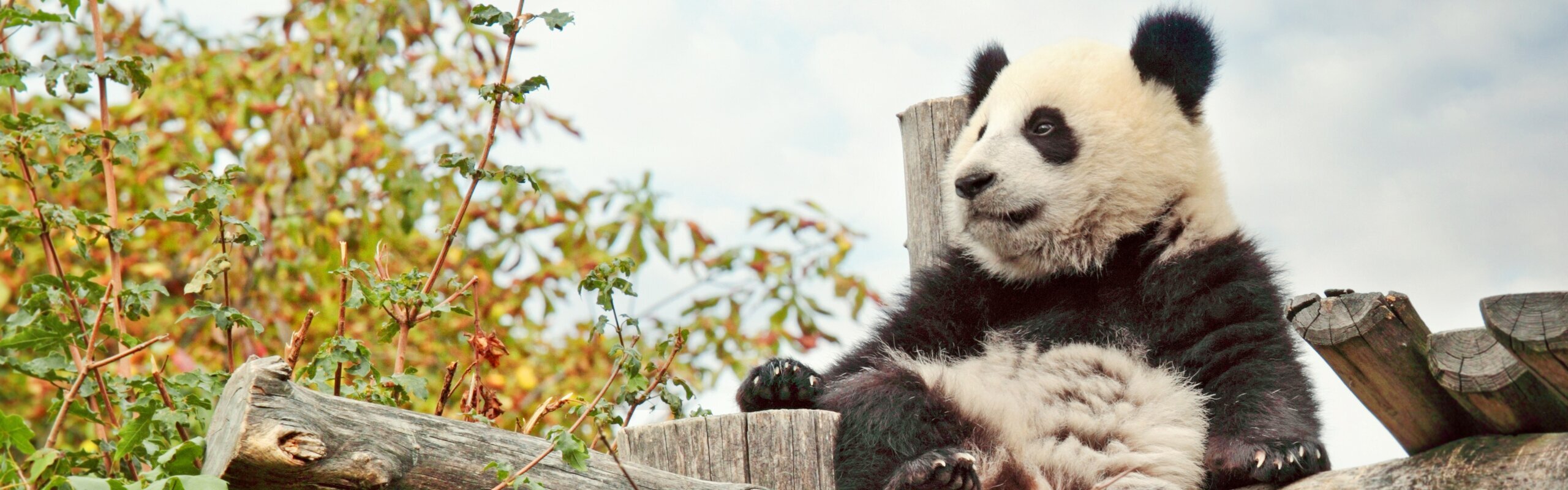

Do you want to know how giant pandas grow up, and their characteristics at different life stages? Read on to learn more about Giant Panda's life cycle.

1. Newborn Pandas (0–3 Months)
Panda cubs in Chengdu Panda BaseGiant pandas are born tiny, around 70-180g. They're blind and pink with a little bit of white fluff, just like a mouse.
Within a month, their backs, limbs, and ears will gradually turn black and grow black and white fur. But at this time, they still can't walk. 0-3
When they are 6 to 8 weeks old, baby pandas can open their eyes, and then they can crawl when they are three months old.
During this period, the panda cubs can only drink milk. The mother panda will hold her baby in her arms to feed and take care of it, just like a human holding her own baby.
Learn more about Baby Pandas — Their Growing Process.
2. Cubhood — Eating Bamboo at Around 6 Months
A baby panda is eating bamboo shoots.Cubs start to eat bamboo around six months, but they haven't been weaned yet.
As long as they stay with their mothers, the cubs will both eat bamboo and drink milk until two or even three years old.
During the period from 6 months to 2 years old, the panda mother will teach them skills such as eating bamboo, finding food, climbing trees, and avoiding danger.
By the time they are one year old, their weight can grow to about 25 to 30 kilograms.
Cubs easily die in the wild because they are so small and defenseless. The mother has to leave them alone in the den to eat for four hours a day.
Where to see the lovely pandas? You may want to visit Chengdu, the hometown of the panda. Here are the popular Chengdu tours with pandas for you:
- 8-Day Chengdu, Jiuzhaigou and Chongqing Tour
- 5-Day Chengdu, Leshan and Mount. Emei Tour
- 1-Day Wolong Panda Volunteer Program Tour
Or read more on our Panda Tour.
3. Living Independently — Leaving Their Mothers at Around 2 Years Old
A young pandaWhen the cub is about two years old, the mother panda will come into heat again. At this time, the cub will be driven away by its mother and start to live alone.
If the cubs do not leave, they may still be attacked by their mother.
Although they are not yet adults, they already have the ability to survive independently at this time.
4. Maturity — Can Breed around 4–6 Years Old
A baby panda with its motherGiant pandas are fully mature and able to breed at four to six years old (females at four, males at six).
The optimal reproductive age is between 6 and 12 years old. After this period, their reproductive capacity begins to decline, and generally lose by the age of 20.
Female pandas usually come into heat in Spring (March to May). However, their heat period is very short, lasting only 2 to 3 days.
Therefore, getting pregnant is not an easy task. Female pandas normally bear 1 cub every 2-3 years.
According to the regulations, pandas born abroad usually need to be returned to China when they are around 4 years old, when they are mature.
For example, at the Dujiangyan or Wolong Panda Base, you can see many returning pandas, such as Fu Bao, Xiao Qiji, Taishan, Lala, etc.
5. Reproduction — Giving Birth
Two baby pandas are eating bamboo together with their mother.Giant panda gestation is 3 to 5 months, and cubs are usually born in late summer (August mostly) in hidden hollow trees or natural dens, where branches, dry grass, etc. are made into a kind of nest.
Normally, giant pandas give birth to a single cub. But sometimes they have twins.
In Wild, the panda mother would normally choose to take care of the stronger one and abandon the other, as she only has the ability to raise one cub. While the captive pandas will keep both cubs.
Want to be a "panda keeper"? You can join our 1-Day Dujiangyan Panda Keeper Program Tour, to cook for pandas and sweep their enclosures!
How Long Does A Panda Live
Giant pandas can live up to 30 years in captivity. Wild pandas live up to 20 years in the wild.
With medical and nutritional help in captivity, pandas can live more than 30 years.
The oldest recorded panda lived to be 38 years old. It is equivalent to 110-130 years old in human terms. They were Xinxing from the Chongqing Zoo and Jiajia from Hong Kong's Ocean Park.
Why Are There So Few Pandas?
In the wild, the cub-bearing period for female giant pandas lasts for around 10 years. Therefore, a female panda is able to bear four to six cubs in her life at most.
Due to the low birth rate and vulnerability of cubs, it is little wonder that pandas are on the verge of extinction.
A wild panda raises around five cubs in a lifetime, of which perhaps half die before reaching maturity, making the rate of pandas reaching adulthood just above the two needed to sustain the population.
See Giant Pandas with China Highlights
If you are interested in a panda tour, we can help you tailor-make your own unique tour.