
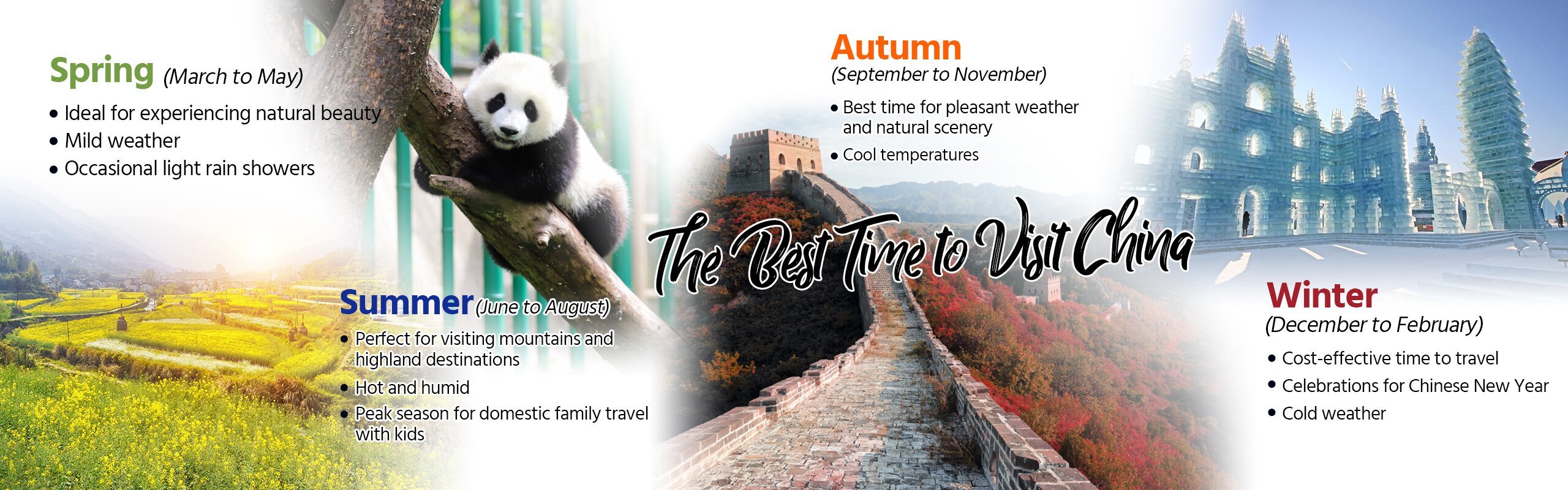

To be honest, we think the best time to travel to China is almost all year round. Because China is a large country and you can always find a suitable destination every month.
This article will help you choose the best time to visit most cities, show you how to match destinations with your travel month, and share useful weather tips for each season.
When Is China at Its Best?
Autumn Is Best, Spring Comes Second
Spring (March-May) and autumn (September-November) are the best times to enjoy pleasant weather and beautiful natural scenery.
Autumn, in particular, is ideal for most cities across China. There's little rain, the summer heat fades, and outdoor sightseeing becomes much more comfortable.
The landscapes come alive with color like the blue lakes of Jiuzhaigou, red maple leaves in Beijing's Xiangshan Park, and golden ginkgo trees at the Forbidden City.
It's a great season for nature lovers, photographers, and anyone who enjoys being outdoors.
Check out our 14-Day Beijing–Xi'an–Zhangjiajie–Guilin–Shanghai
 Shuzheng Lakes in Jiuzhaigou (autumn views)
Spring is just as beautiful as autumn, especially with all the blooming flowers.
You can see vibrant rapeseed fields in Luoping and Huangshan, jacaranda trees in Kunming, and peach blossoms in Tibet.
However, spring tends to have slightly more rain, particularly in southern cities like Guilin, Shanghai, and Guangzhou, but it's usually light and won't affect your travel too much.
Vibrant rapeseed fields in Luoping, YunnanInside Tips: Avoid Peak Holiday Crowds
During spring and autumn, we recommend avoiding the following dates. These are major public holidays in China, when tourist sites are extremely crowded and travel costs can rise by 50–100%:
- Qingming Festival (April 3–5)
- Labor Day (April 30 – May 4)
- National Day (September 30 – October 6)
So, taking crowds, weather, and scenery into account, the best months to travel are April, May, September, and mid-to-late October.
If you're heading to southern destinations like Yunnan or Guilin, early November is also a great option.
See more travel tips on Dates You Should Avoid When Planning a China Tour
What If I Can Only Travel in Summer or Winter?
While not everyone can travel in spring or autumn, especially if you're planning a family trip during your children's winter or summer holidays.
Summer is one of the most popular travel times for Chinese families. Thus, it is the peak season. But with the right planning and local insights, you could still enjoy a comfortable and enriching trip.
How to Beat Summer Crowds:
1. Choose the right route or section, not just the attraction.
Most major sights have more than one way to explore them, and some are far less crowded. For example:
- The Great Wall: Jinshanling and Jiankou sections see far fewer tourists than the famous Badaling.
- Terracotta Warriors: Start with Pit 3 (the quietest), then visit Pit 2, and finish with Pit 1, going against the typical flow.
- Forbidden City: Begin with the side halls instead of the main central axis to avoid the early rush.
2. Go early or late to avoid peak times.
Most tourist hotspots are busiest between 10 a.m. and 3 p.m.
- Get an early start around 6 a.m. for a peaceful morning visit.
- Or go later in the afternoon after 4 p.m., when tour groups start to leave.
- In summer, this also means cooler temperatures and beautiful light for photography, like sunset at Jinshanling.
Sunset at Jinshanling3. Swap popular spots with meaningful alternatives.
Some lesser-known places offer incredible experiences without the crowds, such as:
- In Xi'an, Lintong Museum showcases the first batch of restored Terracotta Warriors, and even offers a hands-on experience restoring relics under expert guidance.
Our hands-on experience to restore relics in Lintong Museum- In Shanghai, Aurora Museum, the largest private museum in the city, will let you see treasures that rival those in national museums and even view ancient Chinese artifacts just 10 centimeters away.
Exhibits of the Shanghai Aurora Museum4. Try to avoid August 1–15, the peak of the peak season with the heaviest crowds.
If your schedule is flexible, late June is less crowded, but avoid southern cities like Guilin and Guangzhou, as they often see heavy rain around that time.
5. Consider working with a local travel agency.
If you're unsure how to navigate the busy summer season, local insight really makes a difference. A thoughtfully planned route, based on real-time crowd patterns and your interests, can turn a busy day into a surprisingly smooth experience.
Feel free to contact us to make your China itinerary.
Summer is also China's rainy season, especially in the south. Mid to late June brings frequent downpours.
While July and August usually have short showers in the morning or evening. These may cause minor delays but won't ruin your entire trip.
If you're planning outdoor activities, have a Plan B for indoor options like cave exploration in Guilin as a backup for hiking or cycling.
Choosing the right destinations helps, too. Head to Guizhou and Yunnan for cooler weather, Inner Mongolia for fresh air and open grasslands, or Guilin for refreshing water activities. See Top Places to Visit in China in Summer
Play with Water in GuilinIf you choose to travel in winter, you'll enjoy fewer crowds and more budget-friendly prices in most destinations. You can also join festive winter events like the Harbin Ice and Snow Festival.
Harbin Ice and Snow WorldHowever, the temperatures in northern China often drop below 0°C (32°F), so be sure to pack warm clothing and dress in layers to stay comfortable during outdoor activities. See How to Plan a Winter Trip to China
China by Month: Travel Calendar
| Month | Recommended Destinations | Why It's a Good Time to Visit |
|---|---|---|
| January | Harbin, Changbai Mountain, Hainan, Yunnan | Ice Festival; beach weather in Sanya; mild temps in tropical Yunnan |
| February | Changbai Mountain, Hainan, Yunnan, Chaoshan | Snow; beaches; warm weather; lively atmosphere of Chinese New Year |
| March | Guilin, Hangzhou, Beijing, Nyingchi | Blossoms begin; mild spring weather; fewer crowds |
| April | Beijing, Xi'an, Suzhou, Yunnan | Prime weather for classic cities and spring scenery |
| May | Zhangjiajie, Yangshuo, Chongqing, Chengdu, Shanghai | Warm but not hot; green mountains |
| June | Inner Mongolia, Qinghai, Tibet, Xinjiang | Cool in the highlands; grassland culture and summer festivals, less rains |
| July | Xinjiang, Tibet, Yunnan, Guizhou | Alpine flowers, long daylight hours, dramatic scenery |
| August | Sichuan, Guizhou, Inner Mongolia | Lush rural views, ethnic festivals, cooler climates |
| September | Beijing, Xi'an, Zhangjiajie, Xinjiang, Shanghai | Autumn colors start; clear skies; harvest season in western China |
| October | Guilin, Hangzhou, Huangshan, Chengdu, Jiuzhaigou, Shanghai, Zhangjiajie | Arguably the best weather; golden leaves; fewer rainy days |
| November | Yunnan, Fujian, Guangzhou, Chaoshan, Hong Kong | Still mild in the south; fewer tourists; fall color in some areas |
| December | Harbin, Hainan, Yunnan | Ice and Snow Festival; warm beach getaways; fewer crowds in classic cities |
Find more ideas on our China tours.