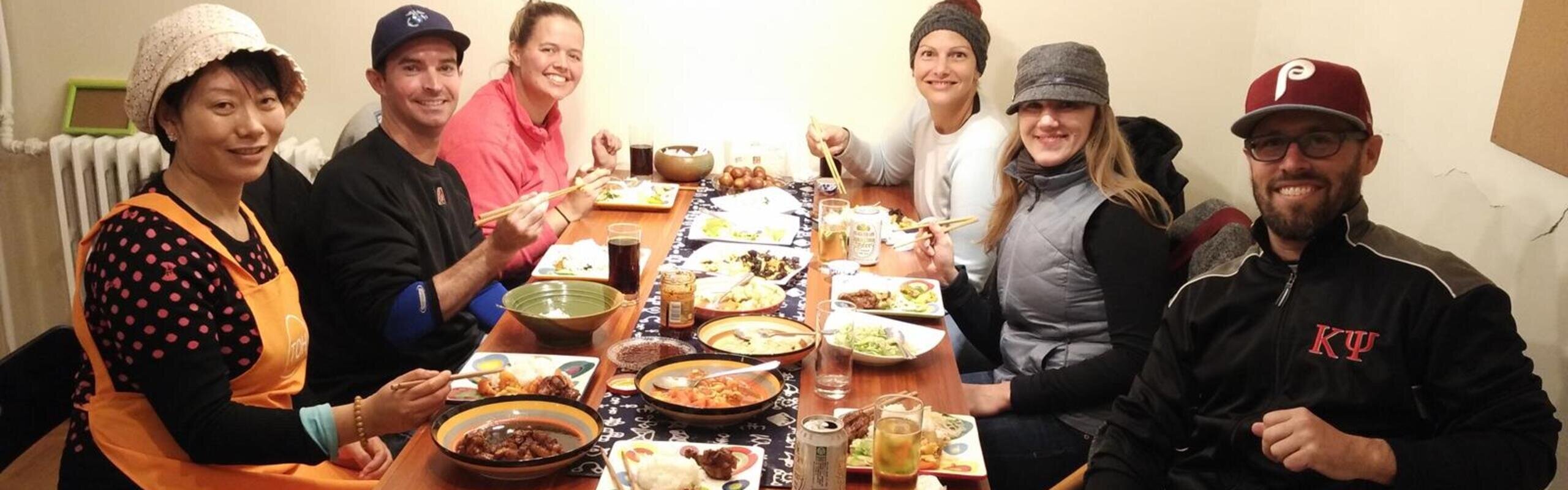

Chinese Dining Culture

Chinese Dining Culture

Chinese Dining Culture

Updated:
Oct 16, 2009;
by:
China Highlights;
Clicks:
223;

Chinese people love to eat and China boasts one of the world's greatest cuisines. During the long development of Chinese eating culture, many practices have evolved that foreign visitors may find quite different from what they are used to and even consider weird. These pages have been written to help those from other parts of the world to understand Chinese eating culture.

China is a country with a long history of ritual and etiquette, and eating is highly important feature of China’s culture, so naturally dining etiquette has developed to a high degree. Dining etiquette is said to have its beginnings in the Zhou Dynasty (1045-256 BC). Through thousands of years of evolution it has developed into a set of generally accepted dining rituals and practices. However, there is still variation in table etiquette according to the character and purpose of a banquet and great differences regionally.

Eating Ambience

Being surrounded by much loud talking and laughing is a typical ambience at a Chinese restaurant. (This goes against what you will see on the dining etiquette page about talking little and quietly and laughing reservedly, as will many other things you see in restaurants.) Chinese people like a noisy and upbeat atmosphere when having a gathering and meals are no exception. People regard it as a rule of thumb that if the dishes of a restaurant are good and tasty then the restaurant will be noisy and busy. The crowds at a restaurant indicate the deliciousness of the dishes. If you want a quiet place to enjoy your meal, some restaurants provide private rooms with one or more tables.

Seating Arrangement

The seating arrangement is probably the most important part of Chinese dining etiquette. Dining etiquette in ancient times was enacted according to a four-tier social strata: 1. the imperial court, 2. local authorities, 3. trade associations and 4. farmers and workers. The respect structure in modern dining etiquette has been simplified to: 1. master of the banquet and 2. guests.

The seat of honor, reserved for the master of the banquet or the guest with highest status, is the one in the center facing east or facing the entrance. Those of higher position sit closer to the master of the banquet. The guests of lowest position sit furthest from the seat of honor. When a family holds a banquet, the seat of honor is for the guest with the highest status and the head of the house takes the least prominent seat.

If round tables are used, the seat facing the entrance is the seat of honor. The seats on the left hand side of the seat of honor are second, fourth, sixth, etc in importance, while those on the right are third, fifth, seventh and so on in importance, until they join together.

In ancient times there was a piece of furniture known as an Eight Immortals table, a big square table with benches for two people on each side. If there was a seat facing the entrance, then the right hand seat when facing the entrance was for the guest of honor. If there was no seat facing the entrance door (presumably if the meal was outside or there were two or more doors of equal importance), then the right hand seat when facing east was the seat of honor. The seats on the left hand side of the seat of honor were, in order of importance, second, fourth, sixth and eighth and those on the right were third, fifth and seventh.

In a grand banquet of many tables, the table of honor is the one furthest from the entrance (or facing east in the event of no clear main entrance). The tables on the left hand side of the tables of honor are, in order of importance, second, fourth, sixth and so on, and those on the right are third, fifth and seventh. Guests are seated according to their  status and degree of relationship to the master of the banquet.

Dining Etiquette

As a guest at a meal, one should be particular about one’s appearance and determine whether to bring small gifts or good wine, according the degree of relationship with the master of the banquet. It is important to attend and be punctual. On arrival one should first introduce oneself, or let the master of the banquet do the introduction if unknown to others, and then take a seat in accordance with the master of the banquet’s arrangement. The seating arrangement is probably the most important part of Chinese dining etiquette.

When eating a meal in China, people are expected to (according to Chinese customs) behave in a civilized manner, pay attention to table manners and practice good dining habits. In order to avoid offense diners should pay attention to the following points:

  1. If the guest of honor is not seated, other people are not allowed to be seated. If he hasn’t eaten, others should not begin to eat. When making toasts, the first toast is made from the seat of honor and continuing down the order of prominence.
  2. Let older people eat first, or if you hear an elder say "let's eat", you can start to eat. You should not steal a march on the elders. 
  3. You should hold your bowl with your thumb on the mouth of the bowl, first finger, middle finger the third finger supporting the bottom of the bowl and palm empty. If you don’t pick up your bowl, bend over the table and eat facing your bowl, it will be regarded as bad table manners. Moreover, it will have the consequence of compressing the stomach and restricting digestion.   
  4. When helping yourself to the dishes, you should take food first from the plates in front of you rather than those in the middle of the table or in front of others. It's bad manners to use your chopsticks to burrow through the food and "dig for treasure" and keep your eyes glued to the plates. It is not good manners to pick up too much food at a time. You should behave elegantly. When taking food, don’t nudge or push against your neighbor. Don’t let the food splash or let soup or sauce drip onto the table. When finding your favorite dish, you should not gobble it up as quickly as possible or put the plate in front of yourself and proceed to eat like a horse. You should consider others at the table. If there is not much left on a plate and you want to finish it, you should consult others. If they say they don’t want any more, then you can eat proceed.
  5. When eating, you should close your mouth to chew food well before you swallow it, which is not only a requirement of etiquette, but also better for digestion. You should by no means open your mouth wide, fill it with large pieces of food and eat up greedily. Don’t put too much food into your mouth at a time to avoid leaving a gluttonous impression. Neither should you stretch your neck, open your mouth wide and extend your tongue to catch food you are lifting to your mouth. If there is food around your mouth, use a tissue or a napkin to wipe it, instead of licking it with your tongue. When chewing food, don’t make noises. It is best not to talk with others with your mouth full. Be temperate in laughing lest you spew your food or the food goes down your windpipe and causes choking. If you need to talk, you should speak little and quietly. 
  6. When spitting out bones or other inedible parts of the meal, use chopsticks or a hand to take them and put them on the table in front of you instead of spitting them directly onto the table or the ground. If you want to cough or sneeze, use your hand or a handkerchief to cover your mouth and turn away. If you find something unpleasant in your mouth when chewing or phlegm in the throat, you should leave the dinner table to spit it out.   
  7. You should try to refill your bowl with rice yourself and take the initiative to fill the bowls of elders with rice and food from the dishes. If elders fill your bowl or add food to your bowl, you should express your thanks.
  8. Concentrate on the meal. Watching television, reading or carrying on some other activity while having a meal is considered a bad habit.

There are also certain rules and conventions relating to chopsticks:

  1. Do not stick chopsticks vertically into your food when not using them, especially not into rice, as this will make Chinese people think of funerals. Only at funerals are chopsticks (or sticks of incense) stuck into the rice that is put onto the altar.
  2. Do not wave your chopsticks around in the air too much or play with them.
  3. Do not stab or skewer food with your chopsticks. Pick food up by exerting sufficient inward pressure on the chopsticks to grasp the food securely and move it smoothly to your mouth or bowl. It is consider bad form to drop food, so ensure it is gripped securely before carrying it. Holding one’s bowl close to the dish when serving oneself or close to the mouth when eating helps.
  4. To separate a piece of food into two pieces, exert controlled pressure on the chopsticks while moving them apart from each other. This needs much practice.
  5. Some consider it unhygienic to use the chopsticks that have been near (or in) one’s mouth to pick food from the central dishes. Serving spoons or chopsticks can be provided, and in this case you will need remember to alternate between using the serving chopsticks to move food to your bowl and your personal chopsticks for transferring the food to your mouth.

Some restaurants in China have forks available and all will have spoons. If you are not used to chopsticks, you can ask the restaurant staff to provide you with a fork or spoon.

Odds and Ends of Chinese Food Culture

Chinese people love to eat and China boasts one of the world's greatest cuisines. During the long period of development of the eating culture, there formed many things about the eating that foreign visitors may find quite different from what they are used to and even feel weird.

Chopsticks

Chopsticks were developed about 5,000 years ago in China. It is likely that people cooked their food in large pots which retained heat well, and hasty eaters then broke twigs off trees to retrieve the food. By 400 BCE, a large population and dwindling resources forced people to conserve fuel.

Chinese eating utensils normally are chopsticks, spoons, bowls. Forks are not used on the table and never can you see knives. It is thought that Confucius, a vegetarian, advised people not to use knives at the table because knives would remind them of the slaughterhouse. It is also thought it is because the Chinese take their meals very seriously, and feel that the meal table should be a place of peace and harmony. The knife could be used as a weapon, and could disrupt the harmony of the table. Because of this, the knife, and anything else that could disrupt the harmony, is banned from the table.

Chopsticks are two long, thin, usually tapered, pieces of wood. Bamboo has been the most popular material of chopsticks because it is inexpensive, readily available, easy to split, resistant to heat, and has no perceptible odor or taste. Cedar, sandalwood, teak, pine, and bone have also been used. The wealthy, however, often had chopsticks made from jade, gold, bronze, brass, agate, coral, ivory, and silver. In fact, during dynastic times it was thought that silver chopsticks would turn black if they came into contact with poisoned food. It is now known that silver has no reaction to arsenic or cyanide, but if rotten eggs, onion, or garlic are used, the hydrogen sulfide they release might cause these chopsticks to change color.

Chopsticks are called "Kuaizi" in Chinese which resembles the pronunciation of other two words, soon and son. Therefore, it is a tradition in some areas to give chopsticks as a gift to newly-married couples, wishing them to have a baby soon.

When using chopsticks to eat, people need pay attention to some rules or common conventions.

Do not stick chopsticks into your food, especially not into rice. Only at funerals are chopsticks stuck into the rice that is put onto the altar.

Do not move your chopsticks around in the air too much, nor play with them.

To separate a piece of food into two pieces, exert controlled pressure on the chopsticks while moving them apart from each other. This needs much exercise.

Most of the restaurants in China now have forks available. If you are not used to chopsticks, you can ask servants of the restaurant to provide you with forks or spoons. Some restaurants will serve several kinds of eating utensils for your choice before you ask and a few have descriptions and pictures available showing how to use chopsticks and some

Picture on the right will show you how to use a pair of chopsticks.

"Thank you" Gesture

Tea usually is served as soon as you have a seat in a restaurant. The servant serves you the tea cup and pour the tea for you when you read the menu and decide what to order. The tea pot is left with you on the table after the cup of every customer around the table is filled with tea, in order that you may serve yourself when you need more. When the servant pours the tea in one's cup, he or she often tips the table with his or her index and middle fingers for two or three times, showing the meaning of thanking the servant for his service and of being enough of the tea. The servant will stop pouring when seeing the gesture.

Drinkable Water

Water is easily available in China, but please don't drink water that comes out of the tap. Drinkable water is available at restaurants and hotels. Very few cities, like Hong Kong and Guilin, have public direct drinking water system available. Highly suggest you take, when traveling, with you bottled spring water which can be bought anywhere at the station stalls and supermarkets.

Eating Ambience

Being surrounded by much loud talking and laughing that is usually heard in the market is a typical ambience at a Chinese restaurant. People like jollification when having a gathering and having meals undoubtedly can not be of exception. People regard it as a rule to judge if the dishes of a restaurant are of good taste that whether the restaurant is noisy or not, because the crowds at the restaurant indicate the deliciousness of the dishes. If you want a quiet place to enjoy your meals, restaurants also provide individual small rooms which Chinese people call "Baoxiang".

Chopsticks

Chopsticks were developed about 5,000 years ago in China. It is likely that people cooked their food in large pots which retained heat well, and hasty eaters then broke twigs off trees to retrieve the food. By 400 BCE, a large population and dwindling resources forced people to conserve fuel.

Chinese eating utensils normally are chopsticks, spoons, bowls. Forks are not used on the table and never can you see knives. It is thought that Confucius, a vegetarian, advised people not to use knives at the table because knives would remind them of the slaughterhouse. It is also thought it is because the Chinese take their meals very seriously, and feel that the meal table should be a place of peace and harmony. The knife could be used as a weapon, and could disrupt the harmony of the table. Because of this, the knife, and anything else that could disrupt the harmony, is banned from the table.

Chopsticks are two long, thin, usually tapered, pieces of wood. Bamboo has been the most popular material of chopsticks because it is inexpensive, readily available, easy to split, resistant to heat, and has no perceptible odor or taste. Cedar, sandalwood, teak, pine, and bone have also been used. The wealthy, however, often had chopsticks made from jade, gold, bronze, brass, agate, coral, ivory, and silver. In fact, during dynastic times it was thought that silver chopsticks would turn black if they came into contact with poisoned food. It is now known that silver has no reaction to arsenic or cyanide, but if rotten eggs, onion, or garlic are used, the hydrogen sulfide they release might cause these chopsticks to change color.

Chopsticks are called "Kuaizi" in Chinese which resembles the pronunciation of other two words, soon and son. Therefore, it is a tradition in some areas to give chopsticks as a gift to newly-married couples, wishing them to have a baby soon.

When using chopsticks to eat, people need pay attention to some rules or common conventions.

Do not stick chopsticks into your food, especially not into rice. Only at funerals are chopsticks stuck into the rice that is put onto the altar.

Do not move your chopsticks around in the air too much, nor play with them.

To separate a piece of food into two pieces, exert controlled pressure on the chopsticks while moving them apart from each other. This needs much exercise.

Most of the restaurants in China now have forks available. If you are not used to chopsticks, you can ask servants of the restaurant to provide you with forks or spoons. Some restaurants will serve several kinds of eating utensils for your choice before you ask and a few have descriptions and pictures available showing how to use chopsticks and some

Picture on the right will show you how to use a pair of chopsticks.


Tour Type:
Duration:
Your Budget:
Beijing Shanghai
Xian Guilin
Lhasa, Tibet Yangtze River
Select more cities

Got a question? Ask us here

We will reply to you within one working day.

Customize Your Own China Trip