













Eight Distinct Regional Cuisine

Eight Distinct Regional Cuisine

Eight Distinct Regional Cuisine

Updated:
Oct 16, 2009;
by:
China Highlights;
Clicks:
188;

China can be divided into many geographical areas, and each area has a distinct style of cooking. The ingredients used in the food are based on the agricultural products produced in the region. In the northern part of China, for example, wheat is more eaten than rice as staple food. Food using wheat as its main ingredients such as noodles and dumplings are widely available. As for vegetables, cabbage is ubiquitous, almost served at every restaurant. Compared to the rather monotonous fare of the north, China's southern cuisine is notable for its exceptional tastiness and its great variety. Most of the famous Chinese dishes served in international capitals - i.e., what is considered "Chinese Cuisine" abroad - belongs in fact to the cuisine tradition of southern China.

Of all the existing regional cooking styles, the following eight ones stand out for their distinctive culinary arts, and are regarded as the "Eight Distinct Regional Cuisines" of China.


Lu Cuisine

Lu Cuisine, also called Shandong Cuisine, is originated from the native cooking styles of East China’s Shandong Province. Its history can date back to Qin Dynasty (221 BC to 207 BC). It has become one of China’s eight cuisines since Song Dynasty (960 AD to 1234 AD). It is the most prevalent distinct regional cuisine in China, popular through out Beijing, Tianjin and Northeast China.

Lu Cuisine is more inclined to keep the freshness of ingredients than other cuisines and fond of salt flavor, featured with tender, savory and crisp. It is particular about making soup.

Seafood is the most notable ingredient of Lu Cuisine as Shandong is a costal province, including scallops, prawns, clams, sea cucumbers, and squid, which are all local ingredients of exemplary quality. Besides seafood, corn, peanuts, grains such as small grains, millet, wheat, oat and barley, and staple vegetables of Shandong province including potatoes, tomatoes, cabbages, mushrooms, onions, garlic and eggplants.

There are over thirty cooking techniques applied in Lu Cuisine, among which Bao technique (quick-fry) and Pa technique are frequently and well used in Lu Cuisine. In Bao (quick-fry), foods are deep-fried in very hot oil over high heat and then the oil is poured out and seasonings are added to the food, which is left in the wok. Pa technique, derived from Shandong Province, is first to cut the well-cooked ingredient into a particular shape, then stick some powder and fry it into golden, finally add some kind of sauce to sauté it while stirring continuously.

Lu Cusine Menu

Lu Cusine Menu

Chuan Cuisine

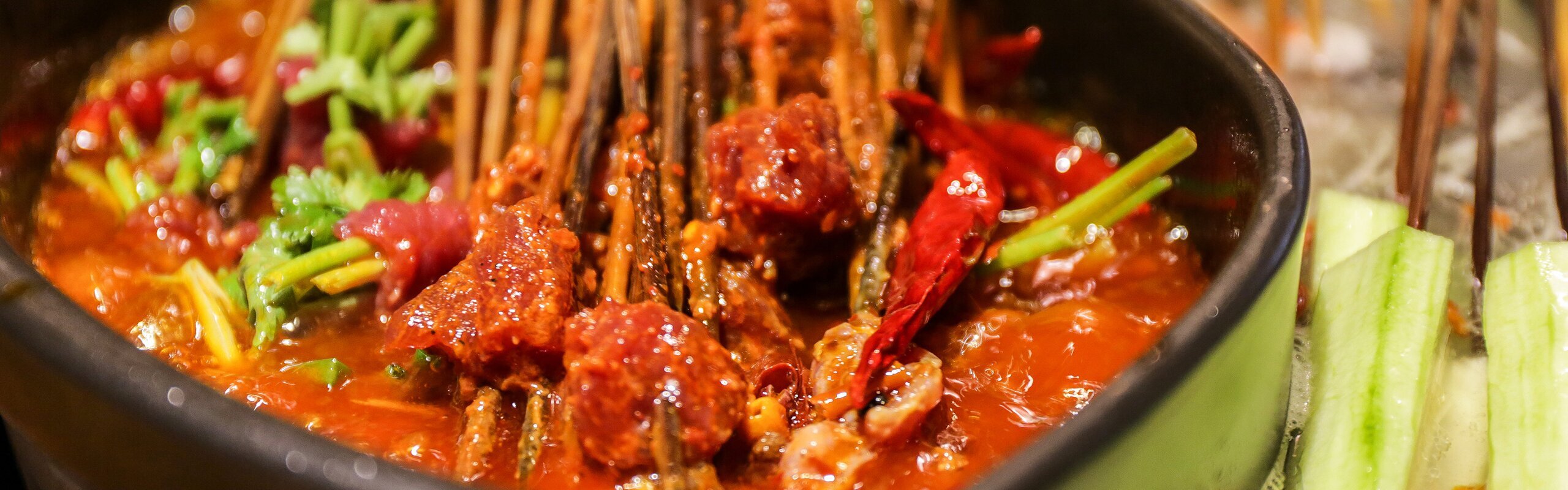
Sichuan Cuisine is the most widely served cuisine in China. The dishes of Sichuan Cuisine are famous for their hot and spicy flavor. An outstanding facet of Sichuan dishes is the delicate use of pepper or chili. The ingredients used are great in variety, including poultry, pork, beef, fish, vegetables and tofu. The methods of cooking vary according to the texture required. Fast-frying is the most widely used cooking method.

Sichuan Cuisine wins universal praise for its hotness, sourness and numbness it produces, which are rare in other regional cuisines. These together sum up the unique flavor of Chuan Cuisine, which enjoys a good reputation as a cuisine that is "one dish with one flavor and one hundred dishes with one hundred flavors". Its cooking methods include baking, sautéing, dry-sautéing and steaming. Chuan Cuisine has good combinations of flavors and often has thick gravy. Based on five flavors: saltiness, sweetness, numbness, spiciness and sourness, all kinds of seasonings are added, which cooperate with each other and develop into twenty-three compound flavors of all sorts, such as home-style, salty and fresh, fishy, litchi flavor and bizarre flavor.

Although, Chuan Cuisine is served at every corner of the world, the most authentic Sichuan food is still to be found at its hometowns: Chengdu and Chongqing.

Special Chuan Cuisine

Spicy Diced Chicken

Spicy Diced Chicken is cooked by frying diced chicken, dry red pepper and golden peanuts. Spicy Diced Chicken is as popular among W esterners as the Mapo Bean Curd.

Mapo Bean Curd (Mapo Tofu)

Mapo Bean Curd is bean curd set in a chili-and-bean based sauce, which is usually a thin, oily, and bright red suspension, and often topped with minced meat, usually pork or beef. Seasonings include water chestnuts, onions, other vegetables, or wood ear fungus. The taste of Mapo Bean Curd is fittingly described as numbing, spicy hot, fresh, tender and soft, aromatic and flaky. Mapo Bean Curd is easy to find outside of China.

Chuan Cuisine Menu

Kung Pao Chicken (diced chicken fried
with peanuts)          
宫保鸡丁 Gongbao Ji Ding
Twice Cooked Pork      回锅肉     Hui Guo Rou
Stir-Fried Bean Curd in Chili Sauce       麻婆豆腐 Mapo Doufu
Sichuan Hotpot    四川火锅 Sichuan Huoguo
Chongqing Spicy Deep-Fried Chicken    
 
重庆辣子鸡 Chongqing Lazi Ji
Steamed Pork with Spicy Cabbage     冬菜扣肉   Dongcai Kourou
Sesame Oil Chicken 麻油鸡 Mayou Ji
Husband and Wife Lung Slices  (slices of
beef and offal seasoned with chili oil)   
夫妻肺片   Fuqi Fei Pian
Dongpo Cuttlefish                       东坡墨鱼 Dongpo Moyu
Fish Flavored Beef Shreds               鱼香牛肉丝 Yu Xiang Niurou Si
Duck Hotpot (the hotpot is divided into
two parts: one spicy, one plain)        
鸳鸯火锅 Yuanyang Huoguo
Fried Bean Curd and Beef with
Cayenne Pepper (very spicy)          
麻辣烫 Mala Tang
Boiled Mutton   沸腾羊肉   Feiteng Yangrou
Boiled Fish with Pickled Chinese
Cabbage                           
酸菜鱼 Suancai Yu

Sichuan Hot Pot

Sichuan Hotpot, like most of the cuisine in that humid and populous province, is very spicy. The broth is flavored with chili peppers and other pungent herbs and spices. The main ingredients include hot pepper, Chinese crystal sugar and wine. Slices of kidney, chicken breast, beef tripe, goose intestines, spring onion, soy bean sprouts, mushrooms, duck and sea cucumber are the usual meats used in the dish.


Fuqi Fei Pian

Fuqi Fei Pian is made of thinly sliced beef, bovine lung or tongue seasoned with chili oil. There is a romantic story about the origin of this famous Sichuan dish. Guo Zhaohua, the inventor of this dish, and his wife sold their acetarious (treated with vinegar) beef slices by trundling a small cart along the street. Their beef slices were very delicious, and no one could resist the charming smell in that street. People liked the food made by this couple very much, so they gave it the name Husband and Wife Lung Slices.

Cantonese Cuisine

Cantonese Cuisine, also known as Yue Cuisine, is the culinary style of Guangdong Province, which was called Canton when the Wade-Giles romanization of Chinese was in use. This particular type of Chinese food has been popularized by Chinese restaurants around the world as the majority of those who set up these restaurants were of Cantonese origin.

Guangdong dishes are characterized by their tender and slightly sweet taste. Sauces are a crucial seasoning in Guangdong cuisine. Classic Cantonese sauces are light and mellow. The most widely used sauces in Guangdong Cuisine include: hoisin sauce, oyster sauce, plum sauce and sweet and sour sauce. Other ingredients popular in Guangdong Cuisine include spring onions, sugar, salt, soya bean products, rice wine, corn starch, vinegar and sesame oil. Garlic is used heavily in some dishes, especially those in which internal organs, such as entrails, may emit unpleasant odors. Ginger, chili peppers, five-spice powder, powdered white pepper, star anise and a few other spices are used, but often sparingly. 

The raw materials for Guangdong Cuisine are very plentiful. “The Chinese eat everything with four legs, except tables, and everything that flies except airplanes” is the most suitable expression of the countless variety of Guangdong food. Things that are rarely eaten or rarely seen on Western tables are commonly used in Guangdong dishes. Snake, cat and pangolin (scaly anteater) are considered by the Cantonese people to be most delicious food.   

In contrast to the fast-fried cooking method of Sichuan dishes, Guangdong people prefer to braise, stew and sauté their food. These cooking methods aim to preserve the flavor of the dishes.

Cantonese Dishes

Traditional Dishes

These dishes are the earliest collection of Chinese food. They are often simple and easy to learn and cook, and are widely found in Chinese homes. They are also the most common foods on the menus of Cantonese restaurants.

Youtiao

A youtiao is a long, golden-brown deep-fried strip of dough. Youtiaos are usually eaten for breakfast with soy milk.

Zhaliang (literally “Fried Two”)

Zhaliang is made by tightly wrapping a rice sheet roll round a youtiao (deep-fried dough stick). Zhaliang is widely eaten in Guangdong and Hong Kong. It is usually eaten with soy milk.

Chinese Steamed Eggs

Chinese Steamed Eggs are made by beating eggs to a creamy consistency and then steaming. Variations are derived by adding different ingredients, such as spring onion and soy sauce.

Other Dishes

Baiqie Chicken (White Cut Chicken)

Baiqie Chicken is made by boiling salt-marinated chicken in water or chicken broth. When it is done, the chicken looks golden in color and tastes fresh and light, preserving the best of the original taste of chicken.
The famous Baiqie Chicken served by Panxi Restaurant in Guangzhou is believed to be the most delicious. The restaurant has received the Golden Tripod of High Quality Production from the Department of Commerce for its Baiqie Chicken.

Noodle Dishes

Shahe Noodles (Shahefen)

Shahe noodles a kind of rice noodles which probably originate from the town of Shahe, now part of Guangzhou. They are broad and white in color. Their texture is elastic and a little chewy. They do not freeze or dry well and are thus generally (where available) purchased fresh, in strips or sheets that may be cut to the desired width. Shahefen is popular in southern China’s Guangdong, Guangxi and Hainan provinces.

Cantonese Cuisine Menu

Min Cuisine

Min Cuisine, also called Fujian Cuisine, originates from South China’s Fujian Province. The history of Min Cuisine dates back to 5000 years ago. It consists of three styles, namely Fuzhou style, which is usually tastes light compared with other styles, often with a mixed sweet and sour taste; Western Fujian style, featuring slightly spicy flavoring from mustard and pepper; and Southern Fujian style, which usually tastes spicy and sweet.

The three notable features of Min Cuisine are: the use of delicacies from the mountains and sea as the main ingredients, a specialism in soup making and expertise in applying various kinds of seasonings. Fujian’s abundant natural resources mean Fujian Cuisine is rich in high-quality ingredients, especially delicacies from the mountains and sea.

Min Cuisine pays a great deal of attention on utilizing soup. As a saying about the region's cuisine goes: "It is unacceptable for a meal not to have soup". Fujian people like to use various kinds of sauces and seasonings to create the tastes of salty, sweet, sour and spicy. Salty seasonings include shrimp sauce, shrimp oil and soy sauce; sour seasonings include white vinegar and qiaotou (a vegetable similar to green onion and garlic); sweet seasonings include brown sugar and crystal sugar; sweet-smelling seasononings include brown sugar, spiced powder, aniseed and cassia bark; and spicy seasonings include pepper and mustard.

The cooking techniques of Fujian Cuisine are: pan-frying, deep-frying, boiling, baking, stewing, mixing, sautéing with wine, stewing in gravy, grilling, cooking with red rice wine, simmering, stir-frying, smoking, braising and salting. Among them the most characteristic one is cooking with red rice wine, which includes stir-frying with red rice wine, and baking with red rice wine, quick-frying with red rice wine and deep-frying with red rice wine. The “drunken" (cooked in wine) dishes are prevalent in Fujian Province and very famous throughout China.

Representative Dishes

Fotiaoqiang (literally Buddha Jumps Over The Wall), one of the most notable dishes in Min Cuisine, is a complex dish making use of many ingredients, including shark fin, sea cucumber, abalone, and Shaoxing wine. As folklore goes, a poet of the Qing Dynasty (1644-1911) wrote a poem to describe the dish: “The dish was so delicious and fragrant, even a Buddha who smelled the aroma would jump over the wall of a temple to taste it.”     

Zui Paigu (literally Drunk Ribs), made of wine marinated ribs, pan-fried with particular seasonings and sauces, is another famous dish in Min Cuisine.

Min Cuisine Menu

Min Cuisine

Su Cuisine

Jiangsu Cuisine, called Su Cuisine for short, originates from the native cooking styles of South China’s Jiangsu Province. It has a fresh taste, with moderate saltiness and sweetness, which is thick without being greasy, and light without being thin. Meanwhile it places an emphasis on the making of soup and retaining the original taste of the ingredients. Once it was the second largest cuisine among ancient China’s royal cuisines, and it remains a major part of the state banquet in China.  
 
Su Cuisine is composed of six styles: Nanjing Style, Yangzhou Style, Suzhou Style, Huai’an Cuisine, Xuzhou Cuisine and Haizhou Cuisine. Among them Nanjing Style, Suzhou Style and Yangzhou Style are the most notable.

Nanjing Style is famous for its fine cutting techniques, which makes the dishes not only fine-tasting, but also very delicate and good-looking. It features freshness, fragrance, crispness and tenderness. Suzhou Cuisine tends to be sweet in taste and excels in using vegetables of the four seasons, freshwater fish and seafood. Yangzhou Style, which has been called Huai-Yang Style in the past, is renowned for its fine cutting techniques, perfect timing, fresh color and original design.

Su Cuisine is made according to precise material choice and a precise cooking schedule . It requires exquisite and fine cooking. There is an excellence in cooking methods such as stewing, simmering, baking over a slow fire, warming up, steaming, sautéing, stir-frying, and skillful braising in mud and baking on forks.

With the Yangtze River passing through it and a coast on the Yellow Sea, Jiangsu Province is abundant in freshwater fish and seafood, which comprise the major ingredients of Su Cuisine. Jiangsu people have been experts at cooking fish with various cooking techniques for about two thousand years. Su Cuisine has exhibited a fondness for duck dishes since about one thousand years ago. A rich variety of local vegetables are widely used in Su Cuisine, including watershield (or Brasenia) from Taihu (Tai Lake), lotus, Chinese chestnut, winter bamboo shoots, water bamboo and water chestnuts.  

Representative Dishes

Santao Ya (a dove encased in the carcass of a wild duck, which is encased in a larger farmed duck, steamed and served in its soup) is a representative dish originated from Yangzhou. It tastes extremely fresh and special.

Salted Soup Duck, originated from Nanjing, is a dish with a history of over one thousand years. Autumn is the best time to make it, because ducks are fat at this time and can be seasoned with Osmanthus flowers. That is why it is also known as “Osmanthus Duck”.     

Steamed Meatballs with Crab Powder.

Su Cuisine Menu

Su Cuisine 

Zhe Cuisine

Zhejiang cuisine, called Zhe cuisine for short, is originated from South China’s Zhejiang Province. It is famous for its mellow, yet not greasy, taste.

It consists of three major styles, namely Hangzhou style, Ningbo style and Shaoxing style. Among them, Hangzhou style is the most notable. It has good taste as well as delicate appearance. It requires expertise in the cooking techniques of quick frying, stir-frying, braising and deep-frying and features clearness, freshness, tenderness, delicateness and purity. Besides seafood and freshwater fish, Hangzhou style exhibits a fondness for bamboo roots. About half the dishes on a Hangzhou menu contain bamboo roots, which add a tender element to the food. Ningbo chefs are especially skillful in making seafood. The best-known Ningbo cooking techniques are stewing, baking and steaming. The taste is moderate in freshness and saltiness. Ningbo chefs’ specialties are making dishes fresh, tender and soft. Emphasis is placed on its original flavor. Shaoxing style is fragrant, crisp, soft and glutinous, with thick soup and pure flavor. Shaoxing style specializes in poultry and freshwater fish. 

Zhejiang Province, located at the Yangtze River Delta, is the famous “land of milk and honey” in China. Using the rich assortment of local ingredients, Zhe Cuisine has an extensive selection of materials and a precisely matches these materials. Emphasis is placed on the season and variety of main ingredients. The choice of supplementary ingredients and seasonings is aimed to give prominence to the main ingredients, strengthen freshness and fragrance and get rid of the smell of fish and greasiness. Most emphasis is placed on moderation in duration and degree of cooking as well as seasoning.

Zhe Cuisine Menu

Zhe Cuisine Menu

Representative Dishes

Xihu Cuyu (West Lake Fish in Vinegar Gravy)

One of its notable features is that it is cooked without oil to preserve the original flavor of the fish. Just smelling the aroma of the dish, can arouse people’s appetites.   

Dongpo Rou (Fried Pork Belly Stewed in Soy Sauce and Wine)

It is said to be an innovation of famous Chinese poet Su Dongpo(1037AD~1101AD)of the Song Dynasty.  

Jiaohua Ji (literally Beggar’s Chicken)

It is lotus-leaf-wrapped chicken roasted in mud. It is fragrant and tastes tender and out-of-the-ordinary.

Xiang Cuisine

Hunan cuisine, also called Xiang cuisine, stems from a province that has an age-old reputation as a 'land of fish and rice'. Hunan Province has always been a cornucopia as far as foodstuffs go. The salient features of Hunan cuisine are richness, creaminess, and moistness, combined with a delicate use of chili. Hunan cuisine is also fragrant, with crunchy fresh vegetables that are cooked "al dente". It is said of Hunan cuisine that it not only has the saltiness of the cuisines of North China and the sweetness of the cuisines of South China, it also has the spicy-hotness as well as the tanginess of more local dishes. Moreover, Hunan cuisine relies on fresh, local ingredients that are seasonal staples, which is another reason why Hunan cuisine is often less expensive than other cuisines.

Hunan cuisine favors cooking techniques such as sautéing, stir-frying, steaming and smoking. It is renowned for its "stewed" dishes. However, Hunan cuisine excels at braising and baking, which lend themselves admirably to the raw materials that make up Hunan cuisine. Equally as important to Hunan cuisine is the art of cutting meats and vegetables, both to please the eye and, in the case of meats,to enhance the tenderness of the finished product.

The special seasonings of Hunan cuisine include soy sauce, tea seed oil, spicy oil, Chinese red pepper, fennel and cassia bark, each of which add its own particular color and flavor to the cuisine. Hunan cuisine is noted for pungency, thanks to its generous but judicious use of spices, especially the use of chili, which is as standard to Hunan cuisine as it is to South American or Indian cuisine. To the people of Hunan, chili can be enjoyed in almost every dish except ice cream.

Xiang Cusine Menu

Xiang Cuisine Menu

Hui Cuisine

Hui Cuisine is also called Anhui Cuisine or Wan Cuisine. It is one of the eight famous cuisines of China, derived from North China’s Anhui Province. Anhui Cuisine mainly consists of three styles representing three regions: Yangtze River region, Huai River region, and Southern Anhui region. Among them the South Anhui style is the most notable. The birthplace of South Anhui style is She County, located at a world famous tourist destination, Huangshan (the Yellow Mountains).

Anhui is abundant in uncultivated fields, mountains and forests, which provide Anhui Cuisine rich local ingredients. Hui Cuisine uses only local produce, so the freshness of the dishes is unparalleled. Most ingredients in Anhui Cuisine, such as pangolin, stone frog, mushroom, bayberry, tea leaves, bamboo shoots and dates all come from mountain areas. The Yellow Mountains are abundant in raw materials suitable for cooking. Wild herbs are readily available here. Hui Cuisine places a great deal of emphasis on natural foods, which makes it a healthy cuisine. It follows traditional ways and uses foods that are also used for medicinal purposes. The use of wild herbs is one of Hui Cuisine’s notable features. 

Hui Cuisine is particular about controlling cooking time and temperature. High, medium or slow heat is applied according to the quality and characteristics of the different materials and the flavor requirements of finished dishes. Hui Cuisine requires skill in sautéing and stewing to achieve a delicate lightness in taste. Some typical dishes stewed in brown sauce may appear a little heavy on oil compared to some other styles. Ham is also often added to enhance the taste.

Some dishes representative of the Hui style of cuisine are: Stir-Fried Frog with Log Flower Mushrooms; Phoenix-Tailed Shrimp Steak; Li Hongzhang Hotchpotch; Bagong Mountain Bean Curd; Grape Fish, Mountain Bamboo Shoots, Assorted Meats; Phoenix-Tailed Shrimp in a Bird's Nest and Red Tato in Honey.


Hui Cuisine Menu

Hui Cuisine Menu


Tour Type:
Duration:
Your Budget:
Beijing Shanghai
Xian Guilin
Lhasa, Tibet Yangtze River
Select more cities

Got a question? Ask us here

We will reply to you within one working day.

Customize Your Own China Trip