
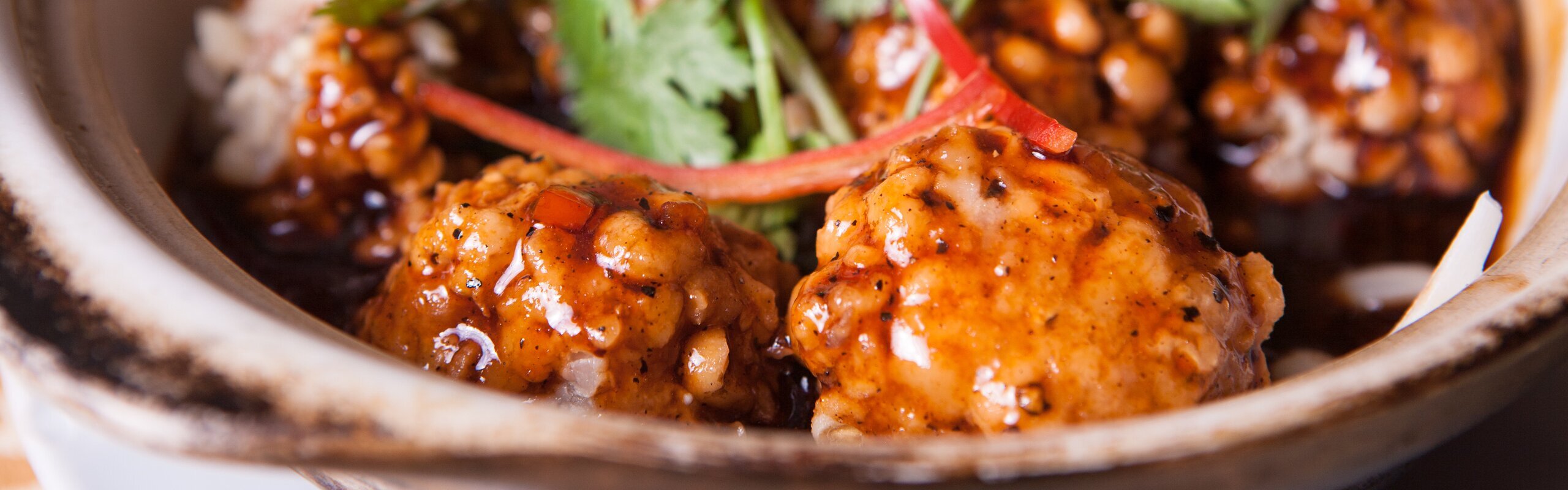

Shandong Province has a long coast, so fresh river fish and seafood were always the local delicacies.
Shandong was one of the first civilized regions in China and an early cultural center, so its cooking tradition set the style for the regions around it, especially to the north in Beijing and northeastern China. Now Shandong cuisine is relished for the many kinds of different seafood and vegetable dishes and their style of frying in high heat that locks in the flavors and isn't oily.
- Names: Shandong food, Lu cuisine (鲁菜 /loo-tseye/)
- Location: northern east-coast China — Qingdao, Jinan, Qufu, Mount Tai
- Distinctives: salty and crispy, favoring braising and seafood.
Flavors of Shandong Cuisine — Fishy, Salty, Tender, Light and Crispy
A wide variety of seafood are used to make Shandong dishes, and the people also like to eat pork. An ancient medical/science text describes the people in the area as relishing both fish and salt, and the people still do.
Seasonings Used in Lu Cuisine
 Onions are commonly used in Shandong dishes
Spices used: Shandong people like spices in the onion family such as green onions and garlic. They include onions in many dishes. Ginger is also commonly used along with a little red pepper. But spice is less heavily applied than in Sichuan cuisine. It is meant to accentuate the flavor of the food.
Condiments and Other Seasonings
Vinegar is heavily used and so is lots of salt. The province is known for its fine dark connoisseur kinds of vinegar that some people drink as a medicinal drink. Soy sauce is also used.
Their Favorite Cooking Methods
The Shandong chef's goal: Unlike other Chinese styles such as Sichuan style where the cook buries the food in a lot of spices and oil, the main aim of an authentic Shandong style chef is to preserve the cut, color, and taste of the main ingredients. So relatively little spice or sugar is used generally and the bao stir fry method is used often.
Extreme heat stir frying — "bao": Their chefs love to cook meat and vegetables in a wok over a big hot flame. They make the oil boil at an extremely high temperature and toss in the ingredients for a quick fry. This singes the outer layer and locks in the flavor. It also keeps oil from seeping into the food. They usually pour out the oil after the main ingredients are cooked, and then they will add spices, herbs, and seasonings, stir it quickly, and serve it hot. There is little residual oil on the food. This cooking method is called "bao."
Sometimes though, the oil will be part of the sauce that the food is served in. They may add flour, herbs and seasonings to the oil to make a tasty sauce.
Fried dough coating method — "pa": Another method of frying is to apply flour to a cut of meat and then stir fry it to make it crispy. Then they add a sauce to sauté it while stirring continuously.
Soup making: Clear broth and white varieties of soups are also popular. The white variety may contain milk or cream. The tradition of making soups stems from the western side of Shandong.
Healthy food: Since the main aim is to preserve the cut, color, and taste, the style of cooking preserves the nutritive value of the food. So the cuisine is generally healthy providing you eat wisely and don't overindulge in any particular food such as pork dishes or lobster.
Daily Staples and Common Vegetables
Steamed Wheat Buns are Commonly Eaten in the Shandong RegionDaily staples: The area lies along the border between the temperate north and the semitropical south, so both wheat and other temperate grains and rice are available and are daily cereals. Wheat noodles, steamed wheat bread and steamed pastries are commonly eaten and is the staple in many meals. Porridge made from oats, millet, and/or barley are also eaten. White rice is regularly eaten, and corn on the cob or fried corn is common. Their meals are sort of a combination between hearty and heavier northern Chinese regional food and light southern Chinese regional food.
Common vegetables: Peanuts are eaten often. Soybean products are common. Commonly eaten vegetables include tomatoes, potatoes, mushrooms, onions, eggplant, seaweed, and especially cabbage.
Best Places to Eat Authentic Shandong Cuisine in Jinan
The capital city of Shandong Province, Jinan, has Lu-style seafood restaurants. Here are our recommendations for restaurants in Jinan:
Shun He Business Hotel Chinese Restaurant
The restaurant is in the Shun He Business Hotel. They mainly serve Shandong style dishes and the service is good. Popular dishes are Hai Shen Da Bao (海参大包, steamed big bun wrapped sea cucumber), rockfish (石斑鱼), Zong Ye Ji (粽叶鸡, steamed chicken wrapped in leaves) and stir-fried scalloped pork kidneys (爆炒腰花).
- Chinese name: 舜和商务大酒店中餐厅 Shun He Shangqu Da Jiudian Zhong Canting /shwnn her shung-woo daa jyoh-dyen/
- Average price per person: 101 yuan
- Address: Tianfa Mansion, 11 Tikou Road, Tianqiao District (天桥区堤口路11号天发大厦)
Jin San Bei Restaurant
The prices are reasonable, and there is a nice dining environment and high-quality service. They mainly serve exquisite Shandong style dishes such as stir-fried scalloped pork kidneys (爆炒腰花), Jiu Zhuan Da Chang (九转大肠, pig's large intestines braised in soy sauce), dumplings wrapped with shrimp meat (虾仁水饺), dough drop and assorted seafood soup (海鲜疙瘩汤), fried crap with sweet and sour sauce (糖醋鲤鱼), beef ribs in black pepper sauce (黑椒牛仔骨), and egg yolk pastry (蛋黄酥).
- Chinese name: 金三杯酒家 Jin San Bei Jiujia /jin san bay jyoh-jyah/
- Average price per person: 88 yuan
- Address: Floor 11, San Lian Appliance, 12 Baotuquan North Road, Lixia District (历下区趵突泉北路12号三联家电11楼)
Ju Feng De Restaurant
The restaurant is said to be one of the oldest restaurants serving Shandong style dishes in Ji'nan. Tender stir-fried scalloped pork kidneys (爆炒腰花) and fried carp with sweet and sour sauce (糖醋鲤鱼) are top dishes there.
- Chinese name: 聚丰德饭店 Ju Feng De Fandian /jyoo fnng der fan-dyen/
- Average price per person: 58 yuan
- Address: 11 Jing Five Road, Shizhong District (市中区经五路11号)
Lu Cuisine Menu
| English | Chinese | Pronunciation | Characters |
|---|---|---|---|
| Stewed Pork Hock | shuǐjīng zhǒuzi | Shway-jing joh-dzrr | 水晶肘子 |
| Diced Pork Cooked in a Pot | tánzi ròu | Tan-dzrr roh | 坛子肉 |
| Braised Colon in Brown Sauce | jiǔzhuǎn dàcháng | Jyoh-jwann daa-chung | 九转大肠 |
| Lungs in Milk Soup | nǎi tāng dài fèi | Neye tung deye fay | 奶汤怠肺 |
| Four Joy Meatballs | sì xǐ wánzi | Srr sshee wann-dzrr | 四喜丸子 |
| Eight Treasures Stuffed Chicken in Milk Soup | nǎi tāng bābǎo bùdài jī | Neye tung baa-baoww boo-deye jee | 奶汤八宝布袋鸡 |
| Dezhou Grilled Chicken | dézhōu pá jī | Der-joh paa jee | 德州扒鸡 |
Travel with China Highlights and Taste Authentic Shandong Cuisine
Enjoying Chinese FoodIf you want to try authentic Shandong Cuisine, our tours can take you to authentic local restaurants.
Recommended Chinese Food Tours
12-Day Beijing, Xi'an, Chengdu, Guilin, and Hong Kong Cuisine tour — This tour explores the most popular destinations in China and savors five different regional cuisines.