
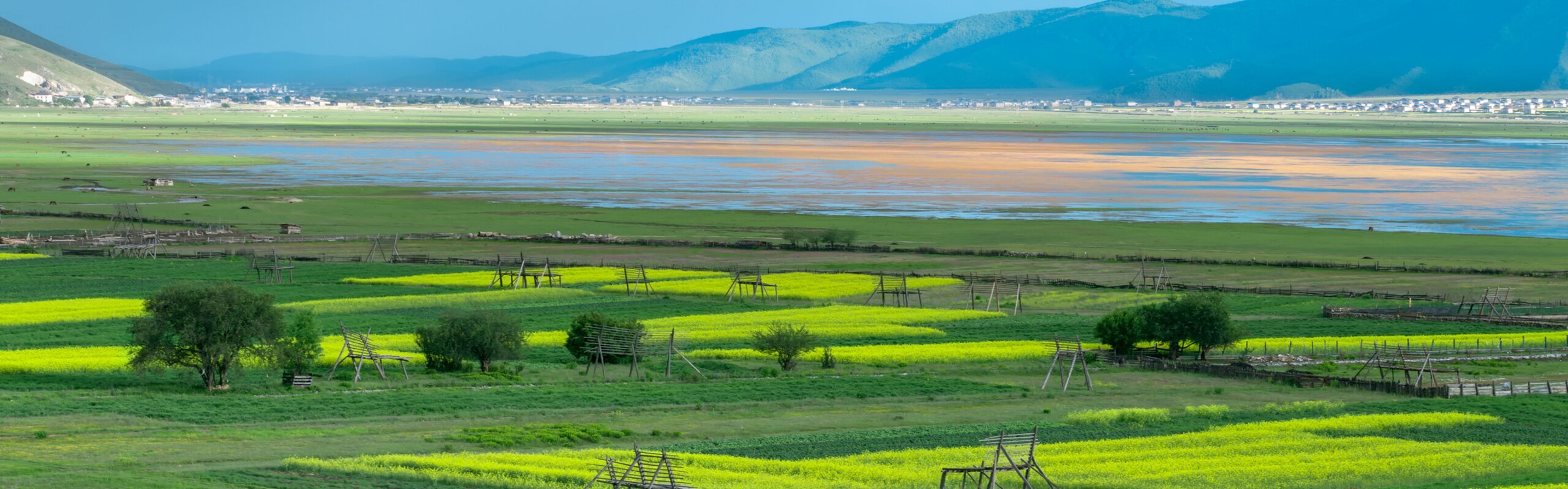

Shangri-La (also named Zhongdian) lies on the southeastern extremity of the Qinghai-Tibet Plateau, at an altitude of 3,380 m (11,900 ft), surrounded by the Hengduan Mountain Range. Shangri-La's high altitude but low latitude give it a characteristic monsoon climate, plateau climate, and mountain climate, all at the same time.
Influenced by the monsoon, the dry and wet seasons are distinct in Shangri-La. Rainfall is concentrated from June to October, accounting for about 80% of the annual precipitation. Sunshine is abundant in Shangri-La all year round.
Shangri-La's average daily high temperature range is small: 6–19°C (43–66°F), but its daily temperature range is big at up to 15°C (27°F) on average.
The Best Time to Visit Shangri-La
The best time to visit Shangri-La is from May to late October, when the temperature stays above freezing. You can see the scenes of wildflowers blooming from May to August, and the most important traditional Tibetan festivals will be held in Shangri-La in summer, bringing you their unique festival atmosphere.
Autumn (September to October) offers spectacular color changes, when the leaves of the trees are ablaze with color and Shangri-La is at its most enchanting.
It is mild in summer in Shangri-La, even on the warmest day, and bitterly cold in Shangri-La's long winter. Access may be restricted by snow in winter, but it is very dry and hence usually clear. Adventure to Shangri-La in winter for austerely beautiful Meili Mountain views and crisp snow scenes.

Recommended Shangri-La tours:
- 4-Day Shangri-La Exploration Tour
- 4-Day Yubeng Village Hiking Tour
- 6-Day Shangri-La, Deqin and Tacheng Adventure Tour
Average Temperature Ranges by Month
| Jan | Feb | Mar | Apr | May | Jun | Jul | Aug | Sep | Oct | Nov | Dec | |
|---|---|---|---|---|---|---|---|---|---|---|---|---|
| High (ºC) | 6 | 7 | 9 | 11 | 16 | 18 | 18 | 19 | 19 | 12 | 10 | 8 |
| Low (ºC) | -9 | -6 | -3 | 1 | 4 | 9 | 10 | 9 | 7 | 1 | -5 | -8 |
| High (ºF) | 43 | 45 | 48 | 52 | 61 | 64 | 64 | 66 | 66 | 54 | 50 | 46 |
| Low (ºF) | 16 | 21 | 27 | 34 | 39 | 48 | 50 | 48 | 44 | 34 | 23 | 18 |
Spring in Shangri-La (April–May)
Shangri-la Old TownSpring always comes late in Shangri-La, and it is short: from April to May. The average high temperature reaches about 14°C (57°F) in the daytime, but it drops to around 3°C (37°F) at night. So please wear warm clothes if you want to go out at night.
Things to Do in Spring
Spring is a good time to see the wild flowers in their full regalia all over the mountains and plains in Shangri-La. The recommended places are:
- Pudacuo National Forest Park for clusters of azaleas
- Little Zhongdian Flower Town for colorful and gorgeous azaleas, Stellera chamaejasme, etc.
May is also one of the best times to hike Tiger Leaping Gorge (a few hours down the valley, near Lijiang), when it is warm, but not too hot, and drier than summer. You can see various wildflowers too on the route. If you are interested in traveling to Tiger Leaping Gorge, we can design your own hiking tour.
Recommended tour plans:
- 7-Day Kunming, Dali, Lijiang, and Tiger leaping Gorge tour
- 8-Day Kunming, Dali, Lijiang, and Shangri-La Highlights Tour
What to wear: a warm coat, down jacket, and layers. It is cold in the early morning and at night, so warm clothes are needed. Wearing layers is practical, if they are easy to take on and off.
Hiking in Tiger Leaping GorgeSummer in Shangri-La (June–August)
Summer is Shangri-La's most beautiful flower season. Flowers are blooming everywhere. The endless green grassland, blue sky, snow-capped peaks, flower seas, lakes, and herds constitute the most charming scenery of Shangri-La in summer.
June, July and August are the rainiest months in Shangri-La with rain on most days, but rainfall is moderate. The temperature range is about 10–18°C (50–64°F).
Things to Do in Summer
Unlike their shyness in spring, Shangri-La's flowers bloom more gorgeously and wantonly in summer. In this season, the green grasses are thick as a blanket, and everywhere is the flowers are like a sea. You can feel the beauty of Shangri-La at Napa Lake, Bita Lake, and Shudu Lake.
In addition, many traditional festivals are held in summer in Shangri-La, when you can feel the joyous festival atmosphere.
The annual Horse Racing Festival is usually held in June. Horse Racing Festival is the most respected traditional folk festival of all ethnic groups in Shangri-La County, and the grandest gathering of Tibetans in this season.
Now the Horse Racing Festival has developed into a grand exchange of ethnic sports competitions and folk literary and artistic activities. The horse racing festival is usually held around the time of the Dragon Boat Festival on the lunar calendar and usually lasts for three days. The venue is Wufengshan Stadium.
Dengba Festival ('Torch Festival') is one of the traditional festivals with strong Tibetan characteristics, which is popular in Tibetan rural areas. Dengba Festival is usually held in Shangri-La's Niru Village in August.
At that time, men and women, old and young, put on festival costumes to held a collective sacrifice for harvest. In addition, it also has horse racing, target shooting, bullfighting, guozhuang dance ('singing and dancing in a circle'), and other entertainment activities.
Contact us for more Shangri-La festival information.
What to wear: Shorts may be warm enough in the daytime if you're walking around, but a coat and warm trousers are needed in the early morning and evening. Summer is the rainy season, so please bring a raincoat with you. Sunshine is very strong in summer, please do not forget to bring sun protection such as a hat, sunglasses, and sun block.
Napahai Lake in SummerAutumn in Shangri-La (September–October)
Like a paint box overturned by God, Shangri-La's autumn is colorful and gorgeous. Golden alpine meadows, fiery red leafy oceans, and blue skies form a beautiful painting, presenting its ultimate natural beauty.
Fall is cool. The average high temperature is about 15°C (59°F), and the nightly low is about 5°C (41°F) in fall. Rainfall is moderate in September and low in October. About half Shangri-La's autumn days have some rain.
Things to Do in Autumn
Walk into a birds' paradise at Napa Lake. In autumn, black necked cranes, yellow ducks, bar-headed geese, and other birds gather there to feed in the grass or on the lake. The red Stellera chamaejasme are in full bloom, making the meadows seem on fire.
Enjoy Meili Snow Mountain, especially viewing the sunrise over the snow-capped mountain. From October to early November is the best time to see the snowy mountain, with the best combination of clear skies and conducive temperatures.
Hike to Yubeng Village, a secluded village said to be "close to heaven". Fall is the most suitable season for Yubeng hiking, when it is dry, and the mountains along the route are colorful. Let us customize a Yubeng hiking trip for you.
What to wear: a lighter windbreaker jacket for the daytime, but sweaters, coats, and other warm clothes for the early morning and evenings.
Recommended tour:
Winter in Shangri-La (November–March)
Winter is the longest season in Shangri-La, lasting five months. The average temperature in the daytime is about 5°C (41°F), and it's about -5°C (23°F) at night. It is the dry season.
Things to Do in Winter
There is lots of snowfall on the surrounding mountains and the occasional blanket of snow on the meadowland below in winter. So, it is a good time to see snow scenes including snow-covered mountains. Go to Feilai Temple's view platform in Deqing County to see the beautiful scenery of Meili Snow Mountain.
Meili Snow MountainIn addition, Shangri-La's Gedong Festival ('God Hopping' Festival) is always held in January. Gedong festival is a religious activity specially organized by Tibetan Buddhist temples in Songzanlin Monastery.
What to wear: It is very cold in winter in Shangri-La, so please wear a thick coat or down jacket to keep warm. Bring gloves, scarf, hat, etc.
Touring Shangri-La with China Highlights
Shangri-La is a good place to enjoy breathtaking scenery and feel at one with the Tibetan culture. Please feel free to contact us if you need any assistance in trip planning and arrangement. Here are some recommended tours for you to consider:
- 4-Day Shangri-La Exploration Tour
- 4-Day Yubeng Village Hiking Tour
- 6-Day Shangri-La, Deqin and Tacheng Adventure Tour
- 8-Day Kunming, Dali, Lijiang, and Shangri-La Highlights Tour
See more Yunnan tours, which cover the highlights in Yunnan and also include exclusive programs to give a unique experience.