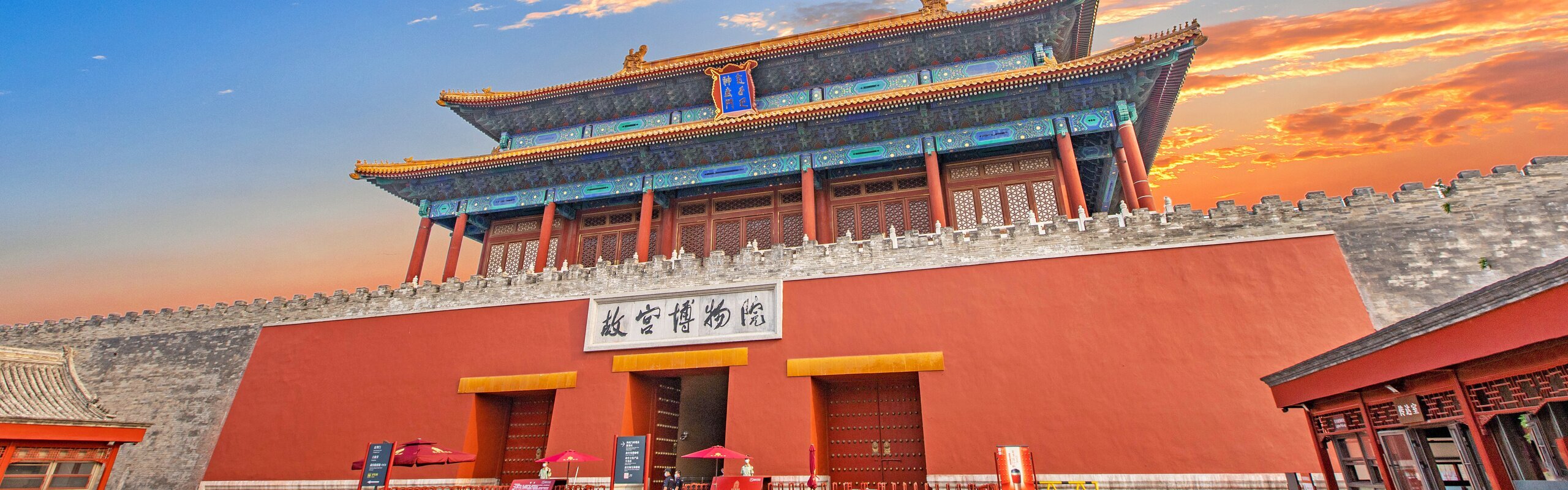

The Forbidden City (Chinese name: 故宫 Gugong 'Former Palace') was the palatial heart of China. It is an imperial palace complex of the Ming and Qing dynasties (1368–1912) in Beijing, China.
As one of the five most important palaces in the world, the grand halls and walls proudly display the essence and culmination of traditional Chinese architecture, fitting for the capital city of the world's largest nation.
Content Preview
- Forbidden City Facts
- Why Is It Called the Forbidden City
- Forbidden City History
- The Layout of the Forbidden City
- Forbidden City Architecture
- Forbidden City Collections
What Are Some Interesting Facts About the Forbidden City?
- The Forbidden City is the world's largest imperial palace, over three times larger than the Louvre Palace in France.
- It has some of the largest and best-preserved ancient wooden structures in the world.
- The Forbidden City took 14 years to build (from 1406 to 1420) and was built by over 1,000,000 workers, including more than 100,000 craftsmen.
- It was the imperial palace of China for 492 years (1420–1912) and was the home of 24 emperors — 14 of the Ming Dynasty and 10 of the Qing Dynasty.
- The Palace Museum in the Forbidden City is one of the world's largest cultural museums, hosting 14 million visitors per year.
- Exotic buildings? There are European and Arabic style buildings in the Forbidden City.
- No trees! There are no trees in the Outer Court because emperors thought they would overshadow or disrupt the majesty of the atmosphere.
- No Birds? Birds cannot land on the palace roofs, which have a special design so as to retain the cleanliness and magnificence of the Forbidden City.
- Cold Palaces? The palaces where concubines or princes who made mistakes and lost the favor of the emperor lived were called the 'Cold Palaces'.
- 9,999½ rooms? Legend has it that the Forbidden City was redesigned to have 9,999½ rooms. Half a room is missing to avoid upsetting the God of Heaven (who was believed to have 10,000 rooms in his heavenly palace).
- Higher-status palaces in the Forbidden City had more complex patterns of doors and windows.
- Fakes! The Palace Museum also (deliberately) exhibits some "fakes". These forgeries are very similar to the originals and are no less valuable.
- The emperors' routine in the Forbidden City was very regular. They usually got up at 4 a.m. and went to bed at 8 p.m. See A Day in the Life of Emperor Qianlong in the Forbidden City.
Why Is It Called the Forbidden City?
The English name "Forbidden City" is a translation of the Chinese name Zijincheng (紫禁城 /dzrr-jin-chng/ 'Purple Forbidden City').
In ancient times, the emperor was said to be a son of Heaven, and therefore Heaven's supreme power was bestowed upon him.
The emperors' residence was built leading north, as an earthly foil to the heavenly Purple Palace, i.e. the North Star, though to be home to the Celestial Emperor.
Considered a divine place, it was certainly forbidden to ordinary people and that is why the Forbidden City is so named.
Now, in China, it is usually called the "Former Palace" (故宫 Gugong /goo-gong/).
Forbidden City History
 The Forbidden City
The Forbidden City is now 601 years old [2021]. It was built from 1406 to 1420 on the orders of Zhu Di - Ming Dynasty Emperor Yongle (reign 1402–24).
Emperor Yongle was the third emperor of the Ming Dynasty. He seized the throne from his nephew.
In order to consolidate his imperial power and protect his own security, he decided to move the capital from Nanjing to Beijing, which was his fief.
Thus, Emperor Yongle ordered Kuai Xiang to design the Forbidden City in Beijing.
The Forbidden City experienced three fires, and so most of present palaces were rebuilt during the Qing Dynasty.
During the Second Opium War (1856–1860), the Forbidden City was controlled by Anglo-French forces and occupied until the end of the war.
Puyi, the last emperor, lived in the Forbidden City until he was expelled in 1924. After that, the Palace Museum in the Forbidden City was established and was opened to the public.
The Layout of the Forbidden City
The Forbidden City covers an area of about 72 hectares (180 acres) with a total floor space of approximately 150,000 square meters (1,600,000 square feet).
The Forbidden City falls into three parts: the defenses (moat and wall), the Outer Court and the Inner Court.
1. Forbidden City Gates and Walls — for Defense
Defensive Wall of the Forbidden CityFor security the Forbidden City is enclosed by a 10-meter-high defensive wall, which has a circumference of 3,430 meters.
At each corner of the Forbidden City, there stands a magnificent watchtower, which was heavily guarded.
The Meridian Gate (Wumen in Chinese) is the main gate of the Forbidden City. It had three openings. Only the emperor could go through the middle one.
It was the place where the emperor issued imperial edicts and battle orders.
The Meridian Gate is the entrance for Forbidden City visits. Visitors need to pass through Tian'anmen ('Gate of Heavenly Peace') to reach the Meridian Gate.
Meridian Gate2. The Outer Court — Used for Ceremonial Purposes
Hall of Supreme HarmonyThe outer court has three main buildings, where emperors attended grand ceremonies. In the Ming Dynasty era, emperors would hold court in Hall of Supreme Harmony to conduct state affairs.
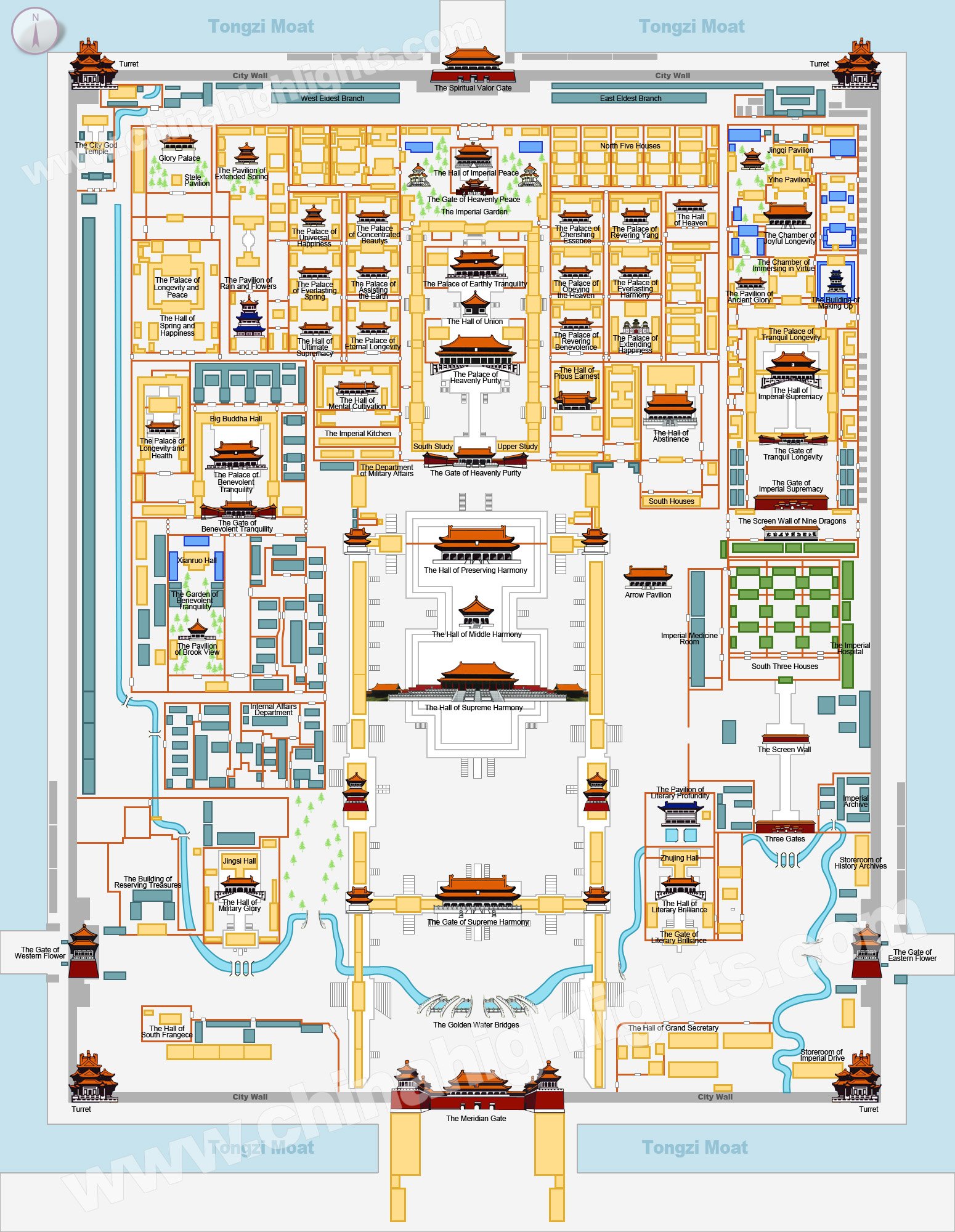 Forbidden City plan view: click to enlarge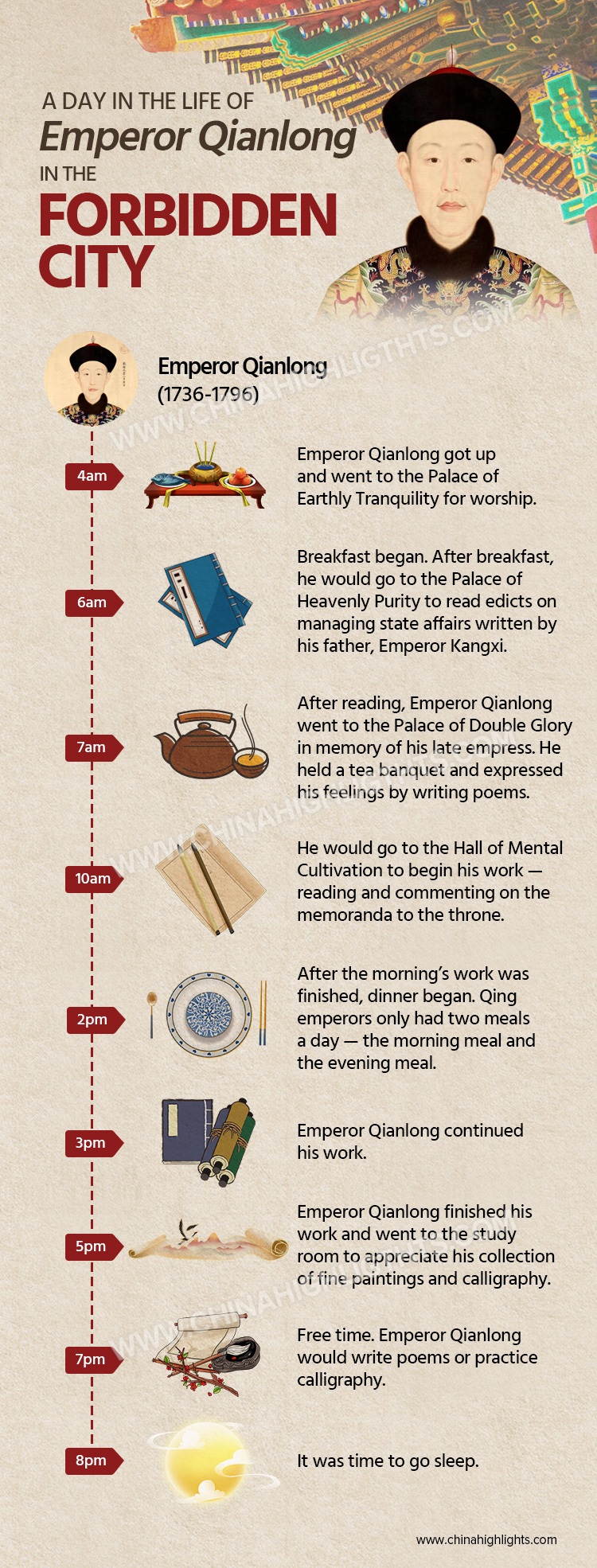
The first hall waiting for you is the Hall of Supreme Harmony (Taihedian), the most important and largest structure in the Forbidden City.
The emperors' Dragon Throne (Longyi) is in this hall. In Qing Dynasty, it was mainly used for ceremonial purposes, such as coronations, investitures, and imperial weddings.
The second hall, behind the Hall of Supreme Harmony is the Hall of Central Harmony (Zhonghedian), the resting place of the emperor before presiding over grand events held in the Hall of Supreme Harmony.
Emperors would rehearse their speeches and presentations here before departing to the Temple of Heaven for the sacrifice rites.
The last hall is the Hall of Preserving Harmony (Baohedian), used for banquets and later for imperial examinations.
There are a couple of side gardens with interesting halls to explore. Please consult with your local guide if you want to visit them and have more time to explore the palace.
3. The Inner Court — Residence of the Emperor and His Family
Palace of Heavenly PurityIn the Qing Dynasty, the emperors lived and worked mostly in the Inner Court.
Out from the Hall of the Preserving Harmony, you will notice a huge block of marble carved with cloud and dragon designs.
Go straight, and you will see another gate, called the Gate of Heavenly Purity (Qianqingmen). This is the main gateway to the inner living court.
The inner court has three main structures at the northern rear of the Forbidden City:
- The first structure inside the inner court is the Palace of Heavenly Purity (Qianqinggong). Before Emperor Yongzheng (r. 1722–35), it was the residence of the emperor. Later it became the emperor's audience hall.
- The second structure, behind it is the Palace of Union and Peace (Jiaotaidian), where the imperial seals were stored.
- The third hall is the Hall of Terrestrial Tranquility (Kunninggong). In the Ming Dynasty, it was the residence of the empress. In the Qing Dynasty, it became a shamanist worship place. It was also used on the emperor's wedding night.
Other important structures:
- Mental Cultivation Hall (Yangxindian): From the time of third Qing emperor Yongzheng, all the remaining Qing emperors, 8 in total, resided in this hall.
- Six Eastern Palaces and Six Western Palaces on either side of the three main structures were the residences of the imperial concubines. It was also where many Qing emperors were born and raised.
- The Imperial Garden is behind the Palace of Earthly Tranquility. It was a place for the emperor's family to relax and visit. The garden offers an aesthetic change — from the crimson and gray building complex to a colorful and luxuriant atmosphere.
Forbidden City Architecture
The Forbidden City is outstanding not only because of its magnitude, but also for its unique architectural design. Here are five key features.
1. Axial Symmetry and South-North Orientation
The important gates and halls of the Forbidden City were arranged symmetrically.To represent the supreme power of the emperor, given from Heaven, and the place where he lived being the center of the world, all the important gates and halls of the Forbidden City were arranged symmetrically on the north-south central axis of old Beijing.
Heaven was thought to be Polaris (the North Star), the only seemingly stationary star in the northern sky, and the Forbidden City's layout points its visitors straight at "Heaven".
If you want to explore how the central axis showcases Beijing's urban layout, you could take a cycling tour.
2. Wooden Structures without Nails
Wooden architecture in the Forbidden CityThe Forbidden City is the largest and most complete complex of ancient wooden structures in the world.
The main frames of all buildings were built with high-quality wooden beams and columns, including whole trunks of precious Phoebe zhennan wood from the jungles of southwest China.
Forbidden City carpenters used interlocking mortise and tenon joints to build its great palace buildings "harmoniously", without nails. Nails were considered violent and inharmonious.
3. The Yellow and Red Color Scheme
Red and yellow are the main Forbidden City colors.The main colors of the Forbidden City are yellow and red. The walls, pillars, doors, and windows were mostly painted in red, which is a regarded as a symbol of good fortune, and happiness in Chinese culture.
During the Ming and Qing dynasties, yellow was a symbol of supreme power and only used by the imperial family.
If you climb up to the top of "Scenery Hill" in Jingshan Park and overlook the Forbidden City, you will see an expanse of yellow glazed tile roofs.
View the entire Forbidden City from Jingshan Park4. Mystical Animal Statuettes on the Roofs
Animal Statuettes on the Roof of the Hall of Supreme HarmonyThere is a row of mystical animal statuettes placed along the ridge line of halls that were only for official use.
The animals, like dragons, phoenixes, and lions, have powerful meanings in Chinese culture.
The Hall of Supreme Harmony has 10 roof ridge statuettes — left to right: 'Series Ten' (行什, unique to this roof, an anti-thunder monkey god), dragon, phoenix, lion, sea horse, Heavenly steed, a fish dragon, a Haetae (sheep-like dragon), a lion-like dragon, and a bull-like dragon.
The number of animals is different based on the importance of the buildings. You can see 10 animals on the Hall of Supreme Harmony, the most important structure in the Forbidden City, and seven on the Palace of Earthly Tranquility, the residence of the Empress.
5. Stone/Bronze Lions
In Chinese culture, the lion is the king of the animals, and is regarded as a symbol of power and strength.
Stone lions can be seen beside the entances of many Forbidden City halls.Stone and bronze lions are popular as symbolic guardians, and can be seen beside the gates of many Forbidden City palace compounds.
The lions are always in pairs, with the female lion on the left and the male on the right.
Forbidden City Collections
Palace MuseumThe Palace Museum in the Forbidden City holds more than a million rare and valuable works of art, a sixth of the total number of cultural relics in China.
The collection includes ceramics, paintings, calligraphy, bronzes, timepieces, jade pieces, ancient books, and historical documents. Some of the valuable collections include:
- The Tomb-Sweeping Day Riverside Painting - a priceless treasure that stands out in the history of Chinese painting: the more than 500 figures in the painting each wear different styles of dress and are involved in different economic activities
- The 'Eternal Territorial Integrity' Gold Cup - the greatest treasure of the Forbidden City: it was used by emperors of the Qing Dynasty
- Lang Kiln Red-Glazed Vase — a rare red glazed porcelain vessel of extraordinary craftsmanship
The Forbidden City is a must-see attraction for visitors to Beijing. Visitors are limited to 80,000 a day. It is advisable to book well in advance.
Recommended Beijing Tours
Get more inspiration on our Beijing tours and contact us to create a trip based on your needs.