
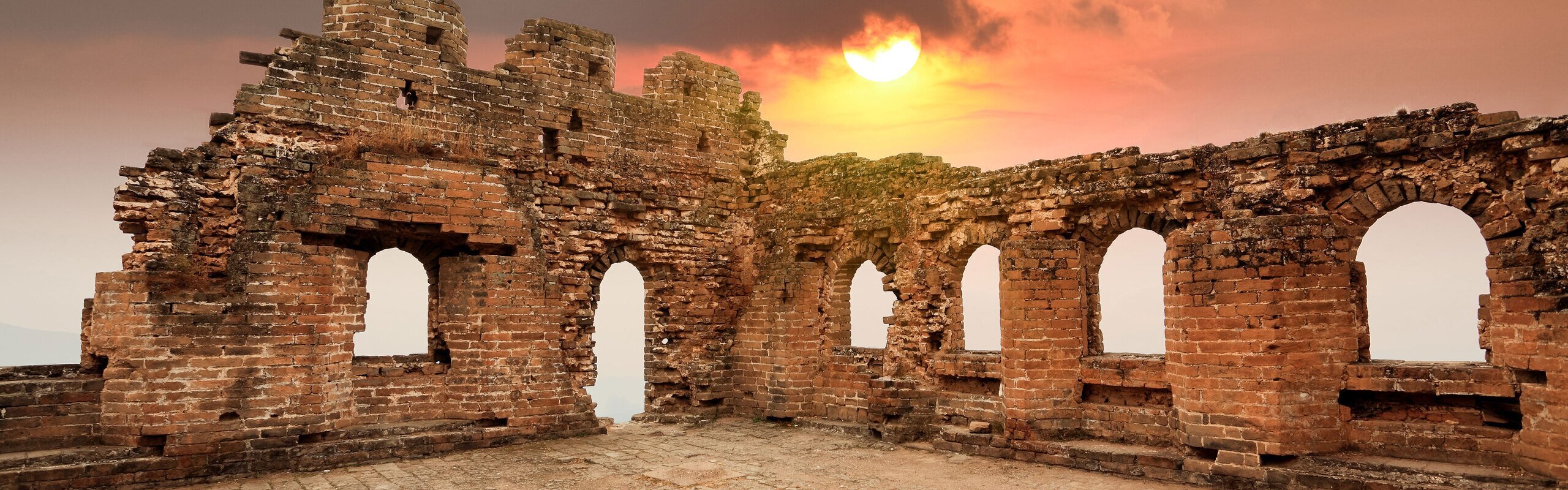

If including inter-state sections, those not protecting the northern border of China, the oldest existing section of the Great Wall of China was the Qi State "Great Wall".
It stretches for over 500 kilometers (300 miles) from the Yellow River at Jinan eastwards to the East China Sea, almost dividing Shandong Province in half.
Duke of Qi Began to Built Qi Sate Wall
During the Spring and Autumn Period (770–476 BC), state warlords began to fight one another for domination. The Five Overlords of the Spring and Autumn Period included Duke Huan of Qi (716–643 BC), who began construction of the Qi State Wall.
When It Was Built and Why

The "Great Wall" of the Qi State was initially built around 650 BC, and expended during the Warring States Period (475–221 BC).
Before the Qi State Wall was built, natural barriers, i.e. rivers and mountain ranges, formed the only defensible boundaries between territories as barriers against enemies, while some defended against opponents by using the natural mountains.
The State of Qi built its Great-Wall-esque military barrier along its southern border to prevent attacks from the State of Lu and the State of Chu.
Characteristics of the Qi State "Great Wall"
The "Great Wall" of the Qi State made use of the local topography and materials.
Walls on Plains and Small Hills
The wall was built 20–30 meters (66–98 feet) wide and 7–8 meters (23–26 feet) high on the plains and hills, using local yellow loess, clay, and sandy soil. Saltwater was applied to the soil to aid binding, and salt leaching is still visible.
Walls on Vulnerable Mountain Ridges
Stones were piled 5–7 meters (16–23 feet) high along more vulnerable mountain ridges with parapets walls both sides. These walls were filled with local soil and rocks, including granite and limestone.
Walls on Easily Defensible Mountain Ridges
Stone walls 1–2 meters (3–7 feet) high were built on open and easily defensible mountain ridges, to form a single parapet wall.
5 Famous Qi State Wall Relics
The Qi State "Great Wall" winds its way among 1,518 undulating peaks, from Yellow River to Pacific Ocean, running west to east across 19 counties of Shandong Province:
The Changqing Section of the Qi "Great Wall"
In Jinan Prefecture, the Changqing (长清) section of the Great Wall is 98 kilometers (61 miles) long and runs across 294 mountain peaks.
The Laiwu Section of the Qi "Great Wall"
In central Shandong Province, the 64-kilometer (40-mile) -long Laiwu Prefecture (莱芜市) section of the Qi State Wall started from Dongshan ('East Mountain'), north of Bamayu Village, Dawangzhuang District (大王庄镇), and proceeded east to Boshan (博山 'Ample Mountain'), running across 200 mountain peaks and 35 villages. It had many pass forts and watchtowers.
The Yongquan Section of the Qi "Great Wall"
Yongquan Qi Great Wall Ecological Scenic Area (涌泉风景区) is near Yongquan Village (涌泉村), Taihe Rural District (太河镇 ), Zichuan Urban District (淄川区), Zibo Prefecture.
'Qi Great Wall Remains Protection Park' is at the top of 'Splitting Mountain', and it boasts the most complete Qi State "Great Wall" remaining. The major attractions are the ancient remains of the Qi State Wall, 'Splitting Mountain Pass Fort', the beacon towers, 'One Line Sky', and 'Heart-Linking Bridge'.
The Yishui Section of the Qi "Great Wall"
Running across the picturesque Yishan Mountains (in Weifang "Kite City" Prefecture) and five villages and towns, the Yishui section of the Qi State Wall is 140 kilometers (87 mile) long.
It winds its way south to Yishui County (沂水县) from Taibo Peak in the Yishan Mountains. 85% of which is dotted with historical remains, including ancient castles, beacon towers, and 'General Appointing Platform'.
The Wulian Section of the Qi "Great Wall"
Mount TaiIn coastal Rizhao Prefecture, the Wulian section of the Qi State Wall was 50 kilometers (31 miles) long. It started at Hexi Reservoir, Wanghu District in the west, and ended at Wulian County (五莲县), running across Xumeng, Songbai, and Hubu villages, two rivers, and hundreds of mountain peaks along its way.
Only two sections of "Great Wall" relics remain in Rizhao after 2,300 years: Xiling in Xumeng Town and Changchengling in Songbai Village.
The sand and soil structured of the Xiling (西岭 'West Ridge') section of the Qi State Wall stretches from north to south, measuring 15 kilometers (9 miles) long, 2.5 meters (8 feet) high, 6.5 meters (21 feet) wide at the bottom, and 3.5 meters (11 feet) wide at the top.
The Changchengling (长城岭 'Great Wall Ridge') section of the Qi State Wall is 1.5 meters (5 feet) high and 6 meters (20 feet) wide at the bottom. Beacon towers of 5 meters (16 feet) high and 20 meters (66 feet) in diameter are situated on the western and eastern points.
- 1-Day Beijing Layover Tour
- 1-Day Jinshanling Great Wall Hiking Tour
- 2-Day Jinshanling Great Wall Hiking and Camping Tour
Build "the Ancient Great Wall" into Your Shandong Tour
Shandong is an interesting province. Star attractions include Mount Tai, Qufu - Confucius' home town, and enchanting coastal cities like Penglai.
Most tours won't take you to the "Great Wall" relics, but our tours are customizable! Tell us your interests and requirements and we will tailor-make a Great Wall tour for you.