
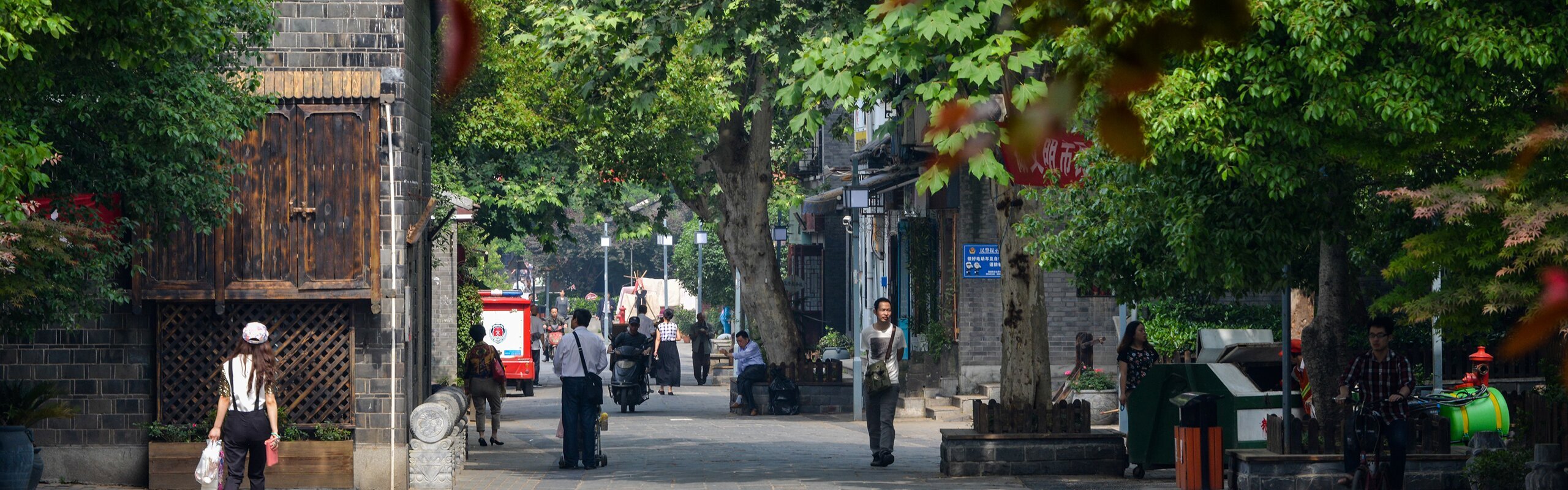

Name: Wuhan (武汉; Wǔhàn (/woo-han/))
Meaning: 'fighting Han people'
Most popularfood: re gan mian ("rrrr gan me-en," hot dry noodles)
Features
- Besides seeing the universities and a bustling Chinese city, there are some parks to visit.
- Hankou is the financial center, Hanyang is the old industrial center, and Wuchang is a university and research park district that is forging hi-tech industries.
Main Attractions
- Yellow Crane Tower, Wuhan Provincial Museum, The Guiyuan Buddhist Temple, East Lake Park, First Bridge Over the Yangtze River
- Most popular souvenirs and local products: jade sculpture, Jiangling lacquerware, and silk flowers
History

It is on the central China plain and on the Yangtze River. In the late 19th century, it was the most prosperous city in the central part of the country. Now it is a cultural and educational center and a transportation hub.
- 223 Walls were built around the town of Wuchang.
- 1911 The Wuchang Uprising occurred, and this was the beginning of the revolt to topple the Qing Empire.
- 1927 Hankou, Wuchang and Hanyang were merged to form the city of Wuhan.
- 1938 The Japanese army captured the city and made it a major military base.
Geography
- Significance of city: It is on the central China plain on the Yangtze River. It was the most prosperous city in central China in the late 19th century, and now it is known as the political, economic, financial, cultural, educational and transportation center of central China.
- Nearby cities: Jiujiang (197 km/122 mi), Nanjing (258 km/160 mi), Changsha (278 km/172 mi)
- Municipality terrain: The city is on the eastern side of the broad Jianghan Plain and the confluence of the Yangtze River and the navigable Hanshui River.
- Average altitude: 23.3 meters (76 feet)
- Main rivers: Yangtze River, Hanshui River
Location Information
- City location: 30.35N, 114.17E, in eastern China
- Municipality Population: 9,785,000
- Municipality Area: 8,494 sq km (3,279 sq mi)
- Population density: 1,152/sq km (2,984/sq mi)
Climate
- Average highest temperature in July: 33 °C (91.4 °F)
- Average lowest temperature in January: 0 °C (32 °F)
- Humid subtropical climate with four seasons; annual precipitation: 1,269 mm (50 in)
Economy
- Average annual income: ~64,000 RMB (~9,275 USD)
- Development: developing; there is rapid real estate development. Wuhan developed as a heavy industry center, but the presence of some of China's best research institutions and universities gives the city the potential to be a high technology and electronics leader.
- Industry: 49.8% tertiary industry (finance, services), 47% secondary (industry), 3.2% primary (agriculture)
- CBD: Wangjiadun District (30.59N, 114.26E) in Hankou
- Shopping streets: Jianghan Road in Hankou
Transportation
- Wuhan Tianhe International Airport is one of the busiest in the central part of the country.
- 6 bridges and 1 tunnel across the Yangtze River
- 2 major regular train stations in Hankou and Wuchang
- The Guangzhou-Wuhan High Speed train is one of the fastest in the world and can reach a speed of 394 km/h.
- A network of 4 ring roads: these are not complete rings.
- Yangtze River cruises to the Three Gorges Dam and Chongqing are available for sightseeing.
Visiting Wuhan for 6 Days Visa-Free
You can stay in Wuhan for 6 days without a visa on international transit via Wuhan Tianhe International Airport, but you can't travel outside the city area on the policy.
 (10,000+ reviews)