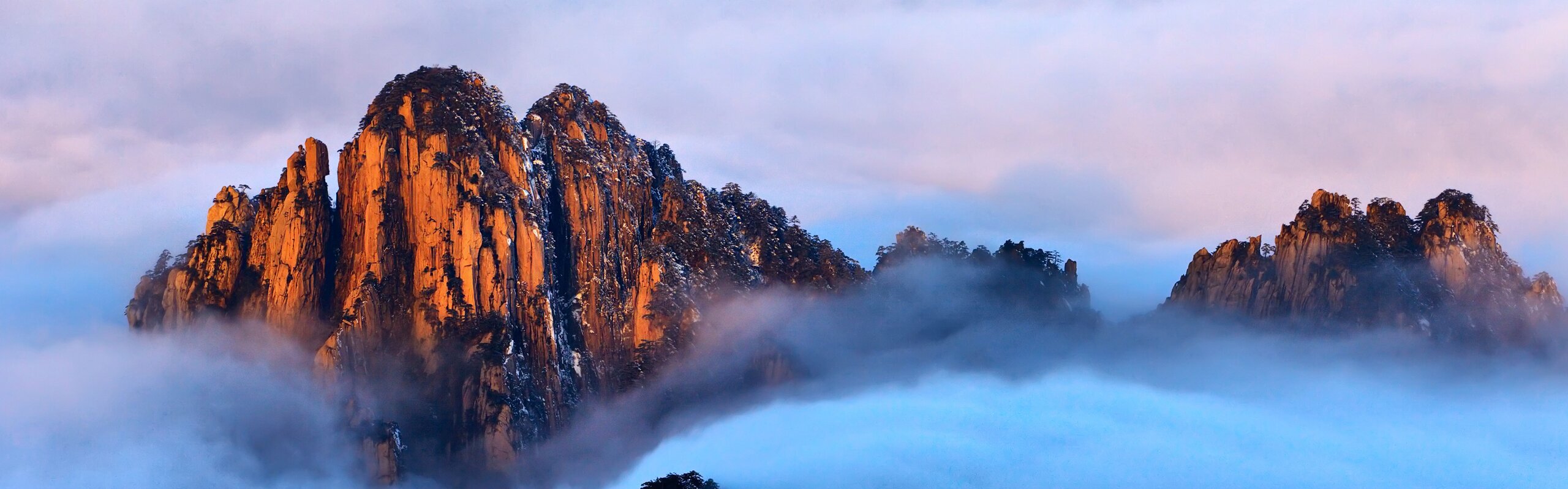

The Yellow Mountains, also called Huangshan (the Scenic Area, not the city or prefecture) is one of the most famous and beautiful mountainous areas in China. It was listed as a World Heritage Site by UNESCO in 1990. Its spectacular natural scenery includes oddly-shaped pines and rocks and mystical seas of cloud.
- Chinese: 黄山 Huángshān /hwung-shan/; huang means 'yellow' and shan means 'mountain(s)'
- Entrance fee: CN¥190/US$30
- Things to do: Enjoy hot springs, photography, and hiking
- Must sees: peculiar pines and rocks, seas of cloud, hot springs, sunrises and sunsets
- Suggested visit: 2 days
- Location: about 50 km (30 miles) north of Huangshan City, Eastern China.
- Transport: Bullet trains from Hangzhou (1½ hours) and Shanghai (2½ hours).
- Highest peak: 1,864 meters / 6,116 feet
Content Preview
- The Yellow Mountains Get Their Name from the Yellow Emperor
- Highlights That Brighten Your Visit
- How to Visit the Yellow Mountains
- How to Get to the Yellow Mountains
- Best Times to Visit the Yellow Mountains
- Travel Tips
- Where to Stay on the Mountains
 Our clients are visiting Yellow Mountains.
The Yellow Mountains Get Their Name from the Yellow Emperor
The Yellow Mountains are not so called because the mountains are yellow, but because the area was renamed after the legendary Yellow Emperor (Huang Di) in 747 AD. It is said that the Yellow Emperor, the mythical ancestor of the Chinese, lived, refined precious medicines, and became a supernatural being on the Yellow Mountains .
After that Huangshan began its ascent to fame. Many Buddhist temples have been built and, more recently, it has become a popular attraction for its majestic scenery.
Huangshan City, about an hour from the Yellow Mountains (the Huangshan Mountains), and Huangshan Prefecture in which the mountains are located, get their name from the fame of the Yellow Mountains.
Highlights That Brighten Your Visit
Greeting Guest Pine on the Yellow Mountains.Outstanding natural beauty is Huangshan's number one feature. The Yellow Mountains' classic attractions are known as its "Four Natural Wonders":
- Imaginatively-named pines
- Oddly-shaped rocks
- Seas of cloud
- Hot springs
Xu Xiake, a noted Chinese geologist in the Ming Dynasty (1368–1644), who visited the Yellow Mountains twice, left his praise in this quote:
"You don't need to see any more mountains after seeing 'the Five Mountains', and you don't need to see the other four mountains after seeing Huangshan."
Explore all the highlights with 3-Day Ancient Villages and Yellow Mountain Tour >>>
Imaginatively-Named Pines
Yellow Mountain pines are particularly hardy, seeming to twist directly out of the smooth rock. Many old pines have been named according to their appearance or some legend about them.
Greeting Guest Pine is the most famous pine in the Yellow Mountains, and doubtless in all of China. It is located on the east side of Jade Screen Peak, by Wenshu Cave. The 10-meter-high (33-foot-high) tree grows like a man standing by the path and stretching out his hand to guests in a greeting gesture. Many Chinese hang a poster of Greeting Guest Pine in their living rooms and restaurants as a decoration.
Oddly-Shaped Rocks
Flying-Over Rock on the Yellow MountainsLikewise, the oddly-shaped rocks of the Yellow Mountains get their names not only from appearance but also from legend. Each rock's name has a story, which gives the rock "life".
Flying-Over Rock is one of the most famous boulders in the Yellow Mountains. The 12-meter- (39-foot-) high rock leans like javelin flown-in on a huge rock ledge. The contact area is very small which makes it more amazing.
Read more about the oddly-shaped rocks of the Yellow Mountains.
Seas of Cloud: Frequently Seen Between November and May
The seas of cloud on the Yellow MountainsThe seas of cloud have contributed much to the ethereal atmosphere of the Yellow Mountains, making peaks look like islands in the sky. The best time to appreciate this phenomenon is from November to May, especially after rainy/snowy days, at sunrise or sunset.
There are hundreds of peaks and thousands of ravines in the Yellow Mountains, but five seas of cloud are named: North Sea, South Sea, East Sea, West Sea, and the Heavenly Sea (in the middle). Celestial Capital Peak (1,800 m / 5,900 ft), Lotus Peak (1,873 m / 6,145 ft), and Bright Top (1,841 m / 6,040 ft) are the three tallest peaks, and best locations to see the stunning seas of cloud.
Buddha's Light — a Rarely Seen Extra Wonder
Buddha's Light is an optical phenomenon like a halo surrounding the observer's shadow, once thought to show the observer's enlightenment. It only can be seen when the observer is between the sun and a cloud, which is around 40 times a year. You have to visit the mountain on a sunny day and get above a sea of cloud. Buddha's Light is most likely to appear between 3 PM and 4 PM at Jade Screen Peak, Celestial Capital Peak, and White Goose Ridge.
Awe-Inspiring Sunrises and Sunsets
We helped with our clients' proposal at sunset on the Yellow Mountains.Watching sunrise and sunset is a very popular and highly recommended Yellow Mountains activity. The glow of the sunrise and sunset draws the shutterbugs to popular viewing spots for amazing colors on the fascinating landscape. For the best shots, you can visit Bright Top Peak for sunrise and Dispelling Cloud Pavilion for sunset.
Stunning sunsets and sunrises always are the best settings for memorable moments of honeymoon, anniversary, or birthday! Traveling with China Highlights, create your special and unforgettable journey.
Stay on the mountains to have the best chance to enjoy these spectacular views. Hotels on the mountains are harder to book, especially in peak season. Book at least one month in advance.
Hot Springs: a Bonus for a Winter Visit
Enjoy a hot spring after hiking on the Yellow Mountains in winter.At the foot of the Yellow Mountains, you can find some famous hot spring hotels, on whose grounds are the hot springs. In the cold of winter, relax your muscles and warm your body in a hot spring after a day's hiking.
Hot springs not only relax you from the tiredness of climbing, but also have the function of healing and restoration. It is said that Huang Di (the Yellow Emperor) bathed in the hot spring and became younger. So, the springs are also called the Springs of Youth.
How to Visit the Yellow Mountains
The mountain area is usually divided into three parts: Front Mountains (Jade Screen Scenic Area and Heavenly Sea Scenic Area ), Back Mountains (North Sea Scenic Area and Songgu Valley), and the West Sea Grand Canyon (West Sea Scenic Area ).
For a one-day trip plan, you can choose one of the three parts to explore via round-way cable car to admire its wonders.
To enjoy more highlights at a comfortable pace as well as watching a sunset and sunrise, an overnight stay on the mountains is recommended. Back Mountain or the West Sea Grand Canyon are suggested for 1 day of a 2-day trip.
To hike around the three parts, 3 days are recommended.
The Front Mountains: the Tallest Peaks, Sheer and Rugged Beauty
Our clients are hiking to the Celestial Capital Peak.- Highlights: Greeting Guest Pine, Jade Screen Peak, Celestial Capital Peak, Lotus Peak, Bright Top Peak
- Closest cable car: Yuping cable car, CN¥90 (US$14), 15 minutes
You should meet Greeting Guest Pine, which appears on many many paintings. You will also have the chance to climb the tallest peaks if they're open. (Don't if you are afraid of heights and steepness.) Bright Top Peak offers a perfect view of sunset, sunrise, and seas of cloud, with an easier ascent.
The Back Mountains: Friendly to Kids and Seniors, Most Highlights with Least Walking
Stone Monkey Watching the Sea- Highlights: Beginning-to-Believe Peak, Refreshing Terrace, Lion Peak, Stone Monkey Watching the Sea
- Closest cable car: Yungu cable car, CN¥80 (US$13), 8 minutes
Back Mountain is an ideal place to admire most of the imaginatively-named pines. For a photo tour, Back Mountain is not to be missed for the sunrise. You can get the best shots at Refreshing Terrace, Lion Peak, and Stone Monkey Watching the Sea.
West Sea Grand Canyon: Challenging but Less Crowded
Steep steps lead to the bottom of the West Sea Grand Canyon.- Highlights: 1st Ring, 2nd Ring, Fairy-Walking Bridge, Flying-Over Stone
- Closest cable car: Taiping Telpher CN¥90 (US$14), 8 minutes, Asia's longest telpher at 3,709 m (2.3 miles) long
Known for dream-like scenery, West Sea Grand Canyon hides its beauty at the bottom. Sharply dropping hundreds of meters, the thrilling and rugged trails make it challenging. Fewer people descend due to its hiking difficulty. Thus, you can enjoy the landscape in relative tranquility.
To get to the bottom, it's down stone steps all the way, and some sections are very narrow and steep (nearly 70 degrees!). Therefore, hiking in West Sea Grand Canyon can be a big challenge, especially to your knees.
West Sea Grand Canyon is usually closed from December to April because of snow and maintenance.
A Classic 2-Day Yellow Mountains Tour
Watching Sunrises at the Yellow Mountains.Staying overnight near the mountain tops allows a more relaxing pace and enough time to admire stunning a sunrise and sunset. Cable cars are beneficial to save time and energy, since there are an estimated 60,000 steps to the main highlights.
Day 1: Go up to the mountain and visit West Sea Grand Canyon.
- Take Yungu Cable Car to the top of the mountain.
- Walk for about 30 minutes to your hotel.
- After lunch, hike down to the bottom of theWest Sea Grand Canyon.
- Watch the sunset at Cloud-Dispelling Pavilion or Bright Top Peak.
3 routes are recommended for West Sea Grand Canyon:
- 1½ hours: The 1st Ring only, then hike back via the same way
- 2½ hours: The 1st Ring and the 2nd Ring, then hike back via the same way
- 2 hours: Visit the right side of the 1st Ring and the left side of the 2nd Ring for better scenery, then take The West Grand Canyon Monorail to Tianhai Station from the bottom of the canyon to the top.
Recommended accommodation: Shilin Hotel (4-star) / Xihai Hotel (5-star) / Huangshan Paiyun Hotel (5-star)
Day 2: Beihai Scenic Area, descend from the mountains
- Enjoy the sunrise at Refreshing Terrace.
- See Black Tiger Pine and Dream Flower Pine
- Take the Yungu cable car down from the mountain
3-Day Trekking in the Yellow Mountains
Yellow Mountains Trekking MapHiking up offers more views and fun for energetic people. To save energy and time, we always suggest Yungu ('Cloud Valley') Temple up and Ciguang Ge (Benevolent Light Pavilion') down. You can visit all the highlights with less walking. Besides, you can reach Huangshan City with the least time (one hour), compared with the other two entrances. You can choose the opposite direction, but it will be more challenging.
Day 1: Hike up the Yellow Mountains from Yungu Temple (about 5 hours)
Length: about 10.5 kilometers (6.5 miles)
- Start your trek from Yungu Temple
- Pass several peculiarly-shaped rocks including Stone Table and Immortal Pointing the Way.
- Arrive at White Goose Ridge.
- After lunch, see Beginning-to-Believe Peak, Flower Peak, and Stone Monkey Watching the Sea
tips: Yungu Cable Car to White Goose Ridge is an option to save time and strength.
Accommodation: Shilin Hotel (4-star) / Xihai Hotel (5-star) / Huangshan Paiyun Hotel (5-star)
Day 2: Trek in the West Sea Grand Canyon (about 6 hours)
Length: 12.5 kilometers (7.8 miles)
- Watch the sunrise at Refreshing Terrace.
- Hike to Cloud-Dispelling Pavilion.
- Trek down into West Sea Grand Canyon. Hike the essential parts — the 1st Ring, 2nd Ring, Bottom, Plank Way, and Fairy-Walking Bridge.
Tips: Take a packed lunch, as there are no restaurants at the bottom of West Sea Grand Canyon.
Accommodation: Baiyun Hotel (4-star).
Day 3: Hike Down the Yellow Mountains after Visiting Guest-Welcoming Pine (about 6 hours)
Length: 12 kilometers (7.5 miles)
- Watch the sunrise at Bright Top.
- Hike to One Hundred Ladders (one hour).
- Then hike to Jade Screen Pavilion to see the famous Greeting-Guests Pine.
- Culminate by trekking up the steepest peak, Celestial Capital Peak (about 2 hours).
- Trek down to the shuttle bus park at Ciguang Ge (approximately 3 hours).
- Leave for the station or the airport for your next destination.
Tips: The Yuping Cable Car to Ciguang Ge is optional to save time and strength.
Learn details of the full itinerary here. We can also customize these itineraries per your interests and schedule.
How to Get to the Yellow Mountains
The usual way to get to the mountains is to first go to Huangshan City, then connect with an hour transfer by road to Huangshan Scenic Area.
To reach Huangshan City, you can choose bullet trains from Hangzhou (1½ hours), Shanghai (2½ hours), Suzhou (3 hours), or Beijing (6½ hours). Or you can choose flights from Beijing, Xi'an, Chengdu, Guangzhou, Shenzhen, Guilin, or Kunming.
Upon arriving in Huangshan City, you can take the direct bus from airport or train station. However, the direct buses don't leave as schedule. You might need to wait until almost all seats are sold out. Contact us for a private transfer, which is less hassle and more efficient for a weekend trip.
See Huangshan Transport.
Best Times to Visit the Yellow Mountains
Huangshan is worth visiting all year round, particularly in spring (late March to May) and autumn (September to mid-November) for the most comfortable weather.
Spring (Late March to May): Comfortable Weather, the Flower Season
Spring Flowers on the Yellow MountainsTemperature averages: 5°C (41°F) to 15°C (60°F)
In spring, leaves are fresh with verdancy. Blossoming azalea flowers decorate the mountains. Hiking on the mountain tops, you are likely to encounter seas of cloud. And breezes make the hike more comfortable.
Summer (June to September): Retreat from the Heat
Visting the Yellow Mountain in SummerTemperature averages: 13°C (55°F) to 20°C (68°F)
Thanks to their altitude, the Yellow Mountains are a wonderful summer retreat in a sea of green. Summer is also the rainy season and the air is at its clearest post rain. After the rain, the peaks are surrounded with mist, creating dream-like scenery. But the long queues and difficulty to book a mountain hotel make it less attractive. Contact us in advance to get a room.
Autumn (October to November): Clear Skies and Red Leaves
Colorful leaves enlighten the Yellow Mountains.Temperature averages: 4°C (39°F) to 12°C (55°F)
Autumn always spoils Yellow Mountain visitors: it's a good season to climb mountains, with less rain and pleasant weather. Plus, the clear skies and red leaves bless the Yellow Mountains with awesome vistas.
Winter (December to mid-March): Snowy Scenery
Snowy Scenery on the Yellow MountainsTemperature averages: -6°C (21°F) to 3°C (37°F)
Though the Yellow Mountains are cold, they are still worth visiting. You can see snow-capped mountains and rime-covered trees if you're lucky enough to meet snowy weather. Both the entrance fees and hotels are discounted, and you can enjoy a virtually crowd-free trip in winter.
See more on Huangshan Weather.
Travel Tips
Travel light! You're highly suggested to take a small backpack for your overnight stay on the mountain. Your cases can be stored at the foot of the mountains at the cost around CN¥20 (US$4) each.
What to pack:
- walking poles (if you use them)
- sunscreen
- mosquito repellent
- enough warm clothes (it's several degrees colder at altitude), layers of clothes are practical for taking on and off when climbing the mountain.
- waterproofs
- wear trekking shoes/boots with a good grip
You're suggested to keep away from monkeys on the mountain. Don't bring out food in front of them.
Sedan chairs are available on the higher mountain paths, usually from CN¥150 (US$24) per km. Make an appointment at least one week in advance to ensure their availability. It is rarely possible to get a sedan chair half way up.
During the low season, from November to January, the three cable cars will take turns to stop operating for annual maintenance. Contact us for updated news on that and more.
Where to Stay on the Mountains
Room of Beihai HotelThe room rates for hotels on the mountains are usually higher than those in the cities and they have more basic facilities. For example, the condition of a "4-star" hotel on the Yellow Mountains is similar to that of a 2–3-star hotel in Shanghai. For environmental protection (to save bringing them up the mountains and rubbish down), no toiletry kits are provided, but you can buy them.
Every item on the mountains is carried up by porters (or cable cars), thus you can expect much higher prices. For example, a 500 ml bottle of water costs CN¥10 (US$1.50), and a simple meal costs CN¥150 (US$23) per person.
Most people stay at the Back Mountains for weekend (2-day) trips, while hikers might stay at the Front Mountains for a trekking tour. Therefore, our suggested hotels are listed by location:
The Back Mountains
Beihai Hotel is currently under reconstruction.
Shilin Hotel (3–4-star): a photography theme hotel, from US$98
- Suitable for those who have a limited budget
- 25 minutes' walking from Yungu Cable Way
- 10 minutes' walking from Refreshing Terrace (best spot to see sunrises)
Xihai Hotel (4–5-star): better service than Shilin Hotel, lower price than Paiyun Hotel, from US$113
- 15 minutes' walking from Taiping Telpher
- 40 minutes' walking from Yungu cable car
Huangshan Paiyun Hotel (5-star): best facilities on the mountain top, from US$164
- Suitable for those who have high requirements for hotel
- 10 minutes' walking from Taiping Telpher
- 45 minutes' walking from Yungu Cable Way
- Redecorated in 2020 and reopened in 2021
The Front Mountains
Yupinglou Hotel (3-star): not recommended, from US$98
- Right by Yuping Cable Car Station
- Inconvenient for most highlights
- Old-fashioned rooms with lower service standards
Baiyun Hotel (4-star): from US$112
- the closest hotel to Bright Top Peak (best place to see sunrises, sunsets, and seas of cloud)
Room rates go up steeply on weekends, public holidays, and student summer holiday (July to August). With limited hotel choices, just contact us to book your hotel at least one month before!
Touring the Yellow Mountains with China Highlights
China Highlights aims to provide you with the best travel service possible. Contact us and will try our best to get over any difficulties you encounter while planning your time in Huangshan.
See our popular tours below for inspiration:
- 3-Day Essence of Huangshan Tour: See the highlights of the Yellow Mountains and ancient villages.
- 4-Day Trekking in the Yellow Mountains: Hike down less-traveled paths to appreciate undisturbed beauty away from the tourists.
- 3-Day Escape to Huangshan from Shanghai or Hangzhou: Start your journey in Shanghai or Hangzhou to enjoy Huangshan highlights.
- See more Huangshan Spotlight Experiences and Huangshan tours.
See the best of the Yellow Mountains and wander around picturesque Hongcun village and Tunxi Ancient Street, for a scenic and historical tour. Our tours can be customized. Just tell us your interests and requirements and we will tailor make your own Yellow Mountains tour.