
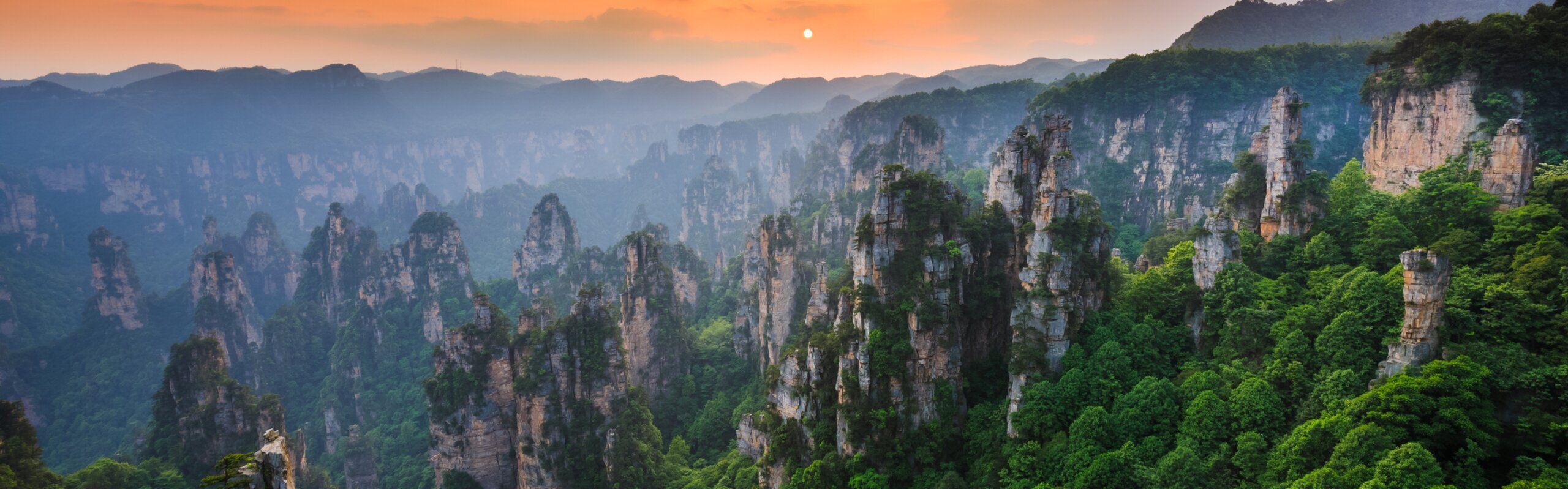

China is home to some of the world's most dramatic mountain landscapes — from snow-capped peaks to alpine valleys. But with so many famous mountains, deciding which ones are truly worth your time can be overwhelming.
Instead of trying to see everything, this guide helps you focus on the mountains that match your interests, fitness level, and travel timeline.
1. Tianmen Mountain: Most Unusual
 Tianmen Mountain
Tianmen Mountain may not be the most famous mountain in China, but it's easily one of the most distinctive. Its highlight is Tianmen Cave — a huge natural arch high on the cliff, reached by climbing the iconic 999 stone steps.
Beyond the scenery, Tianmen Mountain offers plenty of adrenaline-filled experiences. You can ride the world's longest high-altitude cable car, wind through 99 sharp bends, and walk along a glass skywalk clinging to the cliff edge.
Tianmen Mountain's cable carCompared with other mountains, Tianmen Mountain is less about hiking and more about experience, making it a great choice for all ages with minimal physical effort.
There's more to Zhangjiajie than just its mountains. Tianmen Mountain is a great starting point for a longer route. From here, you can join our 8-Day Zhangjiajie, Furong, Fenghuang, and Shanghai Tour to Furong and Fenghuang Ancient Towns, blending iconic peaks with charming old towns.
2. Avatar Mountains: Most Iconic
The floating mountains in Avatar were inspired by Qiankun Pillar in Yuanjiajie, inside Zhangjiajie National Forest Park. These towering sandstone pillars rising into the clouds are among the park's most iconic sights.
Avatar Mountains: Qiankun Pillar in YuanjiajieYou can reach the main viewpoint by taking the Bailong Elevator. It is the world's tallest outdoor sightseeing elevator, and the view opens up all at once when you reach the top.
Bailong Elevator in ZhangjiajieThe park is much larger than Yuanjiajie alone. Beyond well-known areas like Tianzi Mountain and Golden Whip Stream, there are quieter places many visitors miss, such as Aerial Farmland, a rare mountaintop field still farmed by local families.
Aerial FarmlandExploring on your own often means a lot of unnecessary walking. On our 4-Day Zhangjiajie Tour, routes are planned more efficiently by a local guide — less walking, the same scenery. And if you're curious, we can also include hidden spots that most group tours don't reach.
Our clients in Zhangjiajie3. Fanjing Mountain: Most Surreal
People come to Mount Fanjing for one main reason: the visual impact. Seeing Red Clouds Golden Summit, often called the "Sky City," along with the surreal Mushroom Stone, feels like witnessing something that doesn't quite belong to this planet.
Mushroom Stone in Fanjing MountainMount Fanjing is covered by mist and clouds for more than 200 days a year. That said, weather matters here. If you want clearer views, the best windows are from April to June and from September to October.
The climb to Red Clouds Golden Summit is part of the experience. You move through clouds, changing light, and sometimes even a Buddhist halo. It's beautiful, but it's not easy.
Red Clouds Golden SummitThe whole climb takes about an hour and requires climbing steep steps with chains, using both hands and feet. Because of this, we don't recommend it for children under eight or visitors with limited mobility.
4. Mount Everest: Most Challenging
Mount EverestIf you enjoy adventure, Mount Everest deserves a place on your list. Seeing the "Roof of the World" with your own eyes is a powerful experience.
At the world's highest monastery, you'll see monks turning ancient prayer wheels and feel the quiet power of faith.
Mount Everest lies between Nepal and China, but from the China side, reaching Everest Base Camp is accessible by car. This is the highest point you can reach without trekking and one of the best places to view the mountain.
Stay overnight, and you may witness sunrise turning Everest's summit gold. See our 8-Day Lhasa to Everest Base Camp Private Tour.
For those seeking a deeper challenge, we could take you to follow the rhythm of local pilgrims, trekking step by step toward Everest Base Camp.
5. Huashan Mountain: Most Thrilling
Huashan MountainIts legendary plank walk is where that reputation comes from, and it's the biggest draw. Secured by a safety harness, you would move along narrow wooden boards bolted to sheer cliffs, sometimes no wider than half a foot.
Huashan is also closely tied to Chinese wuxia culture. With its sharp, blade-like ridges, it's often imagined as the ultimate battleground in martial arts stories, a place of solitude, resolve, and final duels.
At the same time, it's a sacred Taoist mountain, dotted with quiet, ancient temples along the trails.
Huashan lies roughly 2 hours from Xi'an, perfect for a day trip. For a fuller experience, consider our 7-Day Xi'an Winter Tour with Hukou Waterfall and Hot Spring. The route extends to Hukou Waterfall, pairing mountain adventure with a spectacular waterfall visit.
6. Huangshan Mountain: Most Poetic
Our clients in Huangshan MountainIf you ask me which mountain best represents the highest form of Chinese landscape aesthetics, I believe most Chinese people would give the same answer: Huangshan. And I agree.
Huangshan gathers everything imagined in classical Chinese landscape paintings into one place — twisted pine trees, dramatic granite peaks, rolling seas of clouds, hot springs, and winter snow.
You don't need to understand Chinese culture to appreciate Huangshan.
Stand on its peaks, and you'll instinctively understand what Chinese people mean by "fairyland" and "artistic conception".
To see Huangshan at its best, I recommend staying overnight on the mountain. Only then can you catch both sunrise and sunset — the moments when Huangshan quietly shows its true character.
At the foot of the mountain, don't miss Hongcun and Xidi — two charming villages where traditional Anhui architecture, serene waterways, and local culture make for a perfect stop after exploring the peaks. Personally, I prefer Xidi; it's quieter, more rustic, and far less commercialized.
Xidi VillageIf you're interested, Huangshan is included in our 7-Day Huangshan, Shanghai & Hangzhou journey, which connects the region's landscapes with its art, architecture, and everyday life.
7. Jade Dragon Snow Mountain: Most Unique Setting
The summit of Jade Dragon Snow MountainIf you're drawn to snow mountains but don't want a remote, high-effort journey, Jade Dragon (Yulong) Snow Mountain is hard to beat.
Snow peaks usually sit far from everyday life. Yulong is different. Here, a snow-capped mountain rises right behind a living old town. Lijiang Old Town lies at its foot. Clear blue alpine lakes sit nearby. Snow mountain, ancient town, and blue water — all in one view. It's a rare combination you don't see often.
Blue Moon ValleyIt's not as extreme as Everest. You don't need to push your limits.
Yulong is friendly and easy to visit. You can stay lower at Blue Moon Valley or Spruce Meadow if altitude is a concern. Even the Glacier Park is reached by cable car.
If you want something different, our route starts from Yuhu Village. No cable car. No crowds. We take you to a quieter side of the mountain.
Hiking: another way ro explore a different side of Jade Dragon Snow MountainIf you don't want to choose between snow mountains and iconic landscapes, our 12-Day Best Yunnan and Zhangjiajie Tour lets you experience both in one trip.
How to Plan a China Nature Tour
If you want a big-picture view of China's natural landscapes, a longer route works best. One classic east-to-west journey could look like this:
- Day 1-2: Shanghai arrival
- Day 3-5: Huangshan (Mount Huangshan)
- Day 6-8: Zhangjiajie (Tianmen Mountain and Zhangjiajie Forest Park)
- Day 9-15: Guizhou (Fanjing Mountain)
- Day 16-24: Yunnan (Jade Dragon Snow Mountain)
- Day 25-31: Tibet (Mount Everest)
- Day 32-35: Xi'an (Mount Hua)
- Day 36-40: Beijing departure
It's a long but rewarding journey. You'll experience mountains, karst scenery, high plateaus, and China's cultural heartlands in one continuous trip.
If your time is limited, shorter combinations work just as well. Many travelers choose our 14-Day First-Time China Nature Tour, which balances major highlights with a comfortable pace, or the 21-Day Chinese History and Natural Wonders Tour.
Of course, China's nature goes far beyond this list. Mountains like Mount Tai or Wuyi Mountain offer very different experiences. Just tell us what you're interested in, and we'll help design an itinerary that fits the way you want to travel.