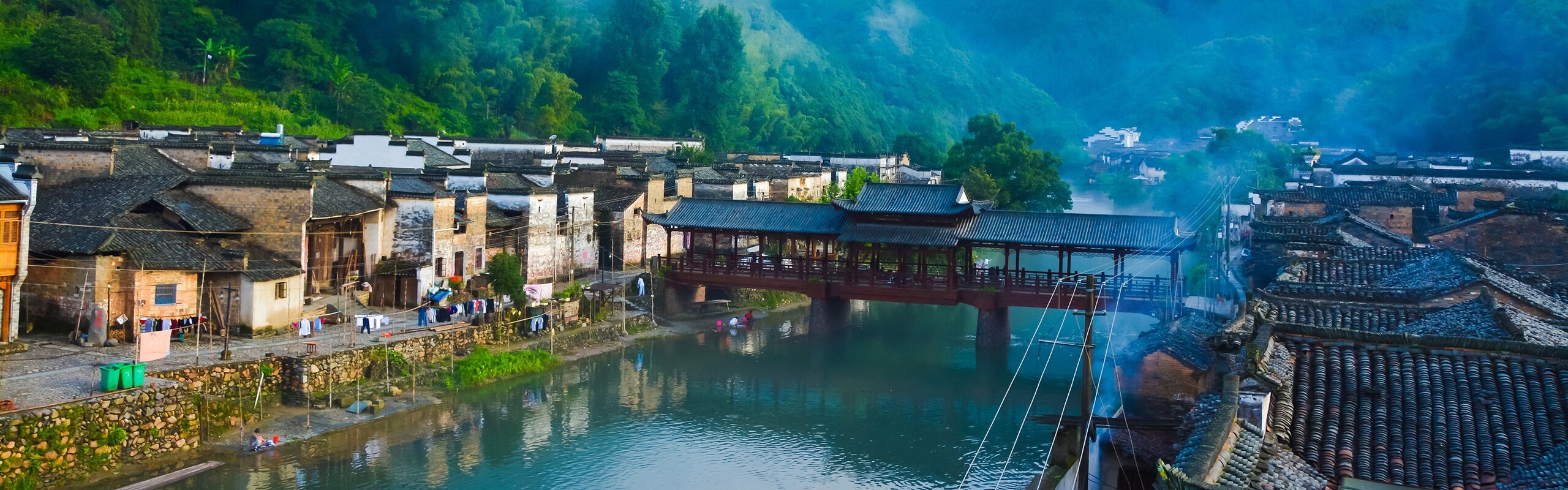

Jingdezhen (/jing-der-jnn/), originally called Changnan, is in northeast Jiangxi Province, about 1½ hours from Huangshan and 4½ hours from Shanghai by bullet train.
In China, when we mention Jingdezhen, we always think of porcelain. Jingdezhen has become a symbol of ceramics. Starting from the Han Dynasty, the history of Jingdezhen's pottery porcelain making has lasted 2,000 years, and today all kinds of porcelains are still being exported to the world from Jingdezhen. Jingdezhen is a veritable porcelain capital in China, even in the world.
 Night view of Ceramic Art Avenue
Jingdezhen Porcelain — Why It's Famous
Jingdezhen has been playing an important part in Chinese porcelain production for millennia, and Jingdezhen porcelain is the most famous type of Chinese porcelain. It can be used for tableware such as tea sets, bowls, utensils and for furnishings such as Jingdezhen decorative plates and vases.
The History of Jingdezhen Porcelain
Historical records tell of Jingdezhen (then called Xinping) making porcelain in the Han Dynasty (206 BC – 220 AD), while archaeological excavations have shown evidence of Jingdezhen firing porcelain in the Eastern Jin Dynasty (265–420). Jingdezhen Porcelain developed rapidly in the Song and Yuan dynasties (960–1368), and a series of imperial factories was set up in Zhushan (a district of Jingdezhen) during the Ming and Qing dynasties (1368–1912), making Jingdezhen the nation's porcelain center.
Jingdezhen porcelain is characterized by its beautiful shapes, various varieties, rich decorations, and unique styles. It is quite famous for its white porcelain, which is known for being 'white as jade, bright as a mirror, thin as paper, and sounding like a rock'.
Jingdezhen Porcelain MakingRegarding Chinese porcelain's glaze, blue was traditionally taken as the most precious color. During the Northern Song Dynasty (960–1127), Jingdezhen kilns imitated the tone and moist texture of blue and white jade, and creatively fired a kind of qingbai ware ('blue-white' ware). The production of blue-white ware made Jingdezhen Porcelain particular important and famous at home and abroad.
Jingdezhen kilns in the expanded Yuan Dynasty (1279–1368) empire rose rapidly on the basis of their production of blue and white glaze in the Song Dynasty. The most remarkable achievement was the creation and firing of mature blue and white porcelain (qinghua ci).
The Ming Dynasty (1368–1644) was the golden age for the development of blue and white porcelain, and it occupied a prominent position in the history of Chinese ceramics. Because of its more mature technology, more diverse patterns and richer colors, Ming porcelain is most valuable in art collections.
Jingdezhen CeramicsTop Things to Do in Jingdezhen
- Explore the world's oldest porcelain production line in Ancient Kiln Folklore Exhibition Area.
- Listen to commentary during a unique porcelain making performance.
- Try it yourself and make a ceramic work that is uniquely yours.
- Wander around in various porcelain markets.
- Encounter a potter in a pristine mountain village (Sanbao International Ceramic Art Village).
- Visit the hometown of porcelain — Yaoli Ancient Town.
See our recommended 3-day Jingdezhen Porcelain Tour. Or contact us directly for more about Jingdezhen tours.
Jingdezhen Ancient Kiln Folk Custom Expo areaExtend a Jingdezhen Trip
If you are considering extending a Jingdezhen trip, Wuyuan, the Yellow Mountains, and Mount Lu should not be missed.
Wuyuan is about 41 km (25 mi) east of Jingdezhen, and it has been praised as "the most beautiful village in China". Wuyuan features the best preserved ancient Hui buildings, and spring (March to April) is the best season for viewing canola blossoms there. 2 full days in Wuyuan is suggested.
Drive for another 3 hours northeast and you will reach Huangshan, which is famous for Yellow Mountain Scenic Area, Hongcun Village, and many other attractions. Listed as a World Heritage Site by UNESCO in 1990, the Yellow Mountains is one of the most famous and beautiful mountainous areas in China. The ancient villages around will bring you back to the elegant China of hundreds of years ago. See more on Huangshan Tours.
Drive west from Jingdezhen for about 3 hours and Lushan National Park will be yours to explore. Mount Lu is one of the most renowned mountains in China, famous for its majestic, surprising, steep, and beautiful landscape. It is a good place to hike and view nature in the southeast of China.
Check out our Jingdezhen area tours for some inspiration or contact us directly for a customized tour.
Jingdezhen and AroundJingdezhen Weather and Best Times to Go
Jingdezhen has a subtropical monsoon climate, with hot summers, abundant rainfall, generally mild and humid conditions, and four distinct seasons.
The urban area of Jingdezhen is in a basin, and the range of daily average temperatures for a year is 3–34°C (37–93°F): winters are relatively mild and summers relatively sweltering.
Jingdezhen can be visited all year around, and normally autumn (September to October) is the best travel season, when the average daily temperature is 13–26°C (56–78°F) and it's less rainy. In addition, the annual "Jingdezhen International Ceramic Fair" is held in October, when you can enjoy the true charm of this porcelain capital. Contact us for more about the ceramic fair.
Spring (March to May) is a good time for mountain climbing and outings, when the average daily temperature is 14–23°C (57–73°F). Yaoli Ancient Town is recommended. The climate of Jingdezhen is changeable in spring with high rainfall.
Summer (June–August) is hot and the average daily high temperature in July is around 35°C (95°F). You can cool yourself in/by Chang River in Jingdezhen. In early summer (June), it is very rainy. The rainy season is concentrated from April to August (peaking in June), so it is recommended to bring rain gear when traveling then.
Winter (December–February) is short and the average temperature is 4–13°C (39–56°F). Compared to Beijing or Xi'an, Jingdezhen is a good choice for a mild winter.
Tell us when you want to go and we will customize a Jingdezhen trip.
Jingdezhen Yaoli Ancient TownHow to Get to Jingdezhen and Travel Around
Transportation has never been a problem for Jingdezhen. Historically, Jingdezhen people transported porcelain to the Yangtze River via Poyang Lake and the Chang River (昌江), and then to the sea for export. Today, Jingdezhen has become a famous travel destination. You can reach Jingdezhen by plane, train, or bus.
By Air
Jingdezhen Luojia Airport is about 7 km (4 mi) northwest of downtown Jingdezhen. There are currently 6 direct flights from Beijing, Shanghai, Shenzhen, Guangzhou, Chengdu, and Xiamen, and there are seamless connecting flights via Shenzhen to Chengdu, Kunming, Xi'an, Haikou, Sanya, and other cities.
By Train
Opened in 2017, Jingdezhen North Railway Station is about 3 km from Jingdezhen city center. With a vase-like design appearance, the entire train station is full of unique Jingdezhen ceramic elements. You can take the bullet train from Jingdezhen North to these places:
- Wuyuan in 30 minutes;
- Nanchang in 2 hours;
- Hangzhou in 2½ hours;
- Wuhan in 3 hours;
- Shanghai in 4½ hours.
Traveling around Jingdezhen
Public transportation including taxis and public buses is convenient for you to travel around Jingdezhen. You could also rent a public bicycle to ride around the city.
Jingdezhen's Porcelain PeopleJingdezhen Food and Where to Eat
Jingdezhen has a long history of making porcelain, and also a long history of tasty food. There you can eat both Jiangxi cuisine and famous Anhui cuisine.
Jingdezhen's local dishes are heavy and oily, and they like chili peppers, so tourists who are not good at eating spicy (or oily) food should be careful when ordering in restaurants.
The traditional delicacies of Jingdezhen include porcelain simmered chicken, kaolin simmered meat, and boiled catfish with bean. In addition, Jingdezhen also has many unmissable snacks, such as cold noodles, lye cake, and dumpling cake.
Recommended Jingdezhen Restaurants
Mao Zai Spcial Snacks毛仔特色小吃
- Features: Jingdezhen local snacks such as cold noodle, lye cake, and dumpling cake
- Address: 136 Shengli Road, Zhushan District, Jingdezhen City景德镇市珠山区胜利路136号
- Tel: (0798) 8284777
Shi Wai Tao Yuan Restaurant世外陶源
- Features: traditional Jingdezhen dishes, located in a valley with beautiful natural view, various exquisite ceramic artworks in front of and behind the house
- Address: Fourth Family Area, Sanbao Village, Zhushan District, Jingdezhen City 景德镇市珠山区三宝村四家里
- Tel: (0798) 8490767
No. 58 Private Kitchen (58号私房菜)
- Features: a creative cultural restaurant; ice flower horseshoe, small stir-fried yellow beef, and stove-boiled hometown fish are the customarily ordered dishes
- Address:58 Lianshe North Road, Jingdezhen景德镇莲社北路58号
- Tel: (0798) 8209905
Jingchun Guan Restaurant景春馆
- Features: special dishes such as abalone braised pork, yellow beef, kumquat roasted sirloin, mountain scent.
- Address: 6 Lishuyuan Nanyuan Back Gate (near Changjiang Avenue), Ciyuan Road, Changjiang District 昌江区瓷源路梨树园南苑后门6号(近昌江大道)
- Tel:(0798) 8513777
Little Yellow Fish Restaurant 图味美小黄鱼
- Features: a restaurant chain; Sichuan-flavored prawns, yellow fish cakes, and three-claw pot are the delicious dishes
- Address: Unit 1-5, Building D, Yinxin Estate, Zhejiang Road, Jingdezhen 景德镇浙江路银信房产D栋1-5号
- Tel: (0798) 8209933
Jingdezhen porcelain simmered chickenWhere to Stay
Jingdezhen's urban area is small, and tourist accommodation is mainly concentrated in two areas: Changjiang District and Zhushan District. There are not many international 5-star options in Jingdezhen, but some local hotels and homestays are also very attractive.
Tao Xi Chuan Guo Mao Hotel (4*), Pudi Manju Hotel — Jingdezhen Wenchuang Taoxichuan (4*) Holiday Inn Express — Taoxichuan Store (4*), and Floral Hotel — Shijie Taoye Hostel (4*) are our commonly used hotels and all these are located in Taoxichuan Innovation Park where you can admire a wide variety of ceramic art.
Or you can consider the hotels around People Square where is convenient for shopping and food hunting. Jinghan Hotel (4*), Pottery Hotel — Jingdezhen Guangchang South Road (3*), and Taomingju City Hostel are recommended.
Contact us with your own requirements, and we will help to choose the right hotel for you in Jingdezhen.
Have a Relaxing Jingdezhen Trip with China Highlights
We will work with you to create a relaxing and comfortable Jingdezhen trip, covering the highlights of Jingdezhen. Enjoy the beauty and get to know the porcelain culture of Jingdezhen in an easy way. Please see the below Jingdezhen trip plan for inspiration:
Or just let me us know what you want. Your trip can be tailor-made according to your requirements. Make an inquiry and customize your tour here.