
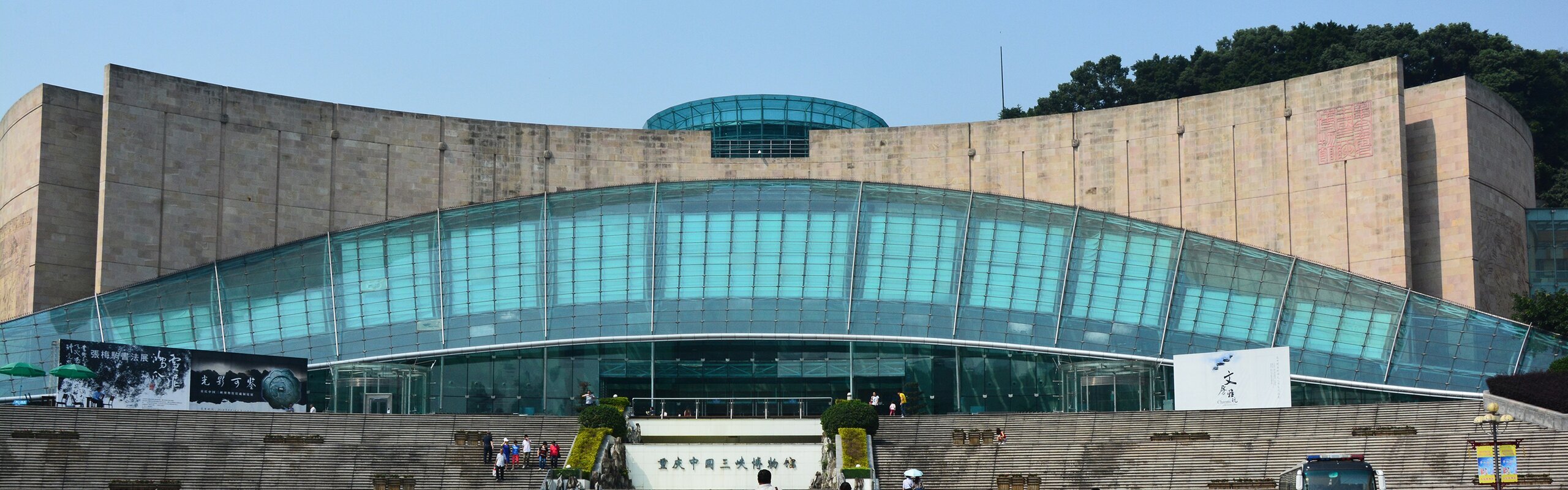

Is it only about the Three Gorges? Is it worth visiting? Actually, it's a comprehensive museum. You'll get a glimpse of Bayu culture, Three Gorges history, wartime stories, migration culture, and Chongqing's urban development.
If you want a quick understanding of Chongqing's past, or some context before taking a Yangtze River cruise, spending around 2 hours here is well worth it. And you'll also visit another iconic landmark of Chongqing, Great Hall of the People, which is right across the museum.
- Opening Hours: 9:00–17:00 (Closed on Mondays)
- Entrance Ticket: Free (no reservation needed)
- How to Get: Metro Line 10 to the Great Hall Station, Exit 1
How to Visit Three Gorges Museum
You can focus on four main exhibitions: Three Gorges, wartime history, sculptures, and porcelain.
And spend more time in Three Gorges part. It's the largest exhibition hall. You can see the most collections and the most impressive film there.
What Can I See on Each Floor?
| 1F | The Marvelous Three Gorges (must-visit) |
| 2F | Ancient Bayu Chongqing: City Evolution |
| 3F | Years of the War of Resistance against Japan Chinese Currency of Past Dynasties Sculpture in Bashu during the Han Dynasty Folk Custom of Ethnic Groups of Southwest China |
| 4F | Calligraphy and Paintings of Past Dynasties Chinese Porcelain of Past Dynasties The Great Benevolence Exhibition of Culture Relics Donated by Society |
Visiting route:
start from the top and work your way down (4F → 3F → 2F → 1F). This route follows a more logical flow based on the museum layout.
Recommended time:
Films are shown 10:00-11:00 am and 2:00-4:00 pm. Visit in the morning if you want fewer crowds, as most people come in the afternoon.
Guide Services Tips
Human guides cover the two main halls, The Marvelous Three Gorges and Chongqing: City Evolution, about 30 minutes each. English is available.
Audio guides are available in English, French, Spanish, Japanese, and Korean, and you can use them in multiple halls.
We can customize a Chongqing itinerary. With private car and a guide throughout your trip, your visit can be more flexible.
What are the Highlights to See in the Museum?
I don't understand these collections. I just walked through. The museum seems boring.
You definitely wouldn't enjoy visiting a museum and ending up feeling this way. So the key is not to see everything, but to know what to focus on.
Two Films with the Scene Life-Size Sculptures
In Three Gorge and Wartime Hall, with the short films and scene sculptures, you can immerse yourself in Chongqing's Yangtze River gorges, dock culture and heavy war past well.
See the Three Gorges and Yangtze River Life Come Alive (1F)
- Screening Times: 10:30、14:30、15:30

In front of the 360° circular screen, you'll watch Three Gorges change by weather, with sunlight, rain, cloud sea, sunset, or snow. Birds sing, and the river rushes around you, and your eyes follow the changing seasons, from summer floods to the red leaves of autumn gorges.
There are also group sculptures of boatmen pulling boats. When you touch the deep rope marks on the stones, you can feel how exhausting their work was to pull the heavy boat.
It feels like you're really standing at the Yangtze, but enjoy all the spectacular views of Three Gorges at once, and see how people live their lives with the river and boats.
Witness Chongqing in War Years under the Bomb (3F)
- Screening Times: 10:00, 11:00, 14:00, 15:00, 16:00
This 15-min film will bring you back to Chongqing in 1938–1943, enduring six years of Japanese bombings. All around you, the city is under air raids, buildings crumbling, smoke rising. Bombs explode, sirens wail, and people's frantic shouts fill your ears.
Then, in a dark, cramped air-raid tunnel, you see sculptures of trapped people. Their struggling faces and movements leave you shocked at the brutality of war brought to Chongqing.
It may change how you see Chongqing. It's not just the cyberpunk 8D city you see today, but also a hero city that has endured, and survived.
If you want a deeper dive into Chongqing's WWII history, you can join us to discover wartime hero stories from Stilwell to the Flying Tigers.
Listen to the Stories of the Collections in Three Gorges
Here are 10 of my favorite collections. And when you actually walk into the China Three Gorges Museum, you may find yourself recognizing them, because you've already "met" them here first.
You'll find them in the Three Gorges, Sculpture, and Porcelain halls.
1. Wuyang Han Que (1F)
Don't miss the stone carvings on both sides of the first-floor hall. They are not just decoration. These are among the earliest forms of Chinese architectural gateways you can see.
The best view is actually from upstairs. Looking down, you get a "bird's-eye view", just like an ancient emperor. Only from this angle can you see the full structure of the gate tower on top.
2. Three-Ram Bronze Zun in Shang Dynasty (1F)
At first glance, it looks like a trumpet. But actually, "Zun" is a liquor vessel.
Look closely, and you'll notice birds and animal patterns on it. Birds often appear in Yangtze River culture, while beasts are more common in Central Plains of China. So this piece shows a blend of two ancient civilizations.
3. Bird-Shaped Bronze Zun (1F)
This chubby bird is really eye-catching. But wait. Fish mouth, eagle beak, beast ears, phoenix crown, dove body, duck feet, and dragon scales. You'll find it's an imaginary animal!
In Central Plains of China, it's also a liquor vessel. But in ancient Chongqing (Southwest China), it became more of an art piece, and no longer functional. So you can't find any holes on its back.
4. Warring States Bronze Tiger Chunyu (1F)
There is a tiger on the top of this pot-shaped object. And the tiger was the totem of the Ba people (Ba is Ancient Chongqing).
You would never expect that it's a musical instrument. How do you play it? You hang it up by passing a rope through the tiger's body, and then strike it to produce sound.
Since it only produces one tone, it was usually played together with bronze drums (though you won't see them here in Three Gorges Museum), often to boost morale.
5. Zu Dou Jia Set (1F)
This unique dining set was used by the Ba people. "Dou" are the small bowls, "Zu" is a tray, and "Jia" is the food tongs (just like the ones you use at a hotel breakfast buffet).
Instead of sharing dishes, they used the tongs to pick up food and sauce into individual bowls before eating. So yes, surprisingly, even in ancient Ba society, people already had an early form of separate dining.
6. Eastern Han Gold Seal of a General (1F)
Pure gold seal, with a tortoise carving. You can safely assume its owner was a high-ranking official.
But here's the mystery: you don't actually know who it belonged to. It was found by a farmer along the river in Chongqing and later donated, so its full story remains unknown.
But you can be an "antiquities restorer" with your kids. Try to recreate this general's seal using gold foil and glue, and take it home as a small souvenir. It's quite an interesting experience.
Join our 5-Day Chongqing and Yangtze River Cruise Tour. You'll not only explore Three Gorges Museum, but also get to visit the places behind the museum exhibits.
7. Money Tree (1F)
Have you ever seen a real money tree? This bronze tree is over one meter tall and covered with coins. It's 304 of them, if you count carefully.
Among the coins, there is a hidden Goddess of Immortality. Now check the base, you'll recognize different animals like tortoises, goats, or toads carved there. So this "money tree" isn't just about wealth. It's about both never-ending fortune and long life.
Even many big-name business people in China have come to see this tree. You might just leave with a bit of luck yourself.
8. Comedy Figurines (3F)
You don't often see figurines this lively in a museum. They sing, play music, dance, sticking out their tongues, grinning, and even make heart-shaped gestures at you. Really interesting.
However, they are actually dwarfs and lived a difficult life. They had to perform in exaggerated, humorous ways to make a living. And more than a thousand years later, they can still make you smile as you walk past.
9. Pink Stove (4F)
This pink stove is made of crystal, very delicate, glossy, and cute. It's also one of the most popular souvenir items in Three Gorges Museum. You can find many kinds of stoves, such as plush keychains, fridge magnets, lollipops, and small display pieces.
I didn't see the pink stove. It was still on a business trip, so I took its souvenir stuff.
10. White glazed porcelain sitting statue of Budhisattva Avalokitesvara (4F)
If you didn't know you were in the porcelain gallery, you might think this moonlight-white statue is carved from jade. It comes from Dehua, one of China's most famous porcelain centers, known for its jade-like texture.
It was created by master He Chaozong. Some of his similar works have been auctioned for millions. You can see a lot about the craftsmanship and value behind this piece.
A private guide helps you uncover more stories behind the exhibits. Join our 12-Day Beijing, Xi'an, Yangtze River, and Shanghai Tour.
How to Arrange a Day Trip with Three Gorges Museum
You can easily combine Three Gorges Museum with the nearby popular attractions.
A Recommended Day Trip Route
Three Gorges Museum→Great Hall of the People→Qixinggang Community food tour→Eling Park→Eling Tested Bed 2→Liziba Light Rail through the Building→Hongya Cave
It's a circular route, and all can be connected by metro. You can conveniently enjoy Chongqing's culture, history, food, and the must-visit attractions.
The Great Hall of the People is also an important civic building in Chongqing. When you walk out Three Gorges Museum, you're facing it. Its contrast colors are best for photos.
You can check our Chongqing Itinerary to get more ideas.
Where to Go Next to Deepen Your Museum Experience
If you want to extend the Three Gorges theme
You can take a Yangtze River Cruise to enjoy the scenery, or visit Baiheliang Underground Museum to see what homes submerged by the Yangtze looked like.
If you want to extend the Wartime theme
1949 Theater: watch a large-scale war-themed show with 360°revolving stage
Bomb shelters: Once the refuge, now the lively hotpot restaurants, market, teahouse...
Stilwell Museum: You'll learn the stories of wartime heroes.
If you want to extend the Sculpture/Art theme
The Dazu Rock Carvings is a UNESCO World Heritage site. Here, you can see over 50,000 spectacular sculptures. Just like the museum's sculptures, their expressions are full of life, not stiff or serious.
Explore Chongqing with Us
A visit to the Three Gorges Museum is just the start. With a private guide, you'll uncover more of Chongqing's stories. Not just in museums, but across the city.
And we design each tour around what you love. Share your interests and travel style, and we'll make it happen. Just contact us.