
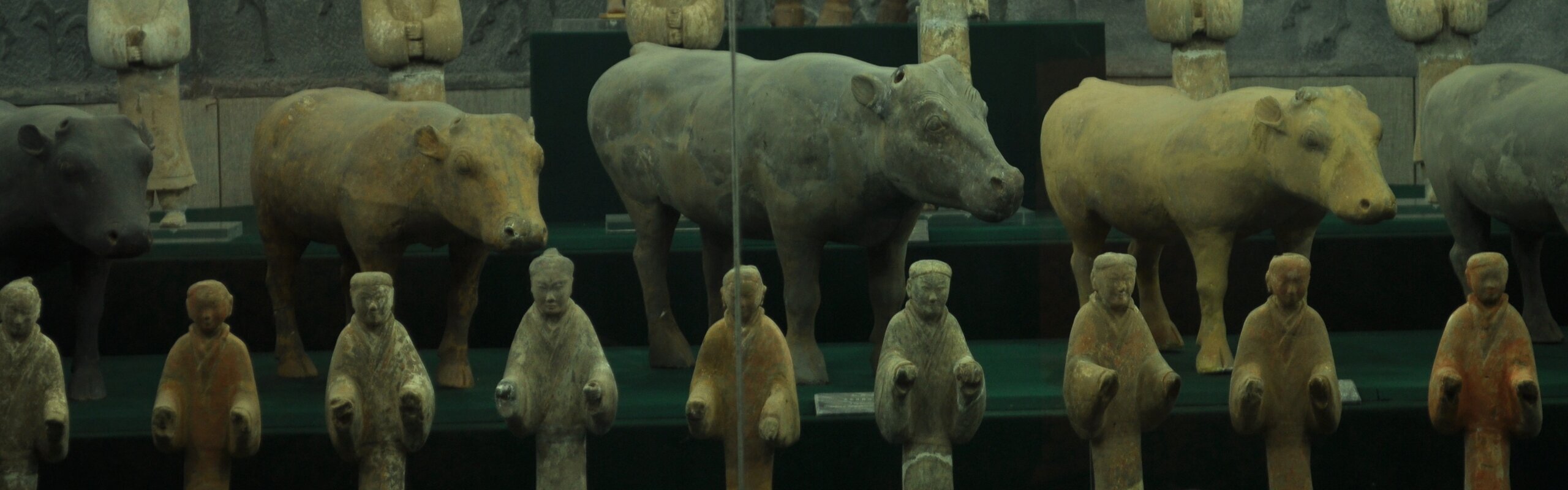

If you're interested in tomb culture or seeking for something quieter and less touristy in Xi'an, Hanyangling is worth exploring. It is the mausoleum of Emperor Jingdi and his empress from the Han Dynasty, located just outside the city.
Compared to the Terracotta Army, Hanyangling offers a distinctly different experience. One of its highlights is an underground museum with a unique display style. Instead of large military formations, you'll encounter more everyday scenes of court life, making the visit feel much more relaxed.
This guide will help you determine if it's worth your time and how to plan your visit.
Facts about the Hanyangling Museum:
- Chinese Name: 汉景帝阳陵博物院
- Location: East section of Airport Road, Jinghe Industrial Park, Weicheng District, Xianyang, about 40 minutes' drive from the Bell Tower and 20 minutes from Xi'an Xianyang International Airport
- Opening Hours: Low season (Dec–Feb), 8:30–18:00 (last entry 16:30); peak season (Mar–Nov), 8:30–18:30 (last entry 17:00)
- Ticket Price: 55 RMB (Dec–Feb) and 70 RMB (Mar–Nov)
- Duration: About 2-2.5 hours
Content Preview
What to See at Hanyangling Mausoleum
The Hanyangling Tomb features four main exhibitions for visitors: the Imperial Tomb Outer Burial Pit Site, the Archaeological Exhibition Hall, the South Gate Site, and the Ancestral Temple Site.
The Imperial Mausoleum Outer Burial Pit Site (1 Hour)
The imperial tomb is square, with 81 radiating outer burial pits around it. Currently, 10 of these pits are open to visitors. This is the core area of Hanyangling and the most important part to see.
What makes it special is that it isn't a traditional exhibition hall where artifacts are relocated indoors. Instead, it is built underground, directly above the original site. You are standing above a 2,000-year-old archaeological site.
As you move through the hall, part of the route follows a suspended glass walkway, while other sections feature solid flooring.
Walking along the glass walkway, the pits are mostly slightly below you to one side, and you look down at them from above.
 Part of the site is built in the form of glass over the burial pit
In some sections, they appear directly beneath your feet. You might find yourself pausing or even crouching to take a closer look down, often creating one of the most memorable moments of the visit.
Further inside, you descend to the same level as the pits and observe them from the side at a closer distance. This shift in perspective helps you understand the site more clearly.
Pit No. 18 – burial pit of palace maids and imperial consortsThese pits contain terracotta figures, animal sculptures, wooden chariots, and various objects. You will learn how an underground "imperial court" functioned, including aspects of food, clothing, officials, and the military.
Some objects remain in their original state of excavation, with their upper parts exposed while the lower parts are still buried. This "partially unearthed" view is rare and gives you a closer sense of a real archaeological site.
Part of the animal figurine's body is still buried in the soilThe Archaeological Exhibition Hall (40 Minutes)
Unlike the burial pits, which are grand and mysterious, this hall focuses on details. Here, you could see the artifacts up close and gradually piece together the world behind the tomb, including who Emperor Jingdi was, gaining a clearer sense of daily life in the Han Dynasty.
Clothed terracotta figurines, whose clothes and arms have decayedOne highlight is a painted kneeling maid figurine, one of the best-preserved pieces. She has a gentle smile often compared to the Mona Lisa. Up close, you could clearly see the details of her clothing and gesture, and get a glimpse into Han court etiquette, costume, and the refined, comfortable life of the time.
The painted kneeling maid figurineIf you are visiting with children, look out for the ancient water clock. It measures time through a steady flow of water and works like a simple clock from over 2,000 years ago.
You could also spot some surprisingly early discoveries, such as the world's earliest tea leaves, one of China's earliest Go boards, and a gilded staff head given to a respected elder people over 70. These small details make the Han Dynasty feel much closer and more real.
The South Gate Site (10 Minutes)
This site marks the main southern entrance to the emperor's mausoleum. In the Han Dynasty, such gates symbolized imperial authority and strict ritual order.
Today, you primarily see the foundations and layout of the gate complex. It is a quick stop, but it helps you understand how meticulously the entire mausoleum was planned.
The South Gate SiteThe Ancestral Temple Site (10 Minutes)
This was where the emperor came to honor his ancestors through ritual ceremonies.
Most of the remains are preserved below underground. On the surface, you mainly see a large open structure marked with glass and metal frames. In some sections, you could look down through glass panels to see parts of the original foundations.
There are few visible objects, so the experience relies more on imagination. If you are not particularly interested in site layouts, it's fine to skip this stop and spend more time on the main highlights.
If you are interested in visiting the Hanyang Mausoleum, check out our 3-Day Essence of Xi'an Tour. Our itineraries can be tailored to your time and interests.
Suggested Visiting Route
For a well-paced visit, we recommend following this order: Imperial Mausoleum Outer Burial Pit Site → Ancestral Temple Site → South Gate Site. The route is straightforward and does not require backtracking, taking about 2 to 2.5 hours.
The first two stops are the main highlights, while the latter sites are quicker visits that help you better understand the layout and rituals of the mausoleum.
If you are short on time, you could focus on the Archaeological Exhibition Hall and the Imperial Mausoleum Outer Burial Pit Site. This shorter visit takes about 1.5 hours.
Tips:
The site is quite spread out, and you will need to get around on foot.
For example, it takes about 15 minutes to walk from the Imperial Mausoleum Outer Burial Pit Site to the Archaeological Exhibition Hall, so it's a good idea to leave a bit of extra time and wear comfortable shoes.
Best Times to Visit
Hanyangling can be visited year-round. As it is located a bit outside the city center, it usually feels quiet, with very few crowds. Most of the main sites are indoors, making it a comfortable visit in any season. At times, it can even feel like you have the space almost to yourself.
If you find Xi'an's top attractions too busy, this is a great place to spend half a day at a slower pace.
In April, cherry blossoms bloom across the park. From late October to early November, the ginkgo trees turn golden, and you could also see bright red persimmons, adding a seasonal touch to your visit.
How to Get to Hanyangling Mausoleum
Hanyangling is very close to Xi'an Airport. It's about a 20-minute drive. If you are arriving or departing by air, we suggest planning your visit on the same day as your airport transfer to save time.
If you prefer to go from downtown Xi'an, you could take Metro Line 2 to Fengcheng Shilu Station, then continue by taxi for about 20 minutes. The whole journey takes around 1 hour.
A direct taxi from downtown takes about 40 minutes. However, it might be harder to find a return ride, especially after 4 pm. We recommend booking your return trip 10–20 minutes ahead of time.
If you prefer a smoother and more time-efficient experience, a private tour is often the best option. We offer a private guide, door-to-door transfers, and a fully customized experience, making your visit easier from start to finish.
Discover More Wonders of Xi'an with China Highlights
If you would like to include Hanyangling in your Xi'an trip without the hassle of planning transport and timing, we can help you arrange a smooth and well-paced itinerary.
From the Terracotta Army to lesser-known sites like Hanyangling, we design trips that make the most of your time and keep your travel experience easy and flexible. Just share your ideas with us, and we will tailor the trip to suit you.