
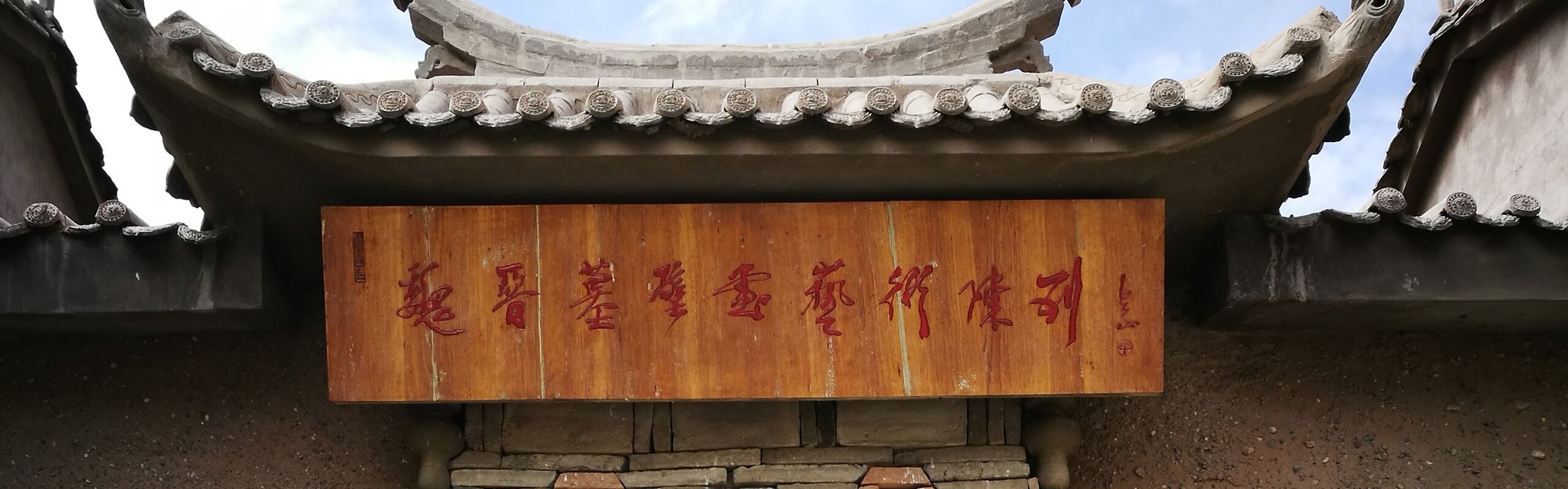

Known as an underground gallery in China, the 13-square-kilometer (5-square-mile)Fresco Tombs of the Wei and the Jin dynasties are home to over 1,000 ancient tombs. Eighteen tombs were excavated from 1972 to 1979, and all are brick-structured, with some bricks engraved with patterns of various kinds, of which the fifth tomb was moved into Gansu Province Museum. Most of the excavated tombs are family tombs, in which the dead family members were buried together; and only two tombs are open to the public now.
Structure of the Fresco Tombs of the Wei and the Jin Dynasties
The Fresco Tombs of the Wei and the Jin dynasties have unique architectural characteristics. As usual, a traditional fresco tomb was composed of a tomb passage, a tomb gate, a gate tower, a fore chamber, a middle chamber, a rear chamber, and a niche during the Wei (220-265) and the Jin (265-420) dynasties.
The building bricks of the tombs are subdivided into straight bricks, carving bricks, and portrait bricks. The tomb gateway is a brick arch, over which a gate tower stands. The gate tower is piled high with carving bricks of various shapes, including figures, beasts, and birds.
Highlights of the Fresco Tombs of the Wei and the Jin Dynasties
Over 760 pieces of fresco have been unearthed from the Fresco Tombs of the Wei and the Jin dynasties, and they have bright colors and unique styles, whose themes were drawn from the daily life of the Wei (220-265) and the Jin (265-420) dynasties, including farming, poultry cultivation, mulberry leaf harvesting, traveling, feasting, hunting, and military drilling. These frescoes are also referred to as "an encyclopedia of the Silk Road" because they vividly show several of the ancient people's activities. The fresco tombs provide precious material objects for research on social life, political events, burial rites, and painting art of the Wei (220-265) and the Jin (265-420) dynasties.
Among these excavated tombs, the sixth tomb is very representative: it is an official's tomb with delicately designed chambers. On both sides of the main chamber, there are a cow and sheep pen, a small room for a carriage, a kitchen and a storehouse. The carvings inside the tomb are very refined and delicate, and they vividly show the official's whole life: farming, doing business, and becoming an official. There are also scenes of laboring and of entertaining.
Location: northwestern Gobi Desert, 20 kilometers(12 miles) away from Jiayuguan City, and between the Xincheng Township of Jiayuguan City and the Dingjiazha Township of Jiuquan City, Gansu Province
Transportation: A sightseeing bus can take you there from Jiayuguan Bus Station
Opening times: 8:30 am to 8:00 pm