
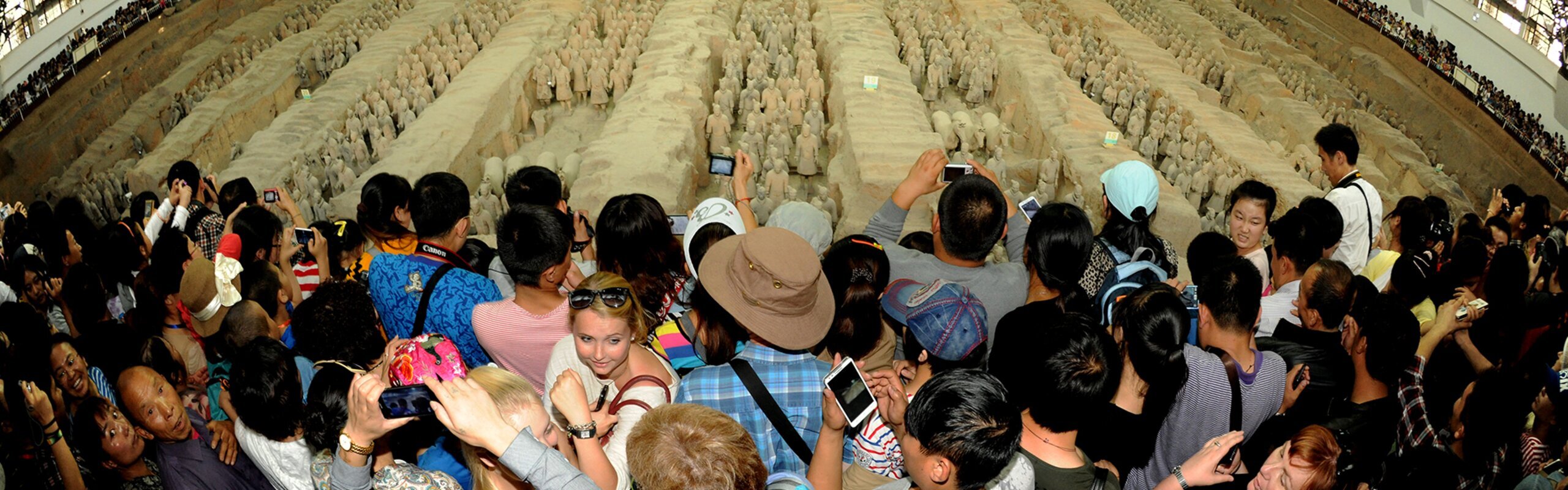

"I spent months planning my China trip, paid a high price for my flights, and finally made it here. But why are the attractions packed, the trains so hard to book, and every day so exhausting?" — You chose the wrong travel dates.
To avoid this, we'll show you which dates to avoid, why they can make your trip more difficult, and what to do if you have to travel during these periods.
China's Golden Weeks (May 1–5 & October 1–7): Worst Time
China has two major Golden Week holidays every year:
- Labor Day Holiday: May 1–5
- National Day Holiday: October 1–7
These are the busiest travel periods in China. For a first trip, we strongly recommend avoiding them whenever possible.
During these holidays, millions of Chinese travelers take trips at the same time. The impact is not limited to one or two attractions. Transportation, hotels, and popular destinations across China all reach their peak demand.
1. Famous Attractions Become Much More Crowded
You may face:
- Longer lines: At Zhangjiajie National Forest Park, you may spend 1–2 hours waiting for shuttle buses, cable cars, or entry.
- Crowded walking areas: Paths can become so packed that it is difficult to walk freely, stop for photos, or enjoy the scenery.
- Traffic jams: Drives to popular destinations can take much longer than usual. For example, a trip to Dali Ancient Town can take around 2 hours during heavy traffic. When possible, take the subway instead. It avoids road traffic and can be much faster during peak holiday periods.
These problems are especially severe at China's most famous attractions, such as the Forbidden City, Badaling Great Wall, Terracotta Army, Zhangjiajie National Forest Park, and Chengdu Panda Base.
China's remote west and southwest, such as Xinjiang and Guizhou provinces, will be less crowded.

2. Train Tickets Become Extremely Difficult to Get
The biggest transportation challenge during Golden Weeks is usually getting high-speed train tickets.
Train tickets to popular tourist cities such as Chengdu, Chongqing, and Guilin can sell out very quickly after they are released.
So even with a well-planned itinerary, you may not get the train you want.
If you must travel during Golden Weeks, consider flying instead. Flights are often easier to book than high-speed trains, but fares usually rise during this period, so booking early is still important.
3. Hotels Become More Expensive
During Golden Weeks, the same hotel room can cost around twice as much as it does during normal travel periods.
For example, a hotel room that costs ¥600 per night on regular days may increase to around ¥1,200 per night during the holiday.
4. Tickets for Major Attractions Can Sell Out Within Minutes
For example, the Forbidden City in Beijing releases tickets 7 days in advance, while the Terracotta Army in Xi'an opens holiday reservations 10 days in advance.
During Golden Weeks, travelers rush to book as soon as tickets are released, and tickets can sell out within minutes.
So even if you plan your China trip months in advance, you may still miss these attractions on your preferred date.
So, When Is the Best Time to Visit China?
If you want comfortable weather and fewer crowds, these periods are generally better choices:
- Mid-April to April 30
- May 6–31
- The entire month of September
- October 8–30
These periods let you avoid the two major Golden Weeks while still enjoying generally comfortable weather across many popular destinations. Check out our Best Times to Visit China.
But If You Have to Travel During Golden Weeks
1. Avoid the Biggest Travel Rush
Most domestic travelers leave home around October 1 or May 1 and return during the last two days of the holiday.
If possible, start your trip 1–2 days earlier, such as September 29–30 before National Day. You can begin sightseeing while many domestic travelers are still on their way to their destinations.
This will not eliminate the crowds, especially during the middle of the holiday, but it can help you avoid the biggest travel rush.
2. Choose Smarter Sightseeing Options
You may not be able to avoid crowds completely, but you can choose a less crowded alternative or visit at night.
For example:
For the Great Wall, skip Badaling and Mutianyu. Instead, we can take you to the quieter Jiankou Great Wall or a private section near Gubei Water Town reserved exclusively for your group, where you can have the Great Wall to yourself and enjoy an afternoon tea at sunset.
In Shanghai, North Bund is usually quieter than the main Bund area while still offering great skyline views.
Some popular attractions, such as the Terracotta Army and Yu Garden, also offer night visits during Golden Week, allowing you to avoid the heaviest daytime crowds.
Chinese New Year: A Special Experience, but Is It Worth It?
Chinese New Year is the most important traditional holiday in China. It offers experiences you cannot find at any other time of the year, such as lantern displays, temple fairs, and festive decorations.
However, for a first and possibly only trip to China, are these special experiences worth dealing with the crowds and higher travel demand?
Our recommendation: If your travel dates are flexible, we do not recommend choosing Chinese New Year for your first trip to China.
Transportation Gets Difficult, and Attractions Are Still Busy
The heaviest travel rush usually falls 1–2 days before Chinese New Year and 1–2 days before the holiday ends, around February 4–5 and February 11–12 in 2027.
Train stations and airports can be extremely crowded, while high-speed train tickets on popular routes can sell out almost immediately. If you need to travel between cities during these days, your itinerary can be much harder to arrange.
Popular tourist attractions are also busy during Chinese New Year, although generally less crowded than during the May and October Golden Weeks. Major sights, temple fairs, and lantern displays can still attract large crowds.
Prices Are Also Higher
As with other major holidays in China, hotel and flight prices usually rise during Chinese New Year.
You may pay significantly more for the same hotel room or flight than you would during a normal travel period.
You Can Still Sightsee, but Some Local Businesses Close
China does not shut down during Chinese New Year.
Major attractions, hotels, shopping malls, and most restaurants remain open as usual. However, some small family-run restaurants and local shops may close for 3-7 days.
You can still sightsee normally, but you may have fewer choices for local restaurants and small shops.
So, Our Take: Skip Chinese New Year for Your First Trip
The extra cost, crowds, and transportation challenges are usually not worth it if your main goal is to see China's major sights and travel smoothly between cities.
But if experiencing China's festive atmosphere is your priority, travel around the Lantern Festival instead.
The Lantern Festival falls on February 20, 2027. A trip around February 15–22 lets you enjoy lantern displays and festive events, such as those at Yu Garden in Shanghai and the Xi'an City Wall, after the biggest holiday travel rush has passed.
Is Summer a Bad Time to Travel to China?
We have to be honest: July and August are among the busiest times to travel in China because Chinese schools are on summer vacation.
This is especially noticeable at family-friendly destinations such as Universal Beijing Resort, Shanghai Disneyland, and Chengdu's panda bases.
As a result, hotel prices can be very high, sometimes even higher than during the May Day holiday.
China is also very hot in summer. Afternoon temperatures can reach 34–35°C or higher in many destinations.
If your dates are flexible, choose June. Chinese schools have not yet started their summer vacation, and the weather is generally less hot.
If you have to travel in July or August, try to travel in early July or after August 15, when crowds are usually lighter than during the peak summer period.
You can also use the crowd-avoidance tips we mentioned above for Golden Week.
Need Help Planning Your China Trip?
China Highlights' travel advisors can help you. We will offer you inspiration and personal suggestions. We know the best times to visit and what should be avoided.
You can see our popular tours below for inspiration or tailor-make a tour according to your interests and requirements.
- Classic Wonders — 12-Day Beijing, Xi'an, Guilin/Yangshuo, Shanghai
- The Golden Triangle — 8-Day Beijing, Xi'an, Shanghai
- See more interesting China tours