

Worried you might be visiting Yunnan in the "wrong" season? Here's the truth: every season has its own wonder — if you know where to go.
Spring unfolds in color, from golden rapeseed fields in Luoping to cherry blossoms in Yiliang Cherry Blossom Valley. Summer brings wild mushrooms. Autumn deepens into harvest tones, with the layered reds of Dongchuan Red Land.
Winter paints the rice terraces with mirror light and sets cherry blossoms ablaze on Wuliang Mountain. One trip is rarely enough. Each season calls you back to a different corner of Yunnan.
So how many days are actually right?
We've found that 7 to 10 days gives you a comfortable pace — enough to experience Yunnan without rushing, while still catching its most seasonal moments.
Below you'll find a classic route (Kunming → Dali → Lijiang → Shangri-La), plus seasonal add-ons and hidden gems that work beautifully for a second or third visit.

Quick Look: Which Season Suits Which Corner of Yunnan?
| Season | Best for | Where to go | What makes it special |
|---|---|---|---|
| Spring (Feb–Apr) |
Flowers | Luoping (rape flower sea) Yiliang Cherry Valley |
Fields of gold Pink blossoms overhead |
| Summer (May–Aug) |
Wild mushrooms Cool escapes Torch Festivals |
Shangri-La (foraging) Lugu Lake (water flowers) Weishan (Torch Festival) |
Hunting for fungi Paddling through floating blooms Celebrating with locals around bonfires |
| Autumn (Sep–Nov) |
Harvest colors | Dongchuan Red Land | Deep red soil rippling against golden wheat |
| Winter (Dec–Feb) |
Snow peaks Cherry blossoms Terraces |
Wuliang Mountain Yuanyang |
"Golden sunrise" on snow mountains Mirror-like paddies Winter cherry |
Our clients visit Lijiang in the blossom season.The Classic Route: Kunming, Dali, Lijiang & Shangri-La
If it's your first time in Yunnan, this 8-day loop is a wonderful place to start. It introduces you to the region's diversity — highland lakes, Tibetan monasteries, ancient towns, and snow-capped mountains.
Notes on Shangri-La:
While we've included it in the classic route, it's not a year-round destination. Winter can be bitterly cold with limited scenery.
The best time to visit Shangri-La is from April to October – temperatures are mild, and you'll find meadows full of wildflowers (April–May) or the chance to forage wild mushrooms (July–September).
If you're traveling in winter, consider spending more time in Dali, Lijiang, or the southern regions.
Day 1–2: Kunming
Arrive, visit the Stone Forest (take the less-crowded Naigu section — the rock formations are darker and more dramatic), and Yuantong Temple.
Naigu Stone ForestIf you have time, wander through Dounan Flower Market — 40 million flowers change hands here every day. You don't have to buy; just watch the auction and smell the roses.
Day 3: Bullet train to Dali (about 2 hours)
A lovely way to spend the afternoon is cycling the west shore of Erhai Lake. Start at Longkan Pier, pass the famous S-bend, and continue to Caicun.
The path hugs the water — you'll feel the breeze on your face and hear the gentle lapping of waves. You might stop at a lakeside café for a cup of Yunnan small-batch coffee. Sunset over Cangshan Mountain is free and unforgettable.
I was riding along the west shore. If you're visiting Dali in summer (late July to early August), consider adding the Torch Festival in Weishan Ancient Town to your itinerary.
Bonfires, music, and dancing bring the town to life. We can arrange for you to try on traditional ethnic costumes, explore festive stalls, and enjoy a special Torch Festival dinner before joining the celebrations.
Torch Festival in WeishanDay 4: Drive to Lijiang (around 2.5 hours)
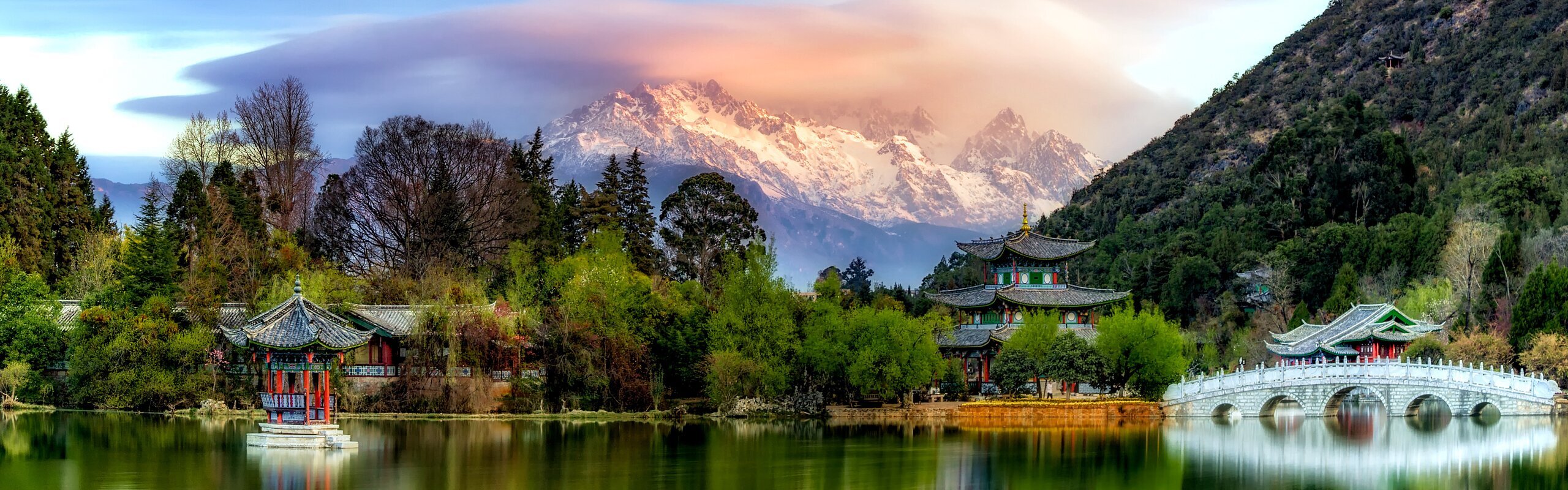
Two sights not to miss: Black Dragon Pool Park (the classic postcard view of Jade Dragon Snow Mountain reflected in the water) and Lijiang Old Town.
Lijiang Old Town can feel very crowded during the day. We love taking guests there in the early morning or exploring quieter corners together.
We like to take our guests on a walking route that follows the Naxi philosophy of living in harmony with nature, ending at Wangu Tower for a panoramic view of the town.
Our guide with our guests in Lijiang Old TownDay 5: Jade Dragon Snow Mountain
A cable car takes you up to 4,680 meters. You don't have to hike if you'd rather not — the view from the upper platform is already breathtaking. In the afternoon, you can visit Blue Moon Valley, where the water shimmers in an almost unreal turquoise.
Blue Moon ValleyJade Dragon Snow Mountain cable car tickets sell out quickly (they're released at 8 pm, seven days in advance). We book them for you in advance so you don't have to worry.
Day 6: Drive to Shangri-La (about 2 hours)
On the way, you'll pass Tiger Leaping Gorge. The full two-day trek is impressive, but we've found that a gentle 2-hour walk from Tea Horse Guesthouse to Halfway Guesthouse gives you the best views of the roaring Jinsha River — without exhausting yourself.
Our suggestions:
1. Tiger Leaping Gorge hiking is not recommended during heavy rain (June–August). We'll suggest the safe viewing platform instead.)
2. If you're traveling between April and October, Shangri-La truly shines. In April–May, the meadows around Napa Lake are covered in wildflowers — purple, yellow, and white. In July–September, you can join a local guide to forage for wild mushrooms in a private and quiet pine forest.
Day 7: Shangri-La
Here you can visit Songzanlin Monastery (often called the "little Potala Palace"), Pudacuo National Park, and Dukezong Ancient Town. At 3,300 meters, it's wise to take things slowly — drink warm water, walk gently, and give your body time to adjust.
We listened to the lamas telling stories at Songzanlin Monastery.Day 8: Departure from Shangri-La (or fly back to Kunming)
Depending on your flight, you can either fly out of Shangri-La or enjoy a scenic flight back to Kunming.
Seasonal Add-ons to This Route
| If you're traveling in… | You might consider adding… | What you'll experience |
|---|---|---|
| Spring (Feb–Mar) | A side trip to Luoping (rape flowers) or Yiliang Cherry Valley | Walking into waist-high golden fields, standing under a canopy of pink blossoms with bees humming around you. |
| Summer (Jul–Aug) | One extra day at Lugu Lake (from Lijiang) | Paddling across calm water dotted with white flowers that seem to float on the surface — the only sound is your oar dipping in and out. |
| Half-day wild mushroom foraging near Shangri-La | A local guide leads you into a quiet pine forest. You'll sift through needles and soil and uncover a hidden mushroom. | |
| Summer (late Jul-early Aug) | Torch Festival in Weishan | Join the Bai people around a giant bonfire, watch torch parades, and taste festival treats — a night of laughter and firelight. |
| Autumn (Oct–Nov) | A side trip to Dongchuan Red Land (from Kunming) | Standing at the edge of rust-red hills stitched with golden wheat, the colors look almost painted. |
| Winter (Dec–Jan) | A side trip to Wuliang Mountain (cherry blossoms) | Walking through hillsides dusted with soft pink winter cherries. |
From spring flowers to winter snow, Yunnan reveals a different side each season. Here are a few itinerary ideas to help you experience it at the right time—all fully customizable.
Hidden Gems: Perfect for a Second Visit (or If You Prefer Less-Traveled Roads)
These places take a bit more time and are best enjoyed when you're not rushing. Each has its own ideal season.
1. Pu'er and Jingmai Mountain (Best from November to March)
Jingmai Mountain became a UNESCO World Heritage site in 2023 — the world's first tea-culture heritage. It's not crowded, and you won't find souvenir shops lining the streets.
What you can do there:
Walk through ancient tea forests where the air smells of fresh leaves and damp earth. Sit with a local family in their stilt house, sip pu'er tea that has been aged for years, and watch clouds drift across the valley below.
Make sure to spend time on two experiences that define this region: the tea mountains and the coffee.
In Pu'er, you can visit a working tea plantation — see how leaves are picked, roasted, and pressed into cakes. Then head to a coffee estate (yes, Yunnan grows excellent arabica), where you can taste a freshly roasted cup while looking out over rolling hills. It's a perfect slow day.
Pu'er and its sea of cloudsA suggested 7-day flow:
- Day 1: Pu'er Arrival and explore the Pu'er Old Street
- Day 2: Visit a coffee plantation and explore Taiyanghe Forest Park to meet red pandas
- Days 3-4: Jingmai Mountain
- Days 5-6: Xishuangbanna (Manting Park, Tropical Botanical Garden, & Manzhang Dai Village)
- Day 7: Departure
(We especially love the sunrise over Jingmai's sea of clouds. You don't even need to hike — just step out of your room and look east.)
This itinerary is best started from Kunming. You can travel from Kunming to Pu'er either by flight or high-speed train.
The route can also be done in reverse, depending on your flight options and schedule.
If you prefer a simpler plan, you can focus just on Pu'er and Jingmai Mountain. After your stay in Jingmai, you can fly back to Kunming directly.
2. Jianshui and Yuanyang (Best from December to March)
Why winter? The terraces are flooded, reflecting the sky like a thousand mirrors. (In summer, it gets very hot — around 38–40°C – and the terraces are green; still beautiful, but less dramatic.)
YuanyangWhat a day might look like:
Start at Duoyishu Terraces just before sunrise. The air feels cool on your skin, with a faint scent of wet earth. You'll hear water trickling from one level to the next, and distant calls of villagers starting their day.
From there, you can take a flat trail toward Azheke Village. The path winds between the terraces — sometimes so narrow that you can reach out and touch the water. There's no rush; you can stop whenever you like to take in the view.
By late afternoon, you'll reach Bada Terraces. As the sun drops, the water turns gold, then silver, then deep blue. It's a quiet, almost meditative moment.
Tip: Yuanyang Rice Terraces are most photogenic at sunrise and sunset — we'll time your visit to avoid midday heat and crowds.
Getting there: A bullet train from Kunming to Jianshui takes about 2 hours 15 minutes, followed by a 2-hour drive to Yuanyang.
The sunset at Yuanyang Rice Terraces3. Tengchong and Nujiang (Best from October to May)
Not just old towns. Not just photos. This is a road trip for those who want to feel far from everything.
Start from Dali, and head west.
Along the way, you may meet elderly women with traditional facial tattoos—quiet reminders of a culture that is slowly fading. These markings carry stories that are rarely told. Were they symbols of beauty? Or once a way of protection in a harsher time?
There are answers you can read about—but also stories you can only hear if you sit down and ask.
In Laomudeng Village, you'll find something unexpected: a Christian church standing in a remote mountain village, quietly coexisting with local ethnic traditions. It's not staged. It's just how life is here.
The Christian churchDrive further into Nujiang Grand Canyon and reach Bingzhongluo, where the Nujiang River curves into a perfect bend between steep mountains.
In this season, the water turns its clearest emerald green, standing out sharply against the canyon walls. The scale, the silence—it feels completely removed from the outside world.
Nujiang RiverFinally end in Tengchong, where you can soak in natural hot springs after days on the road. Get more details in our 8-Day Less-Traveled Northwest Yunnan Tour.
If you visit from mid-November to early December, you'll also catch golden ginkgo forests at their peak.
Tengchong in autumnPractical Info: Getting Around, Where to Stay, and Tips for International Visitors
Getting Around Yunnan
Within Yunnan, high-speed trains are the main way to travel between major cities. You can book tickets using 12306 (official platform) or Trip.com (more user-friendly for international travelers).
When a Car is the Better Choice:
For short hops like Dali → Lijiang or Lijiang → Shangr-La, the time difference by train is small, but a car gives you door-to-door convenience – no dragging luggage through stations, and you can stop whenever you spot a beautiful view.
| Departure | Arrival | By Bullet Train | By Plane | By Car |
|---|---|---|---|---|
| Kunming | Dali | 2h | 1h | 4.5h |
| Kunming | Lijiang | 4h | 1h40m | 5.5h |
| Kunming | Shangri-La | 5h | 1h | 7h |
| Kunming | Xishuangbanna | 3.5h | 1h | 7h |
| Kunming | Pu'er | 3h | 1h | 5.5h |
| Kunming | Jingmai Mountain | - | 1h | 8.5h |
| Kunming | Jianshui | 2h15m | - | 2h |
| Dali | Lijiang | 2h | - | 2.5h |
| Dali | Shangri-La | 3.5h | - | 3.5h |
| Dali | Pu'er | 5.5h | - | 6h |
| Dali | Xishuangbanna | 6h | 1h | 7.5h |
| Lijiang | Shangri-La | 1.5h | - | 2h |
| Lijiang | Pu'er | 8h | - | 7.5h |
| Lijiang | Xishuangbanna | 8h45m | 1h | 9h |
China–Laos Railway: You can take a high-speed train from Kunming all the way to Vientiane (passing through Xishuangbanna). Just remember to keep your physical train ticket—you'll need it for immigration at the border.
Where to Stay: A Few Friendly Tips
| City | Best area | What to keep in mind |
|---|---|---|
| Kunming | Near Green Lake (Cuihu) | Central and convenient |
| Dali | South gate of old town (nightlife) or by Erhai Lake (view) | Inside the old town is lively, but you'll need to drag your suitcase over stone streets. Outside is easier. |
| Lijiang | South gate of the old town | Same trade-off as Dali. |
| Shangri-La | Outside Dukezong Ancient Town | More hotel options, better value, and the old town is small enough to explore on foot. |
It would be a bit tiring to drag the suitcase on such a stone-paved road.Travel Tips for International Visitors
Payment
Most ticket offices and local shops accept Alipay or WeChat Pay — you can link your international credit card to these apps. For small vendors, it's handy to have some RMB cash. Foreign credit cards are rarely accepted directly.
Altitude
Shangri-La sits at 3,300 meters (10,800 feet). On your first day, it's a good idea to avoid heavy meals, drink warm water, and walk slowly. Our guides carry portable oxygen. If you feel a bit dizzy, just rest — most people adjust within 24 hours.
Connectivity
Consider buying an eSIM (Nomad, Airalo, or similar) before you leave. China Mobile has the best coverage in Yunnan, including most mountain areas. One thing to note: Google Maps is unreliable here. You might find Apple Maps works better, or you can download Baidu Maps (it has an English interface).
Language
English signage is limited outside major attractions. A translation app like Google Translate (with the offline Chinese pack downloaded) can be very helpful. Or simply travel with us — all our guides speak fluent English.
Travel with China Highlights
We don't just sell tours. We love helping travelers design trips that match their pace, their family's energy, and the season's hidden moments.
What you can expect with us:
- A private English-speaking guide who knows the back roads and the quiet hours
- All tickets booked in advance – no queueing, no last-minute stress
- A flexible itinerary: want to spend an extra hour watching the sunrise over Yuanyang? We adjust on the spot
- 24/7 support while you're traveling
Our Yunnan Tours would give you more inspiration.
A final thought
Yunnan doesn't reward hurry. It rewards attention. Whether it's your first visit or your second, let the season be your guide and leave a little room for the unexpected. Feel free to talk to us.