

Many of Yunnan's famous landscapes can already be seen from a car. So the real question isn't "Should I hike?" but "Is this hike worth giving up half a day, a full day, or several days of my trip?"
The right trail can turn a standard sightseeing stop into one of the highlights of your Yunnan trip.
The wrong one can leave you exhausted, short on time, or dealing with rain and altitude you didn't plan for.
Our advice: choose the trail to fit your itinerary, not your fitness alone.
Start with the quick picks below, then see how each hike actually works on the ground.
Which Yunnan Hike Fits Your Trip?
| Trail | If you want to experience | Time | Difficulty | Highest/typical altitude |
|---|---|---|---|---|
| Tiger Leaping Gorge | Yunnan's iconic snow mountain and gorge landscape | 2 hours or 2 days | Easy or challenging | 1,900–2,700 m |
| Jade Dragon Snow Mountain | A closer walk beneath a snow-capped mountain | 6 hours | Moderate | Up to about 3,600 m |
| Cangshan Mountain | A gentle mountain walk with Erhai Lake views | 4 hours | Easy | Around 2,600 m |
| Lugu lake | A lakeside walk with Mosuo culture | 2 hours | Easy | 2,700–2,830 m |
| Baoshan Stone Village | A quieter mountain trail away from classic routes | 1 day to overnight | Moderate–challenging | 1,800–2,100 m |
| Yubeng | A multi-day trek beneath Meili Snow Mountain | 4 days | Challenging | Up to about 3,900 m |
| Yuanyang Rice Terraces | Rice terraces, Hani villages, and photography | 4 hours | Easy–moderate | 1,800–2,000 m |
A quick decision:
If you only want one hike: choose Tiger Leaping Gorge for the classic Yunnan experience.
If you want a gentler walk: choose Cangshan or the shorter Lugu Lake route.
If hiking is the main reason you're coming: choose Yubeng, but give it several days.
7 Yunnan Hikes, from a 2-Hour Walk to a 4-Day Trek
1. Tiger Leaping Gorge — 2 hours or 2 days

If you're traveling the classic Lijiang–Shangri-La route and want one genuinely memorable hike without adding a separate destination, Tiger Leaping Gorge is the best choice.
It sits directly between Lijiang and Shangri-La, making it one of the easiest major treks to fit into a classic Yunnan itinerary.
For a gentle introduction, have your driver take you to Tea Horse Guesthouse and walk to Halfway Guesthouse. Allow about 2 hours.
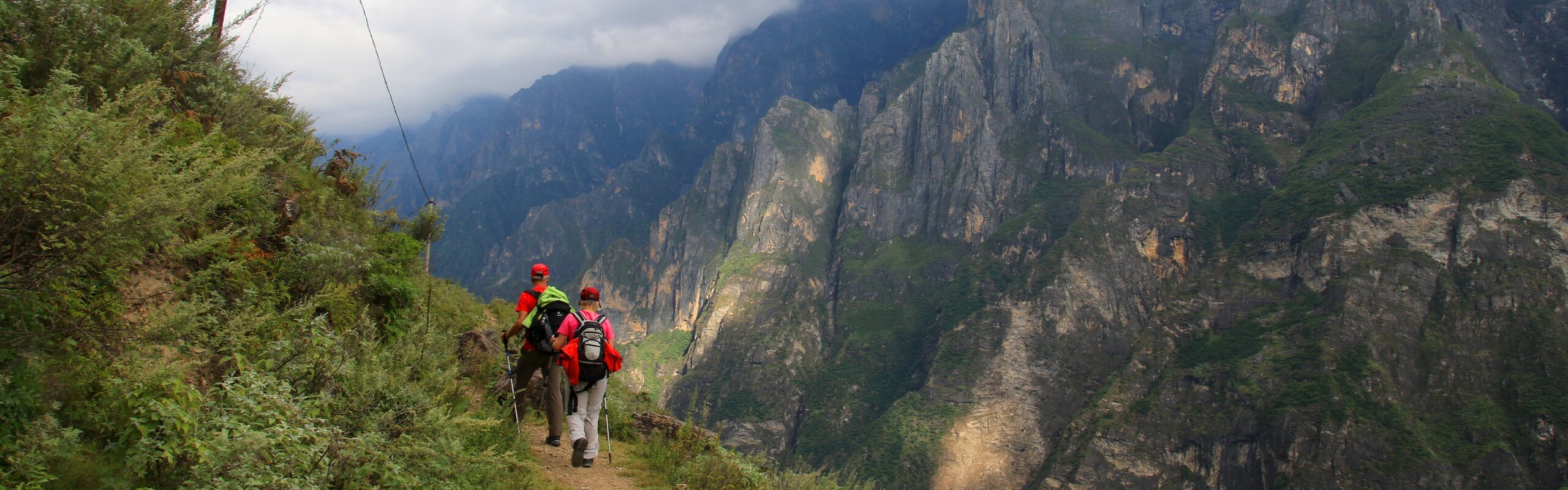
This section avoids the famous 28 Bends and takes you past the gorge, cliffs, snow mountains, and Jinsha River without committing to the full trek.
For the classic experience, allow 2 days for the High Trail. The full route is roughly 20–25 km. The first day includes the strenuous 28 Bends, while the second continues toward Tina's Guesthouse.
Don't mistake the short Tea Horse–Halfway section for the full hike. The complete High Trail is a real trek, not a sightseeing walk.
Best itinerary: Lijiang → Tiger Leaping Gorge → Shangri-La.
Our take: If Tiger Leaping Gorge already lies on your route, we'd add the hike rather than spend another half-day on a standard viewpoint. See our 8-Day Classic Yunnan Tour.
2. Jade Dragon Snow Mountain — about 6 hours
Instead of spending the day entirely around the cable-car areas, start from Yuhu Village at the foot of Jade Dragon Snow Mountain and hike toward the Alpine Meadow.
The round trip is about 9 km and takes around 6 hours, with about 900 m of ascent. It reaches roughly 3,600 m. The trail passes through grassland and forest, with the snow peaks rising above you.
Important: don't treat this as an alternative to the cable-car visit in terms of altitude or effort. The hike takes you into a different part of the mountain and requires substantially more physical effort.
This hike is included in our 6-Day Lijiang to Shangri-La Adventure Tour, alongside Tiger Leaping Gorge and cultural stops in Lijiang and Shangri-La.
3. Cangshan Mountain — about 4 hours
Choose it if you want real mountain scenery without turning your Dali stay into a trekking trip.
Take the Zhonghe cable car up, then walk along the relatively gentle Yudai Road before descending by Gantong cable car. The route is around 11.5 km.
You'll walk through forests, past streams and waterfalls, and past a mountain temple, with Erhai Lake spread out below.
4. Lugu Lake — about 2 hours
Choose it if you prefer a leisurely walk with beautiful scenery and cultural discoveries over a strenuous climb.
From Luowa Pier to Nüshen Bay, the lakeside route is about 5 km and takes roughly 2 hours at an easy pace.
You walk beside the lake with the mountains rising around you, then reach the wetlands around Caohai.
Give yourself an overnight at Lugu Lake rather than trying to squeeze the walk into a rushed day trip from Lijiang.
Then add a Mosuo family visit if you want to understand the people who live around the lake rather than seeing it only from the road.
Our tip: Don't choose Lugu Lake because you want a "hiking challenge." Choose it because you want two quiet hours beside one of Yunnan's most beautiful lakes.
5. Baoshan Stone Village — 1 day to overnight
Choose it if you've already done the classic Lijiang sights and want something quieter.
Baoshan Stone Village sits dramatically above the Jinsha River Gorge, with Naxi houses built into a steep rocky landscape.
You can follow old paths toward areas such as Taizi Pass, with steep sections, exposed terrain, and narrow passages along the gorge.
Unlike the major sightseeing routes, the trails here are less standardized, and your hiking distance depends on the route you choose.
Expect around 10–18 km of walking, which can take roughly 3–7 hours. Some sections are steep and exposed, so this hike is best for travelers with decent fitness.
Our take: This is not the hike we'd give you on a tight first-time Yunnan itinerary. Save it for a trip where you have an extra day and want to trade convenience for a quieter landscape.
6. Yubeng — give it 4 days
Choose it if hiking is one of the main reasons you're coming to northwest Yunnan.
Yubeng needs its own block of time. You'll stay in the village and hike beneath Meili Snow Mountain, rather than treating it as a half-day or one-day add-on.
A typical trekking plan includes the hike into Yubeng, hikes to Ice Lake and the Sacred Waterfall, and the journey out.
Yubeng Village is around 3,200 m, while Ice Lake reaches about 3,900 m. The Ice Lake hike can take around 7–10 hours, depending on the route and conditions.
The combination of long hiking days and high altitude makes Yubeng considerably more demanding than the other routes on this list.
Our tip: Don't squeeze Yubeng into a standard 7–8 day Yunnan trip. If you want Yubeng, build the itinerary around it. See our 4-Day Yubeng Village Hiking Tour.
7. Yuanyang Rice Terraces — about 4 hours
Choose it if you want an easy-to-moderate walk where the landscape changes every few minutes.
A typical route starts at Duoyishu Terraces after sunrise and continues toward Azheke Hani Village.
Walking through the terraced rice fields allows you to see traditional villages, mushroom-shaped houses, and local farmers working among the terraces.
Along the way, you'll discover how water is carried from the forest and distributed through the fields, giving you a deeper understanding of the farming system rather than just a photo stop from above.
The day can end with sunset views over the vast rice fields at Bada or another nearby viewpoint.
The hiking itself takes around 4 hours and covers about 12 km.
Our take: Pair Yuanyang with Jianshui rather than making it a rushed standalone stop. One night in the rice-terrace area gives you enough time for both sunrise and sunset.
Best Time for Hiking in Yunnan
There's no single best month for every route.
For most classic hiking routes, March–May and September–November offer comfortable temperatures and generally good trail conditions.
These are the easiest months to plan a classic Yunnan hiking trip, especially around Lijiang, Tiger Leaping Gorge, and Dali.
June–August is the rainy season. Heavy rain can make mountain trails slippery, particularly on exposed and remote routes.
For specific routes:
- Jade Dragon Snow Mountain: November–May offer better chances of seeing snow-covered peaks.
- Yuanyang Rice Terraces: November–April is the best period for the famous water-filled terraces.
- Yubeng Village: May–June and September–October offer better trekking conditions.
If you're traveling outside these periods, you can still hike, but choose the route according to the weather conditions for your travel dates.
4 Things to Know Before Hiking in Yunnan
1. Do I need a guide?
Not always.
For a short, established route such as Cangshan, you can usually follow the route without a dedicated trekking guide.
For Yubeng, Tiger Leaping Gorge, Baoshan, or more remote routes, a local guide can be especially helpful. They can handle navigation, adjust the route to current conditions, and help with transport and accommodation.
For a private trip, we can build the guide and vehicle support around the actual hike rather than sending you off with a generic map.
2. What shoes and clothes should I bring?
Wear sturdy hiking shoes with good grip, especially for longer routes.
Bring layers rather than relying on one thick jacket. Temperatures can change quickly with altitude, and higher mountain trails can feel cold when you stop.
A waterproof jacket is useful during the rainy season.
3. What about luggage during the hike?
For a half-day hike, leave your main luggage at your hotel and carry a small daypack.
For an overnight or point-to-point trek, arrange luggage storage or transfer and take only what you need on the trail.
With a private customized trip, we can make this easier: your larger bags can stay in the vehicle and be transferred to your next destination while you hike, so you only need to carry what you need for the trail.
4. How should I prepare for altitude?
Altitude is most relevant on Jade Dragon Snow Mountain and especially Yubeng, where the trail can reach around 3,600–3,900 m.
If you're concerned about altitude sickness, talk to your doctor before the trip about whether preventive medication is appropriate for you. Gradual acclimatization remains the foundation of altitude-sickness prevention.
On the trail, keep a steady pace and stay hydrated. Portable oxygen can provide temporary relief in some situations, but it is not a substitute for stopping or descending if symptoms are serious.
If you develop a significant or worsening headache, nausea, dizziness, unusual breathlessness, confusion, or difficulty walking, stop hiking and tell your guide immediately.
Hiking Yunnan with Us
With a private customized trip, you get local support throughout the hike. Experienced guides, transport, and practical details such as where your luggage goes while you hike are all handled.
Tell us your pace and interests, and we'll build a Yunnan itinerary that pairs hiking with the landscapes and cultures you came for.
More recommended hiking tours: